The short answer
Build three dinners around food already available at home, buy the ingredients that make the plan workable, and review what was used before claiming savings.
General educational guide. Sources checked September 10, 2026. Examples are illustrative; amounts should be adjusted to your household. Read our disclosure.
A pantry challenge is a short meal-planning exercise built around food you already have. Start by choosing three dinners, check the usable ingredients in your pantry, refrigerator, and freezer, and buy the missing items that make those meals practical. You do not need a zero-dollar grocery week or an empty cupboard to make the exercise useful.
The aim is to turn overlooked ingredients into meals you actually want to eat. Keep enough food available for everyone, including dietary needs, breakfasts, lunches, and snacks. A challenge rule should never determine whether a household member gets enough to eat.
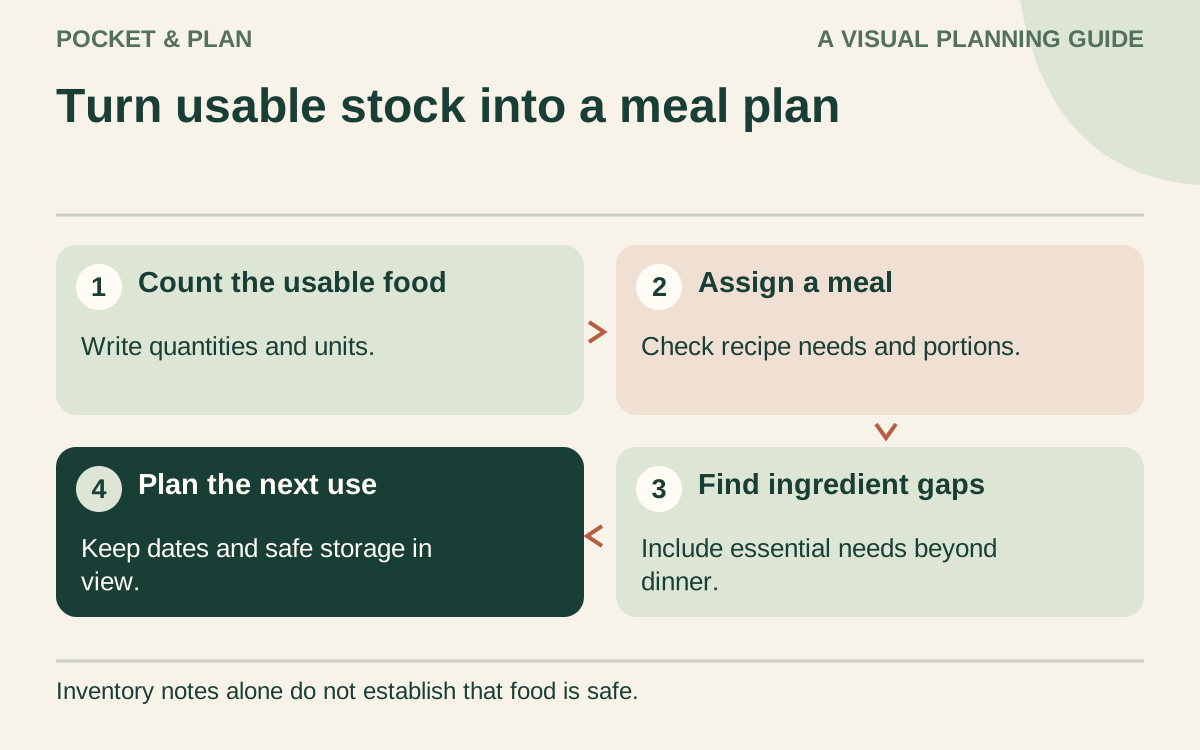
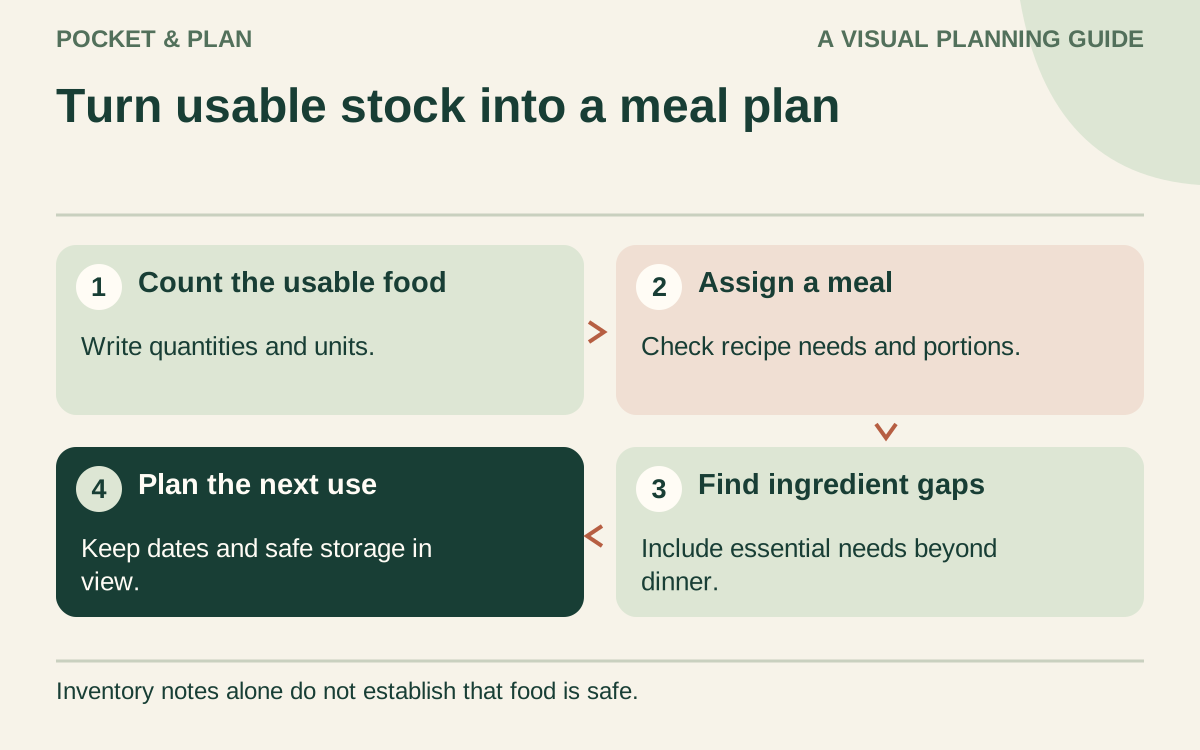
Use the printable pantry inventory to record usable quantities, meal assignments, and restocking actions. Inventory notes do not establish that food is safe; use the storage guidance below before assigning it to a meal. This is a manual worksheet for handwriting, with no automatic calculations. Print on US Letter paper in the orientation shown on the file.
Choose a small boundary and an end date
Write a simple rule: “For the next three planned dinners at home, we will start with ingredients already here and make one top-up list.” This is a suggested trial format, not an official food or savings program.
Choose evenings when you can cook and a familiar meal for the busiest one. A demanding new recipe that needs six extra ingredients may work against your purpose. If plans change, move the dinner while continuing to follow the food’s safe storage requirements.
Keep regular food money available until the trial is reconciled. The grocery budget guide can help separate the amount you planned to spend from the amount you have actually used. A pantry experiment is easier to judge when those figures stay visible.
Make an inventory you can cook from
Look through the three storage areas and record the amount that is actually usable. “Rice” is less useful than “about enough dry rice for two planned dinners.” Avoid counting an unopened reserve twice or assuming every container in the freezer is a ready meal.
The EPA recommends checking stored food before shopping and planning meals around what needs to be used. Our worksheet adds a specific meal assignment so the inventory becomes a plan rather than another list.
| Food or ingredient | Usable quantity | Planned job | Missing item or next action |
|---|---|---|---|
| Dry rice | Enough for two dinners | Dinner one and dinner three | Check the chosen recipes |
| Unopened canned beans | Two cans | Dinner one | Buy the planned vegetables |
| Dry pasta | One meal’s quantity | Dinner two | Check sauce ingredients |
| Frozen vegetables | One meal’s quantity | Dinner three | Keep frozen until needed |
| Refrigerated leftovers | Record portions and preparation date | Use only within safe storage limits | Verify date and handling first |
This example is an organizational template, not a nutritionally complete menu or a set of portion recommendations. Fill in quantities for the people who will eat, the recipes you choose, and their dietary needs.
Let food safety set the limits
Do not attempt to rescue unsafe food to complete the challenge. An unknown preparation date or storage history is not a reason to assume leftovers are safe. Check item-specific storage guidance in FoodSafety.gov’s FoodKeeper, and follow product instructions where applicable.
USDA’s leftovers guidance says to refrigerate leftovers within two hours, or one hour when the temperature is above 90°F. Discard perishable food left out beyond those limits. Refrigerated leftovers generally have a three-to-four-day window; reheat leftovers to 165°F, checked with a food thermometer. Divide larger cooked quantities into shallow containers for prompt cooling and keep the refrigerator at 40°F or below.
These limits do not make previously mishandled food safe. Do not stretch storage time because a meal moved to a later evening, and do not treat reheating as a way to erase unsafe storage. Plan freezing while food is still safe when it will not be eaten in time, following the USDA instructions.
Write one list of ingredients that complete the meals
After choosing the three dinners, list the missing ingredients together. Check for overlap so one purchase can have two planned uses. Buy a suitable quantity rather than stocking up simply because you have made room on a shelf.
Here is a hypothetical top-up list. The amounts are invented budgeting figures, not current prices or evidence from a shopping trip:
| Planned top-up | Hypothetical cost |
|---|---|
| Vegetables for dinners one and two | $5.00 |
| Eggs for the selected dinner-three recipe | $3.50 |
| Fruit for the household’s other meals | $4.00 |
| Dairy or another suitable item needed that week | $3.50 |
| Total | $16.00 |
The $16 total includes needs beyond the three dinners. If the household discovers it needs another essential item, it adds the item and revises the amount. The spending boundary is a planning aid, not a reason to omit something necessary.
Use the budget planner to see how the revised grocery estimate fits with other household commitments. Keep this small trial separate from a broader no-spend month, which has its own optional-purchase rules.
Separate this week’s cash flow from lasting savings
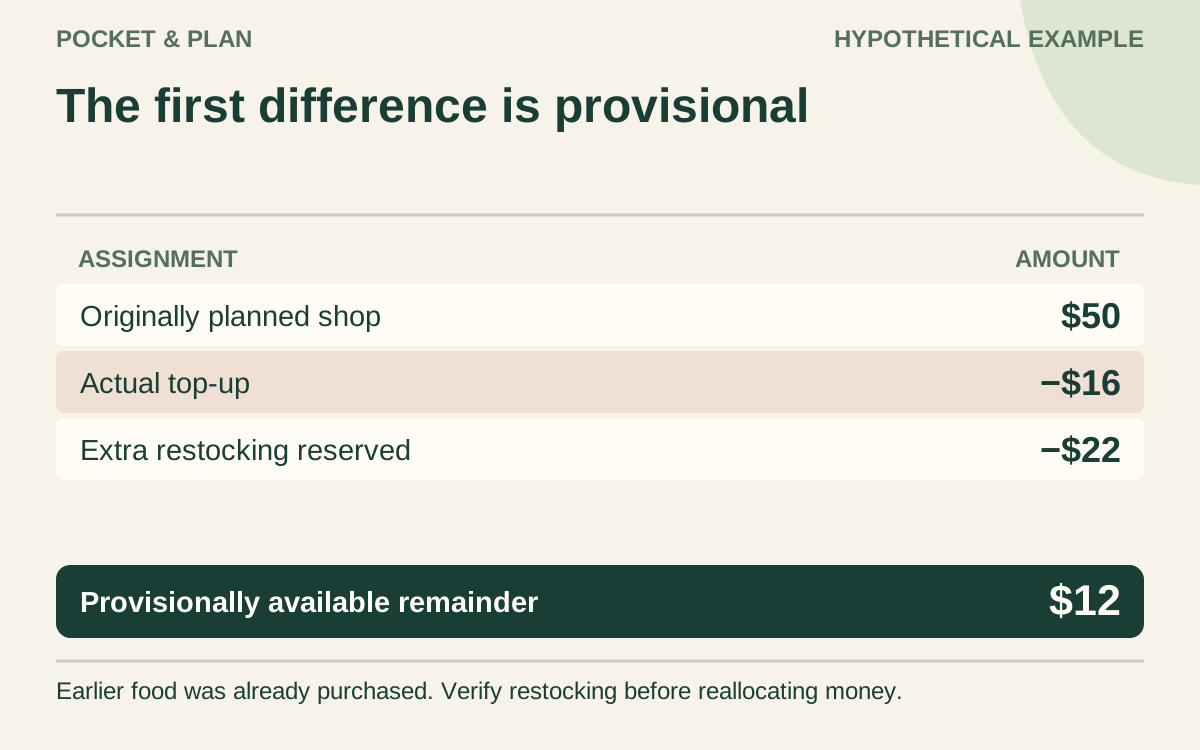
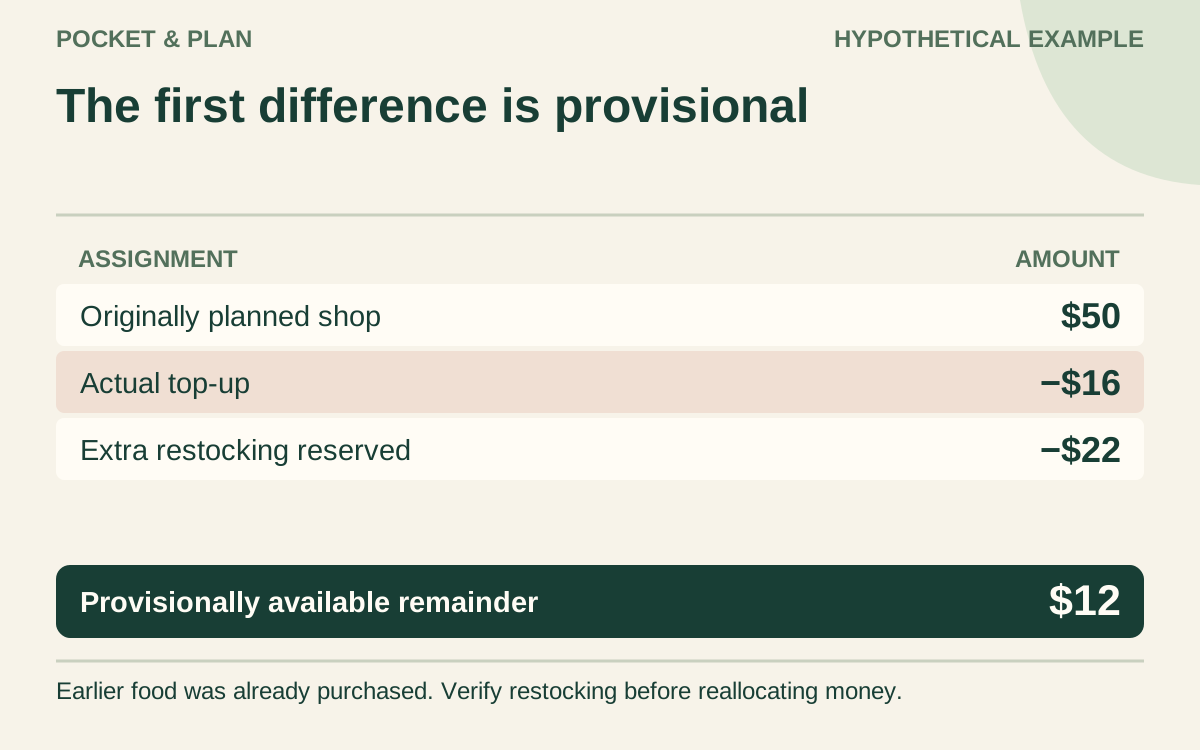
Suppose the hypothetical household had planned a $50 shopping trip for this period and instead spent the $16 top-up. The immediate difference is $34: $50 minus $16. That is money not spent on that trip; it is not automatically a lasting $34 saving.
At review, the household expects $22 of additional restocking next week specifically to replace pantry items used during the trial. Reserving that $22 leaves $12 of the original difference provisionally available. If the restock costs $25 instead, the remainder becomes $9. Count actual purchases and changed needs before moving money to another goal.
The ingredients already in the kitchen were purchased earlier, so dinners made from them were not free. You can separately note an item that was eaten instead of discarded, without assigning it an invented savings value.
For your next regular shopping cycle, the budget meal plan for two shows how overlapping ingredients, package quantities, and remaining stock fit together.
Finish with a better next shopping list
Record which dinners worked, which ingredient was missing, and what still needs a plan. Add necessary restocks deliberately instead of buying back everything you used at once. Keep any protected reserve items on their own list so the trial does not silently consume them.
If there is money left after the review, assign it a purpose in your sinking-fund plan. The lasting result may simply be one reliable dinner and a clearer view of what is already in your kitchen. Repeat the exercise when that would be useful, rather than extending it until meals become difficult.
Sources & verification
These primary reference sources support the guide. Worked examples are our own illustrations, not national averages or reported personal results.
- EPA — Preventing Wasted Food At Home ↗Checked September 10, 2026
- USDA FSIS — Leftovers and Food Safety ↗Checked September 10, 2026
- FoodSafety.gov — FoodKeeper App ↗Checked September 10, 2026
Published · Last substantive update .
Found a factual error or a calculation that needs checking? Suggest a correction by email with this guide's link. The link opens a draft in your email app; you send it yourself. Contact details · Corrections policy