The short answer
Choose dinners with a useful ingredient overlap, buy the missing quantities, and distinguish the full basket payment from the cost of ingredients those dinners consume.
General educational guide. Sources checked September 11, 2026. Examples are illustrative; amounts should be adjusted to your household. Read our disclosure.
A budget meal plan for two starts with dinners you will eat, quantities you can use, and the full amount needed at checkout. Choose meals with some ingredient overlap, subtract usable inventory, then price the packages you actually need to buy. Keep the cost of ingredients used separate from cash spent on packages that last beyond these dinners.
The original example below covers three dinners only. It is an untested planning illustration with invented prices and assumed portions, not a nutrition plan or evidence from a real shopping trip. Adjust quantities and ingredients to both people’s appetites, dietary needs, and familiar recipes; budget other meals separately.
Choose the evenings before choosing the basket
Pick three consecutive evenings when two people expect to eat at home. Assign a familiar meal to the busiest evening and check that the equipment and cooking time are realistic. Agree on acceptable substitutions before shopping.
The EPA’s food-waste guidance recommends planning around meals actually eaten at home and putting quantities on the shopping list. Our approach adds a second question: where will the unused part of each purchased package go?
A reusable meal rotation can include a grain bowl, a pasta meal, and a planned use for part of a cooked sauce. This differs from a pantry challenge: the purpose here is a repeatable menu and purchase calculation, whether the kitchen starts well stocked or nearly empty.
Assign the ingredients to three dinners
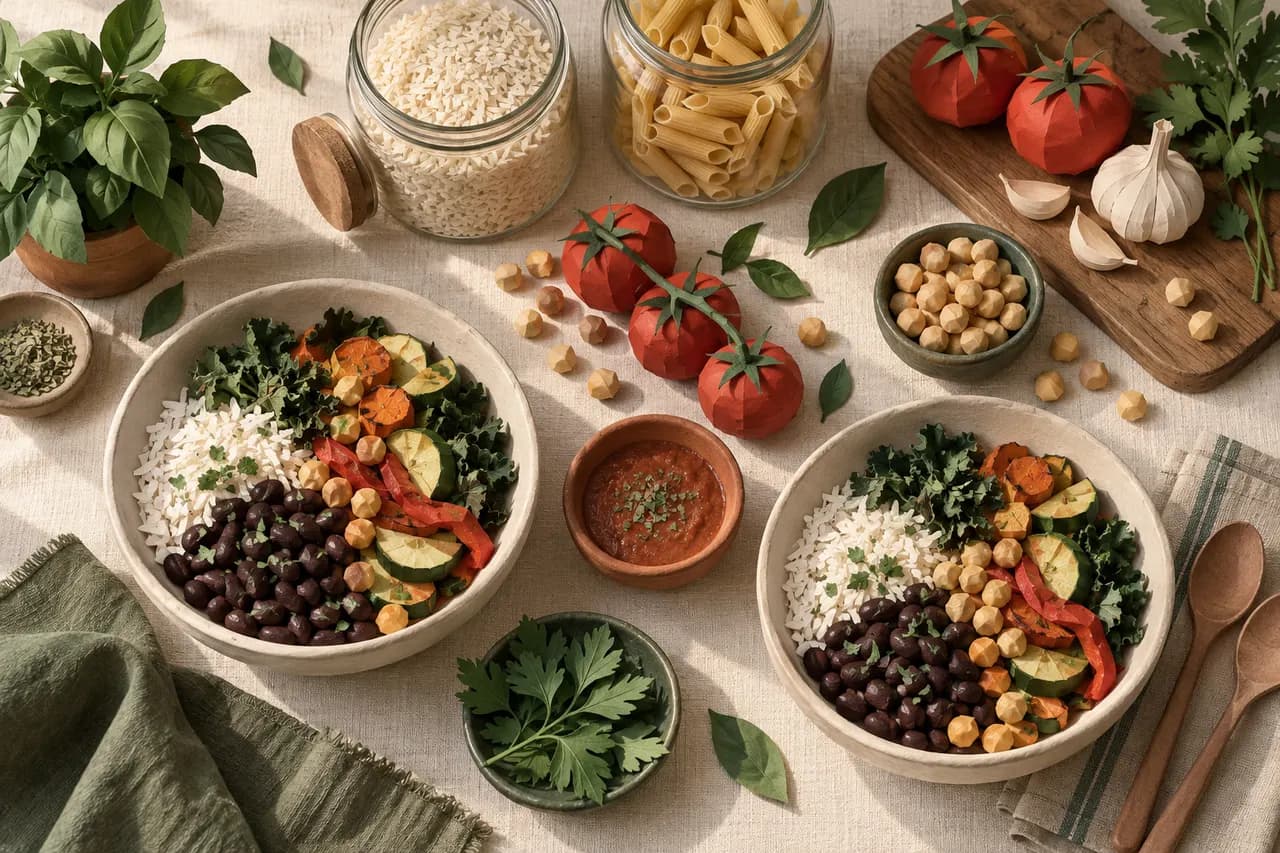
This example uses canned beans and chickpeas, frozen vegetables, dry grains, and canned tomatoes. Weights for rice and pasta are dry; bean and chickpea weights are drained. Check the actual drained yield of your chosen cans rather than treating a can’s total weight as edible beans.
| Dinner for two | Ingredients assigned to that dinner |
|---|---|
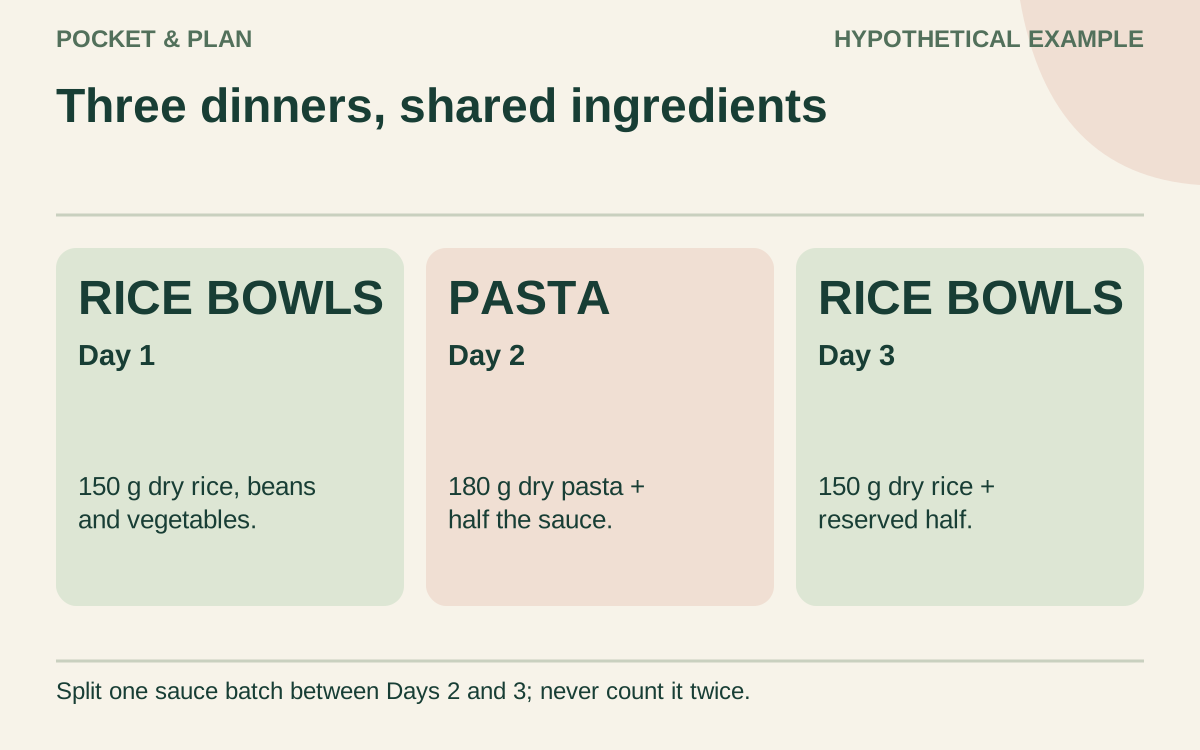
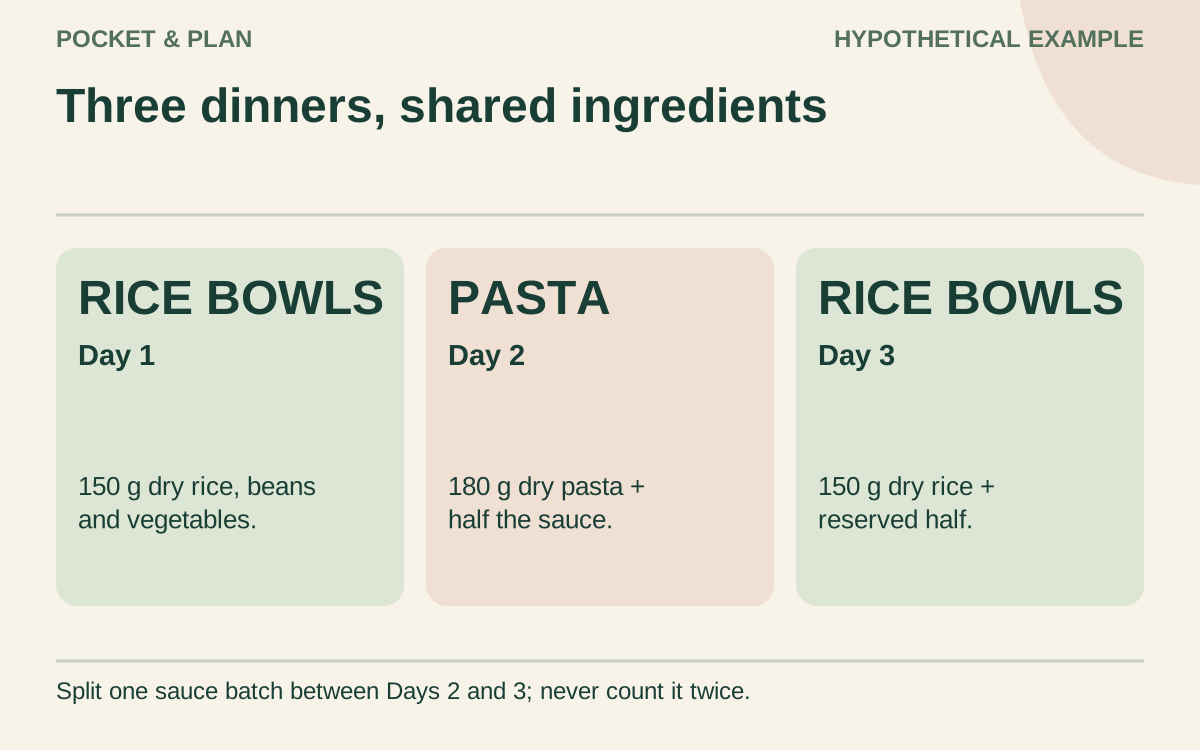
| Day 1: bean and vegetable rice bowls | 150 g dry rice, 240 g drained beans, 200 g frozen vegetables |
| Day 2: chickpea and tomato pasta | 180 g dry pasta, half the sauce batch described below |
| Day 3: chickpea and vegetable rice bowls | 150 g dry rice, the reserved half of that sauce batch |
For the sauce batch, combine 480 g drained chickpeas, 400 g canned tomatoes, and 400 g frozen vegetables using your familiar preparation method and product cooking directions. Divide the cooked batch equally: one half for Day 2 and one half reserved safely for Day 3. Do not assign the full batch to both dinners.
The example also allocates 30 mL of cooking oil and 6 g of your chosen seasoning across Days 1 and 2. Cook rice and pasta according to their package instructions. These quantities provide the arithmetic for six assumed dinner servings; they do not establish an appropriate serving size for every person.
Turn required quantities into package purchases
Suppose the starting inventory contains 100 g dry rice, 200 g frozen vegetables, and enough of the selected oil and seasoning. All are usable and available for these meals. The remaining ingredients must be purchased.
| Ingredient | Total needed | Already available | Example purchase | Invented checkout cost |
|---|---|---|---|---|
| Dry rice | 300 g | 100 g | 500 g bag | $2.50 |
| Dry pasta | 180 g | 0 g | 500 g bag | $1.50 |
| Drained beans | 240 g | 0 g | One can yielding 240 g | $1.20 |
| Drained chickpeas | 480 g | 0 g | Two cans yielding 240 g each | $2.40 |
| Canned tomatoes | 400 g | 0 g | 400 g can | $1.00 |
| Frozen vegetables | 600 g | 200 g | 500 g bag | $2.00 |
| Oil and seasoning | 30 mL and 6 g | Enough | None | $0.00 new cash |
| Basket total | $10.60 |
These invented checkout amounts are the complete charges assumed for the example. There is no delivery charge or additional tax in this illustration; include anything that applies to your actual shop. If you need a whole bottle of oil, add its checkout price instead of copying the zero-purchase row.
After the dinners, the example leaves 300 g dry rice, 320 g dry pasta, and 100 g frozen vegetables. Give those ingredients another planned use. Buying a larger package is useful only when its remaining contents fit future meals and storage.
Separate checkout cash from the cost of food used
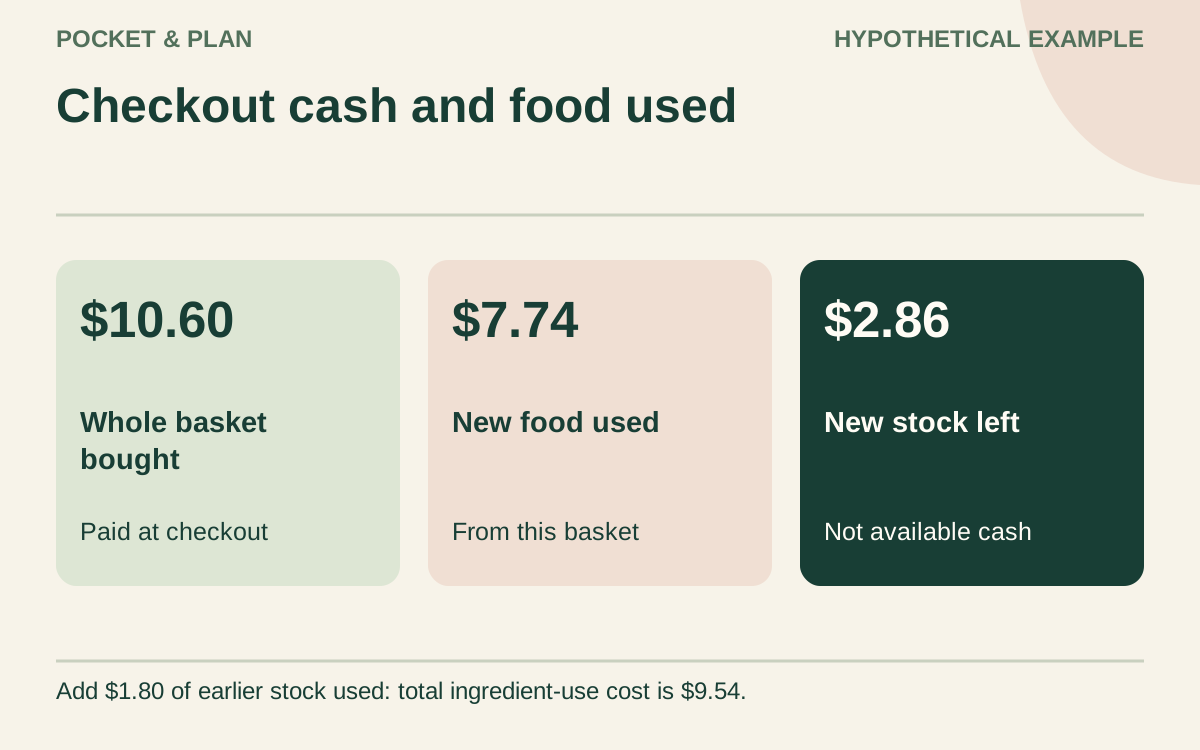
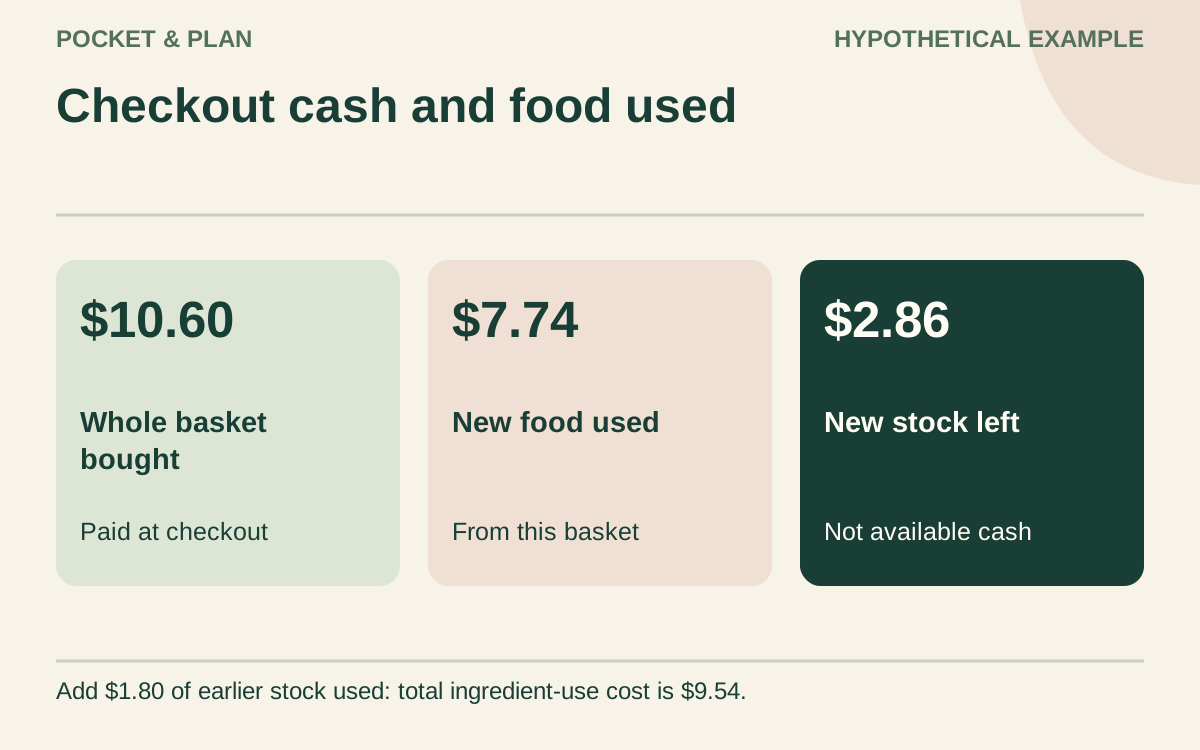
The cashier needs $10.60 even though these meals use only part of some purchases. From the new basket, the ingredients used cost $1.00 rice + $0.54 pasta + $1.20 beans + $2.40 chickpeas + $1.00 tomatoes + $1.60 vegetables = $7.74.
For this example only, value the starting rice at $0.50, starting vegetables at $0.80, and consumed oil and seasoning at $0.30 and $0.20. Those previously purchased ingredients add $1.80, making the total ingredient-use cost $9.54. Dividing by six assumed servings gives $1.59 per serving; this is an accounting illustration, not a promised meal price.
The new food left after the plan is valued at $2.86: $10.60 purchased minus $7.74 used from those purchases. Keep that stock value out of available cash. Use your price book and receipts to replace these invented unit costs with your own observations.
Give the reserved sauce a safe storage plan
Label the Day 3 portion with its preparation date and refrigerate it promptly in a shallow covered container. USDA FSIS guidance says to refrigerate leftovers within two hours, or one hour above 90°F, and keep the refrigerator at 40°F or below. Discard perishable food left out beyond those limits. Properly refrigerated leftovers generally keep for three to four days.
Reheat the reserved portion to 165°F, measured with a food thermometer; FoodSafety.gov lists this temperature for all leftovers. If the meal moves beyond its safe storage window, plan freezing while the food is still safe. Reheating does not correct earlier unsafe storage.
Review the menu before repeating it
Record whether the quantities suited you, what remained, and any extra purchases. If the dinners were insufficient, enlarge the plan and recalculate rather than treating the original cost as a target to protect.
Compare the whole grocery week in your grocery budget for two, including other meals and necessary restocking. Keep the dinners that worked, update one troublesome ingredient or evening, and make the next list from the stock actually left. The useful outcome is a menu you can maintain with clear purchase quantities.
Sources & verification
These primary reference sources support the guide. Worked examples are our own illustrations, not national averages or reported personal results.
- EPA — Preventing Wasted Food At Home ↗Checked September 11, 2026
- USDA FSIS — Leftovers and Food Safety ↗Checked September 11, 2026
- FoodSafety.gov — Safe Minimum Internal Temperatures ↗Checked September 11, 2026
Published · Last substantive update .
Found a factual error or a calculation that needs checking? Suggest a correction by email with this guide's link. The link opens a draft in your email app; you send it yourself. Contact details · Corrections policy