The short answer
Record the prices of a small set of repeat purchases so you can compare equivalent quantities and decide whether a deal fits your actual grocery plan.
General educational guide. Sources checked September 10, 2026. Examples are illustrative; amounts should be adjusted to your household. Read our disclosure.
A grocery price book is a dated list of the prices you see for foods you buy repeatedly. Record the package quantity and calculate the price for one consistent unit, such as an ounce or a pound. That makes two different package sizes easier to compare without relying on your memory of the sticker price.
Choose the free Excel grocery price book, printable price book PDF, or blank grocery price book CSV. Excel calculates unit prices; the PDF and CSV are manual records. None of these files fetches store prices.
Use the Excel or printable price book
The Excel version has 50 observation rows. Fill the amber cells with a date, store, comparable item, total package quantity, chosen unit, and package price. Keep offer conditions and receipt or source notes alongside the observation. Its calculated unit price divides the price by the quantity you entered. The display uses four decimal places, while the underlying formula keeps the unrounded result.
Choose exactly the same unit when comparing equivalent products. The dropdown distinguishes weight ounces, pounds, US fluid ounces, count, grams, kilograms, milliliters, and liters. It does not convert between them or decide which products are substitutes. A result per pound and a result per ounce need conversion to the same unit before comparison; a weight price and a volume price are not interchangeable.
For an offer requiring two packs, enter the entire qualifying bundle’s quantity and price. Quantity must be greater than zero; when the unit is count, use a whole number of items. A price of 0 is valid for a genuinely free qualifying item, while a missing price is incomplete. Follow each row’s input message before using its result. The top counts distinguish valid prices from incomplete observations; they do not rank products or total a shopping basket.
Keep the calculated cells intact and use a new copy after 50 observations. The PDF has eight rows on one landscape US Letter page, including a space to state your tax and discount convention. Calculate its unit prices by hand. The CSV is also manual and has no formulas or automatic input checks. Keep earlier observations dated in every format so an old offer is not mistaken for a current price.
Choose ten purchases worth remembering
Pick a manageable set from your own recent shopping: oats, pasta, rice, beans, a regular frozen vegetable, or another item your household reliably uses. Ten is a starting suggestion, not a required number. Recording every aisle would make a simple shopping aid harder to maintain.
Describe each comparison group precisely. Plain rolled oats and individually flavored oatmeal packets belong in separate groups. Your dietary requirements and preferred preparation can make two apparently similar products unsuitable substitutes.
If two people shop, agree on these descriptions during your couples budget check-in. A shared label such as “dry whole-wheat pasta, any shape” makes separate observations easier to combine than a vague entry like “dinner food.”
Give the template columns clear meanings
Use one row for each price observation. Keep previous observations when you add a new one so a temporary offer does not erase the earlier comparison.
| Template field | What to record |
|---|---|
| Purchase date | The date paid; if only checking a shelf, identify it as an observation in Notes |
| Store | Store and location, or the online pickup location |
| Item | Brand, product, and a useful comparison description |
| Pack quantity | Numeric net quantity for the whole package |
| Unit | The quantity unit, consistently used within that comparison group |
| Pack price | The price paid or observed, with its conditions in Notes |
| Unit price | Pack price divided by pack quantity |
| Notes | Offer expiry, loyalty conditions, purchase limits, or an observed rather than paid price |
Use the same convention for taxes and discounts in every comparison. For example, record the displayed item price after an item-specific coupon and before tax, then label that convention. Keep delivery charges or a basket-wide discount separate when you cannot allocate them accurately.
Calculate the unit price before comparing
NIST explains unit pricing as pricing by a unit of measure, which helps compare product quantities. The working calculation is:
Package price ÷ package quantity = price per unit.
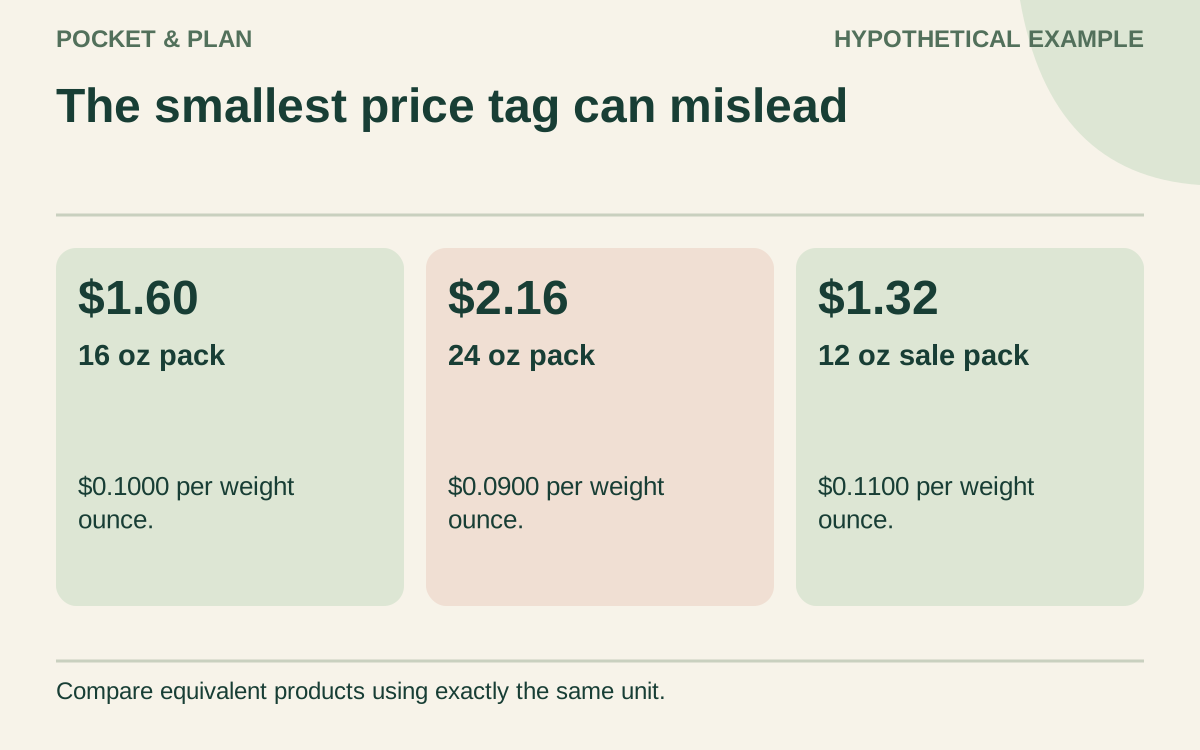
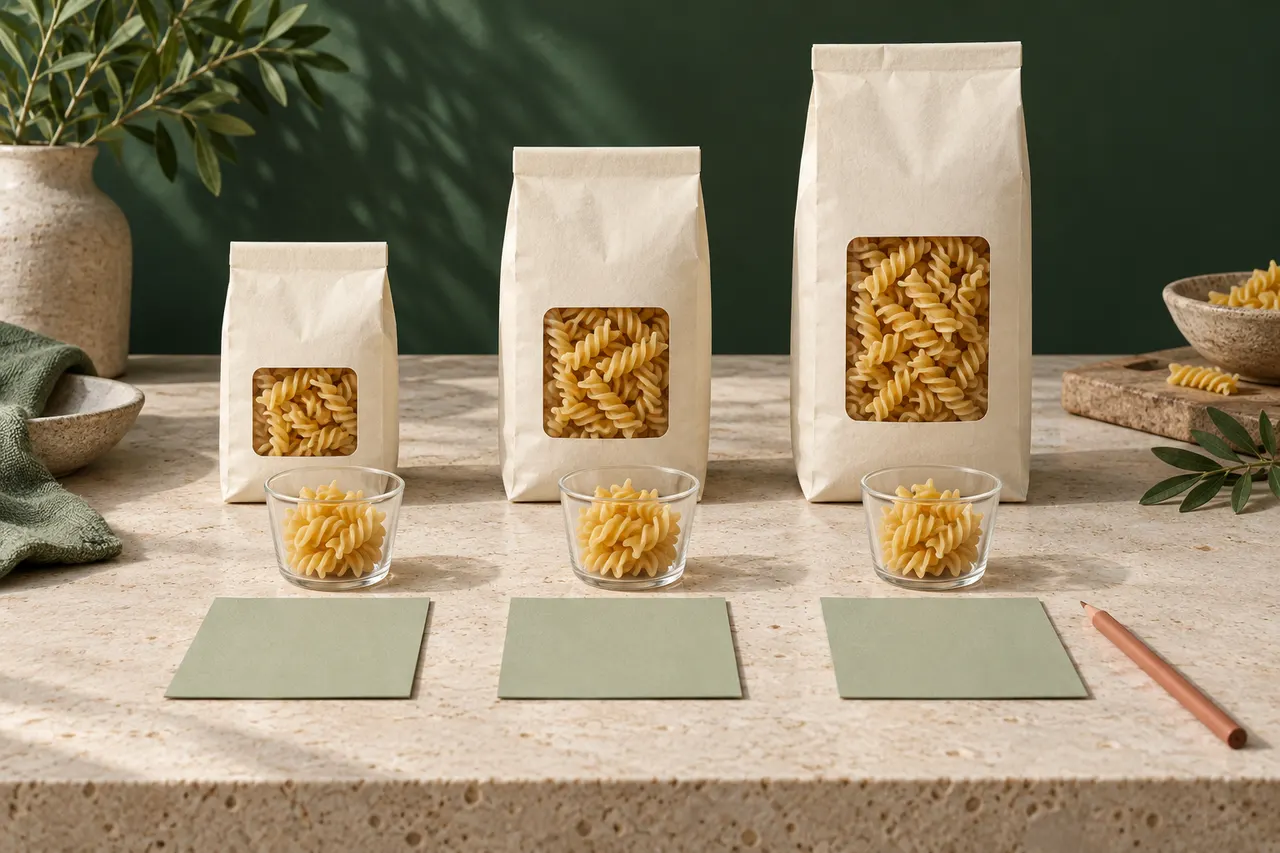
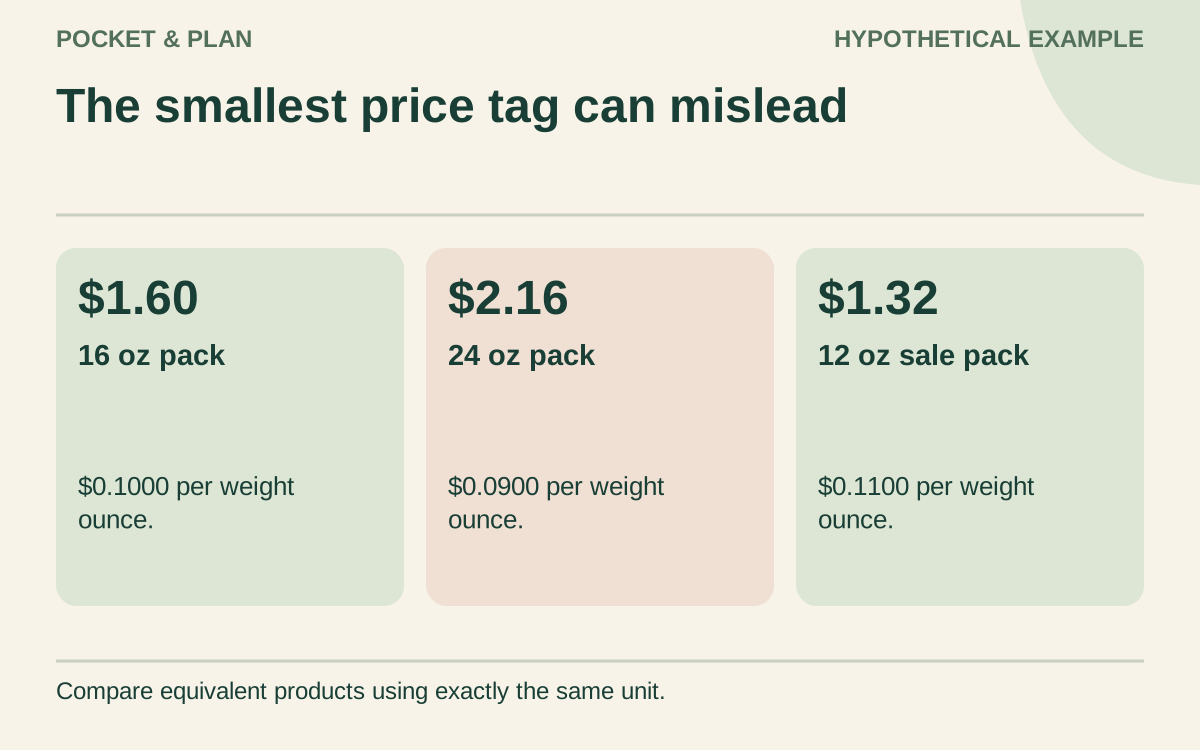
Here are invented observations for the same kind of dry pasta, all compared per ounce:
| Hypothetical option | Net quantity | Package price | Price per ounce |
|---|---|---|---|
| A: standard pack | 16 oz | $1.60 | $0.1000 |
| B: large pack | 24 oz | $2.16 | $0.0900 |
| C: small sale pack | 12 oz | $1.32 | $0.1100 |
Option C has the lowest package price, while B has the lowest price per ounce. For an equal 48 ounces, three A packs cost $4.80, two B packs cost $4.32, and four C packs cost $5.28. B is $0.48 below A for that quantity. These figures demonstrate the calculation; they are not current store prices.
Keep enough decimal places to distinguish close unit prices. Rounding $0.094 and $0.096 to cents makes both appear as $0.09 and $0.10, exaggerating a small difference. Compare the unrounded calculation before making a purchase decision.
Match units and offer conditions
A shelf label per pound cannot be compared directly with one per ounce. Convert both to the same unit first; one pound is 16 ounces. Weight ounces and fluid ounces measure different things, so do not use that conversion to compare weight with volume. NIST’s unit-price explanation highlights inconsistent shelf-label units as a barrier to useful comparisons.
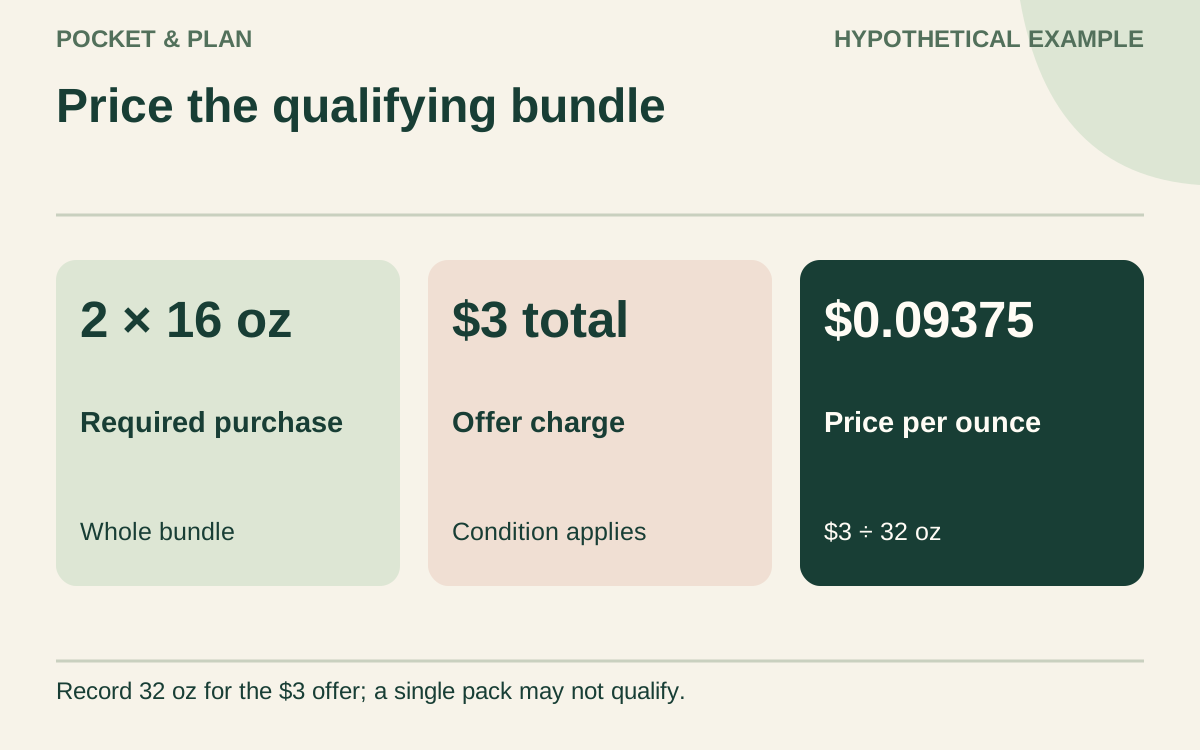
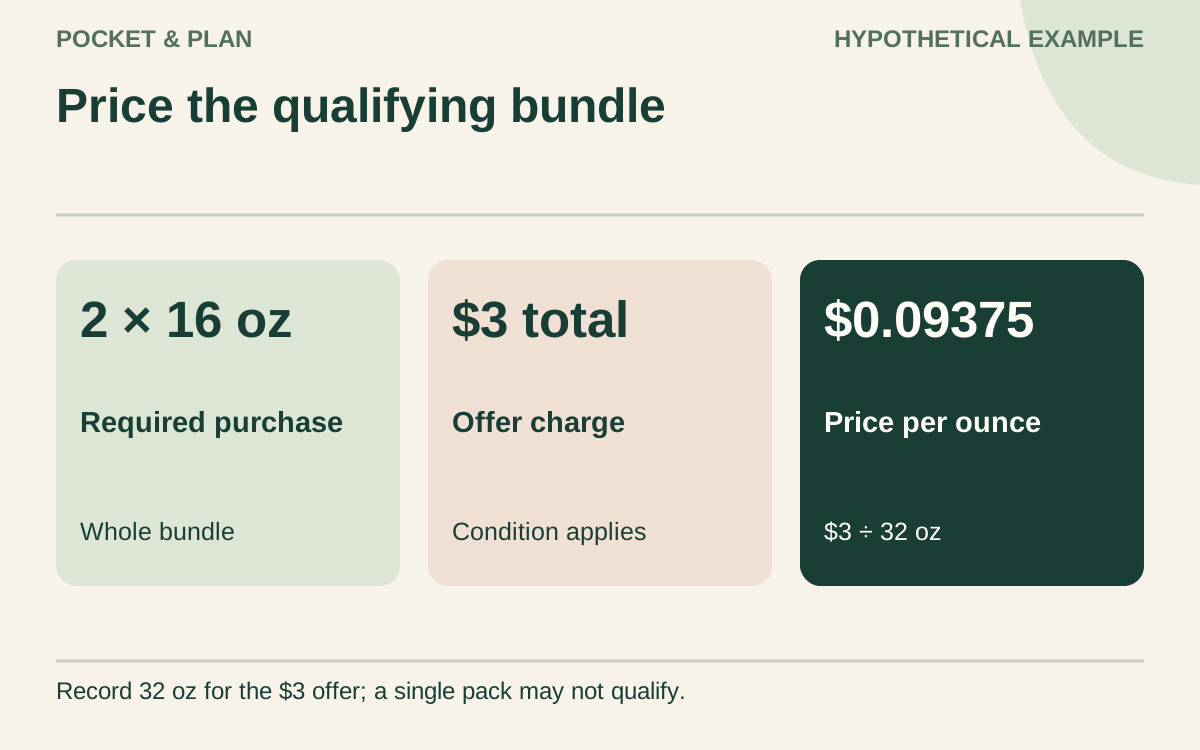
Read multi-buy conditions before entering the price. In a hypothetical offer requiring two 16-ounce packs for $3, the qualifying purchase is $3 for 32 ounces: $0.09375 per ounce. Do not record a single-pack price of $1.50 unless one pack really qualifies at that price. Add the requirement to Notes.
An expired sale remains useful history, but it is not today’s available offer. Mark it clearly and check the current price before planning the basket.
Check whether the larger package fits your week
Unit price is one input to a decision. You still need enough grocery money today, room to store the purchase properly, and a realistic use for it. The EPA’s food-waste guidance points out that larger-quantity offers save money only when the food gets used before spoiling.
Consider a separate hypothetical yogurt comparison. A 32-ounce container costs $4, or $0.125 per ounce. A 16-ounce container costs $2.40, or $0.15 per ounce. If you will actually use only 16 ounces of the larger container and the rest goes uneaten, you spent $4 for the quantity you used instead of $2.40. Buying the smaller container leaves $1.60 in that shopping budget under these assumptions.
Use your grocery budget for two to decide the available amount and the meals you need. The price book helps compare products within that plan; it does not decide how much food your household needs.
Update a few rows after each shop
Add a verified price when one of your tracked items appears on the receipt. Note a changed pack size even if the package looks familiar. Before the next shop, review only the relevant rows and check whether any remembered offers have ended.
Avoid an extra store trip for a tiny unit-price difference without considering travel cost and time. A price book is useful when it makes the next ordinary shopping decision clearer. Keep your working copy with the other free household worksheets, and expand the list only when another repeated purchase would benefit from the same comparison.
Sources & verification
These primary reference sources support the guide. Worked examples are our own illustrations, not national averages or reported personal results.
- NIST — Uniform Unit Pricing: Tools for Consumers to Fight Shrinkflation ↗Checked September 10, 2026
- NIST — The Unit Price is Right ↗Checked September 10, 2026
- EPA — Preventing Wasted Food At Home ↗Checked September 10, 2026
Published · Last substantive update .
Found a factual error or a calculation that needs checking? Suggest a correction by email with this guide's link. The link opens a draft in your email app; you send it yourself. Contact details · Corrections policy