The short answer
Start with the costs your household actually has, give future expenses a place, and use clear category boundaries to make each monthly review easier.
General educational guide. Sources checked September 10, 2026. Examples are illustrative; amounts should be adjusted to your household. Read our disclosure.
A useful monthly budget includes housing, utilities, food, transportation, health costs, household responsibilities, required debt payments, flexible spending, and money reserved for future costs or savings. Keep only the categories that apply to you. A category earns its place when it helps you make a decision or find an expense you otherwise miss.
The checklist below helps you build that structure. The dollar amounts are an original hypothetical example, not a recommended spending level or a claim about typical US household costs.
Start with records, then choose your labels
Gather recent statements, pay records, bills, and any record of cash spending. First describe the spending that happened. You can decide what to change after you have a credible starting point.
Consumer.gov’s budgeting instructions start with bills and pay stubs and compare monthly income with expenses. For this worksheet, use take-home money available to your household; payroll deductions already removed from that amount do not need a second spending assignment.
Write a short definition beside any category that could mean two things. For example, “groceries: food and drinks for home” leaves cleaning products in household supplies. Another household might combine both. Either arrangement can work when everyone uses it consistently.
Use this category checklist as a starting point
These groups are prompts, not a requirement to maintain dozens of spreadsheet rows:
| Category | Possible entries | Boundary to decide |
|---|---|---|
| Housing and utilities | Rent, mortgage, electricity, water, basic internet | Whether insurance or fees are already included in a payment |
| Groceries | Ingredients, pantry basics, food for home | Whether toiletries and cleaning supplies belong here |
| Transportation | Transit, fuel, parking, required vehicle payments | How to reserve for maintenance paid less often |
| Health | Out-of-pocket care, prescriptions, premiums paid from take-home funds | What payroll already deducted |
| Household responsibilities | Child care, dependent support, pet care, school needs | Which costs are shared and which are personal |
| Required debt payments | Amounts currently due on existing debts | Whether a payment is already listed under housing or transport |
| Flexible spending | Dining out, hobbies, optional subscriptions, personal purchases | Which recurring charges can actually be changed this month |
| Future expenses | Annual fees, planned gifts, seasonal purchases | The amount already reserved for each purpose |
| Savings goals | An emergency reserve or another named goal | Whether a transfer is new saving or movement of existing savings |
| Unassigned buffer | Money available for estimation errors | When to give the unused amount another job |
Add a separate row when a cost deserves its own decision. If pet expenses are a frequent surprise, “household” may be too broad. If you rarely buy clothes, separating five clothing subcategories may add work without useful information.
Keep payment frequency separate from purpose
An annual charge still belongs in your monthly planning. Add a timing label beside each expense: monthly, weekly, annual, seasonal, or uncertain. The category says what the money is for; the timing label says when you need it.
The CFPB’s spending review recommends looking back across several months to find less frequent expenses and including regular savings contributions. Although that page sits within its homebuying material, this record-checking step is useful for an everyday household budget too.
For a known $240 fee due in six months with $60 already reserved, the remaining need is $180. Six available monthly contributions would be $30 each. If only three contribution dates remain, the same gap requires $60 each. Use the actual time left, not an automatic division by 12. Our sinking-fund guide explains the reserve ledger in more detail.
For a one-time transition, the moving budget checklist separates costs from held deposits and their payment dates. For seasonal household purchases, the back-to-school checklist separates items needed now from later school-year reserves.
Check an original $4,000 example
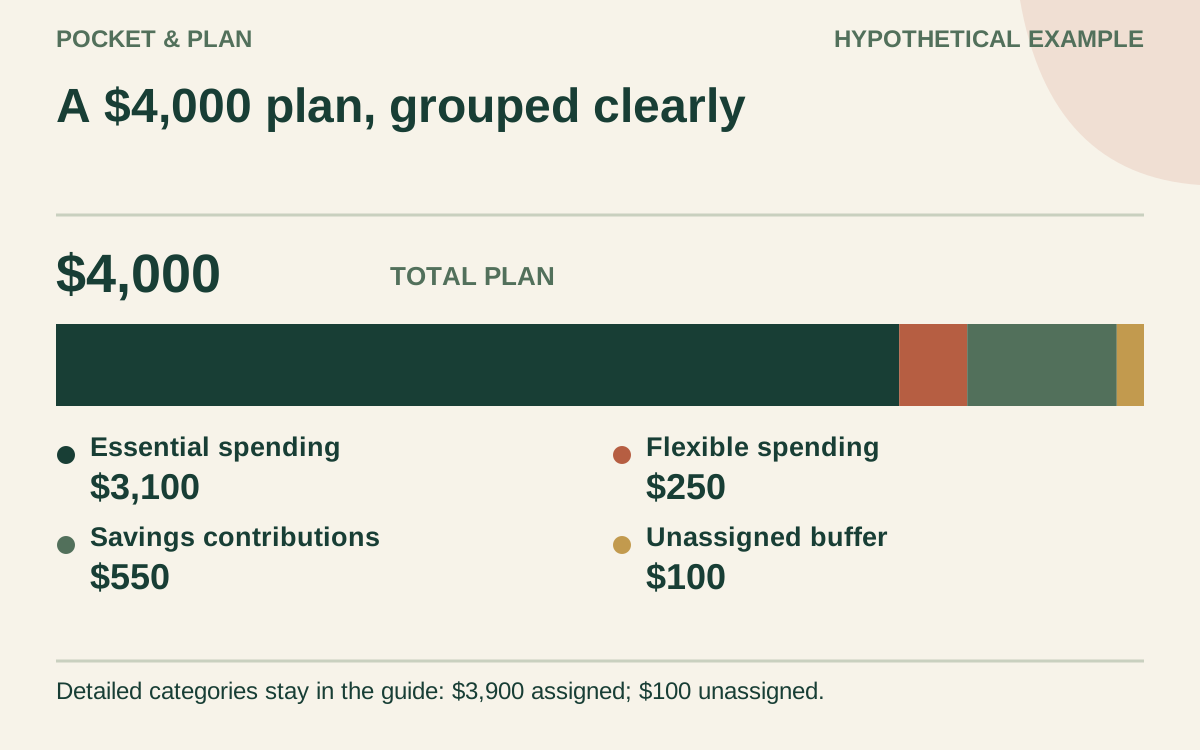
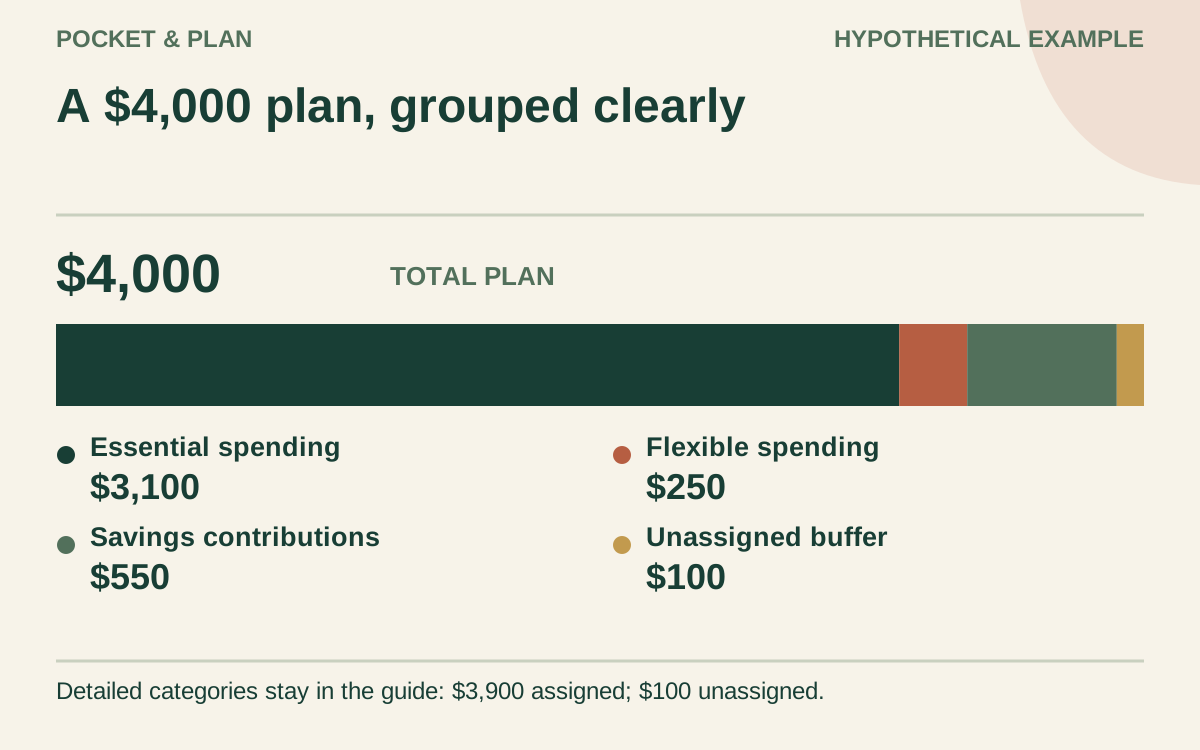
Imagine a household with $4,000 of monthly take-home income and no unassigned carryover. It creates the following plan:
| Monthly assignment | Amount |
|---|---|
| Housing and utilities | $1,650 |
| Groceries | $450 |
| Transportation | $300 |
| Health costs | $200 |
| Household responsibilities | $350 |
| Required debt payments not listed elsewhere | $150 |
| Flexible spending | $250 |
| Contributions for future expenses | $300 |
| Emergency savings contribution | $250 |
| Unassigned buffer | $100 |
| Total income accounted for | $4,000 |
The first nine assignments total $3,900, leaving $100 unassigned. Savings contributions are deliberate uses of this month’s income even though the money has not been spent at a store.
To check this example in our monthly budget planner, enter $1,650 for housing and utilities, $450 for groceries, $300 for transport, $700 for other essentials, $250 for flexible spending, and $550 for savings. Other essentials combines health, household responsibilities, and required debt payments. Savings combines the two contributions. The planner should show $100 remaining; keep the detailed breakdown in your own worksheet.
Prevent the three common double counts
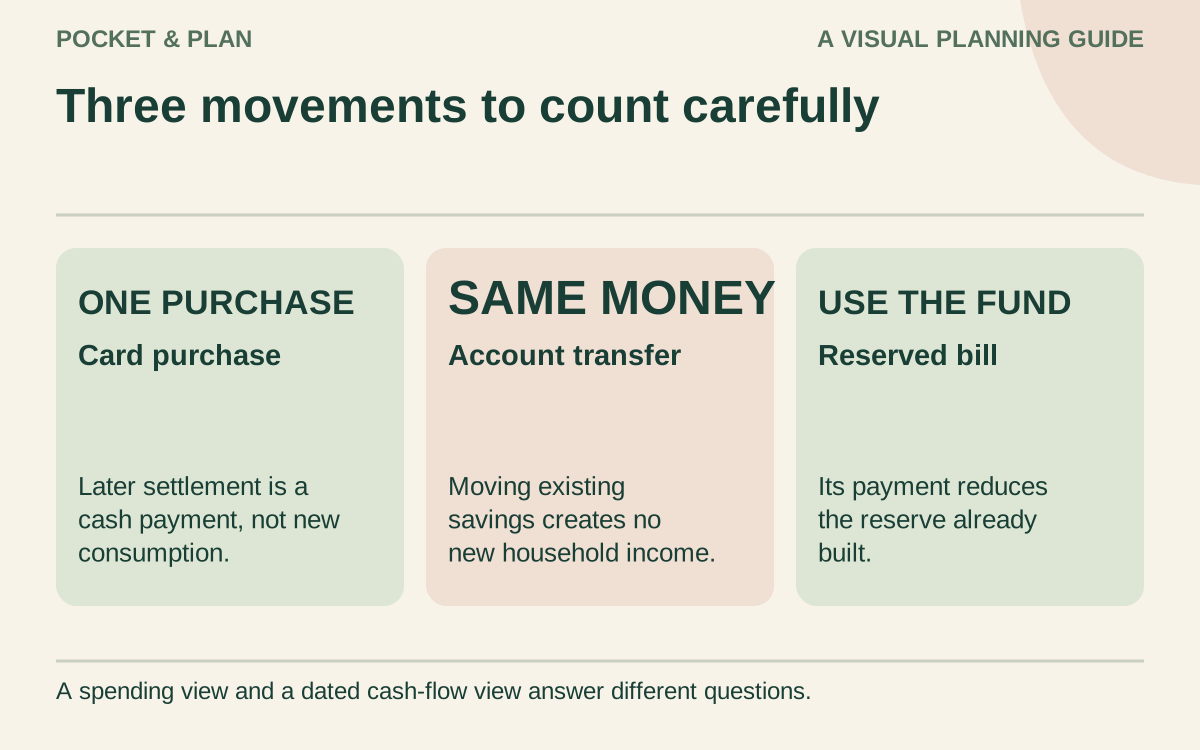
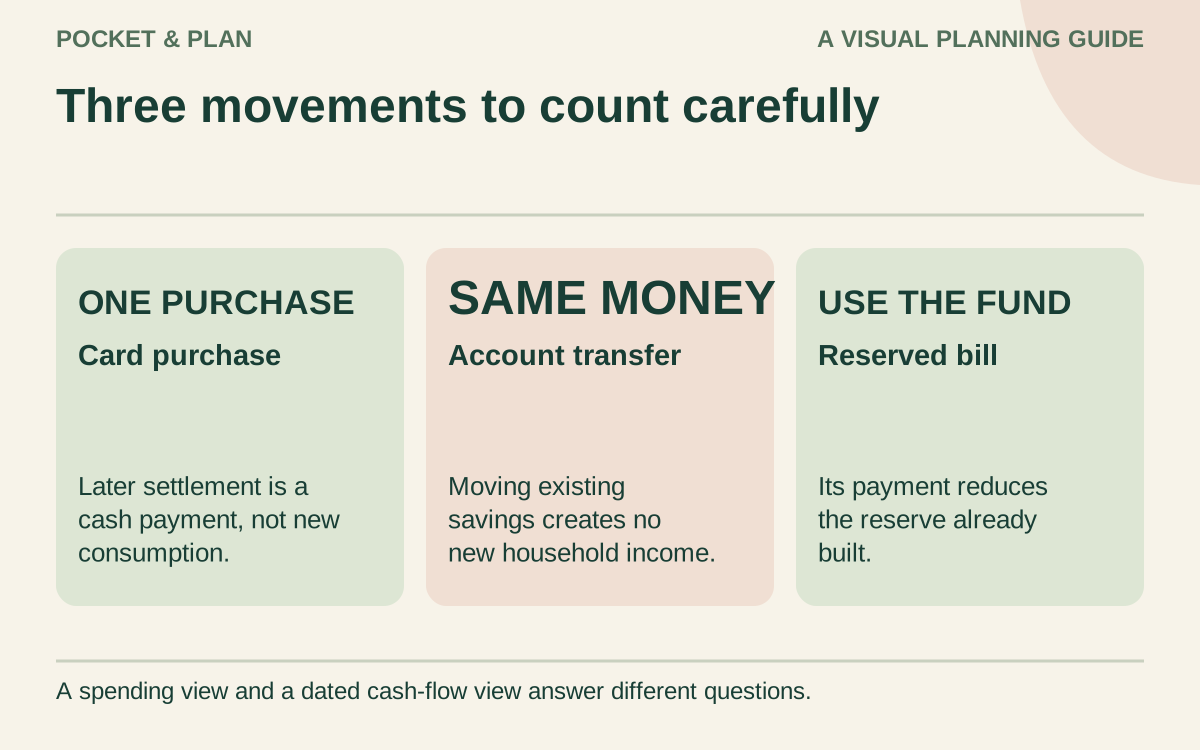
Credit card purchases and repayments: if you record a $65 grocery purchase as grocery spending, paying that same $65 card balance is settlement of the purchase. Do not also record another $65 of new consumption. Payments toward an older balance need their own assignment, and interest or fees need to be accounted for separately.
Transfers between your accounts: moving $200 of existing savings to a different account does not create $200 of new income or $200 of new savings. Record a new contribution only when you assign previously unassigned money to that goal.
Future-cost reserves: if you already funded a bill over earlier months, show the eventual payment reducing that reserve. In a cash-flow view the withdrawal still appears on its payment date; in your income-allocation view, do not fund the entire bill a second time.
Review category quality at month-end
Use this short checklist before copying the plan forward:
- Every transaction has one clear home, including cash purchases and fees.
- “Miscellaneous” has notes explaining what actually happened.
- Annual and seasonal costs have a date and an existing reserve balance.
- Shared categories have the same meaning for everyone using the plan.
- Planned totals are compared with actual spending, with transfers identified.
- Any shortfall is visible and has a next action rather than a hidden negative balance.
If a category keeps overrunning, check its definition and its estimate before adding more rules. For shared costs, the couples worksheet helps clarify responsibility. For payment dates, use the bill tracker. Your category list can then stay focused on the question it answers best: where does this month’s money need to go?
Sources & verification
These primary reference sources support the guide. Worked examples are our own illustrations, not national averages or reported personal results.
- Consumer.gov — Making a Budget ↗Checked September 10, 2026
- CFPB — Assess your spending ↗Checked September 10, 2026
Published · Last substantive update .
Found a factual error or a calculation that needs checking? Suggest a correction by email with this guide's link. The link opens a draft in your email app; you send it yourself. Contact details · Corrections policy