The short answer
Build a first reserve around the unexpected costs your household faces, then choose a contribution schedule that leaves existing essentials and bills funded.
General educational guide. Sources checked September 11, 2026. Examples are illustrative; amounts should be adjusted to your household. Read our disclosure.
Start an emergency fund by naming the unexpected costs it should help cover, choosing an initial target from your household’s circumstances, and assigning affordable contributions from money actually available. Keep the reserve identifiable, record withdrawals, and revisit both the target and schedule as life changes. You do not need to reach a large round number before keeping a useful record.
A starter target is an initial milestone, not proof that every possible emergency is covered. The steps below help you make that distinction while building a plan you can maintain.
Separate unexpected needs from expenses already on the calendar
The CFPB emergency-fund guide describes the fund as money for unplanned expenses or financial emergencies, including income loss. That purpose differs from saving for a bill you already expect to receive.
Use two questions when sorting a cost: “Did we know this was coming?” and “Is there already money assigned to it?” A planned annual renewal belongs in a future-cost reserve. An urgent, unanticipated essential repair may call for emergency money. An overlooked predictable bill still needs payment, but calling it an emergency should also prompt a calendar correction.
Create separate labels for sinking funds and emergency savings, even if they share an account. Otherwise the same $300 can appear to cover both next month’s known bill and an unexpected expense.
For work you already expect, build a separate home maintenance budget with the responsible payer, estimate, and payment date. That list helps keep a scheduled service bill from quietly consuming the reserve assigned to unexpected needs.
Choose a first target from evidence you can explain
Look at actual past disruptions and current responsibilities. Write down a few events that would require money before normal income could reasonably cover them. Use documented costs or clearly labeled estimates, not an online average presented as your own likely expense.
This short worksheet turns a vague target into a reviewable decision:
| Question | Information to record |
|---|---|
| What essential expense could arrive unexpectedly? | A specific household scenario |
| What amount is supported by a bill, quote, or other record? | The figure and its date, or a labeled estimate |
| What reserve already exists for that purpose? | Money actually available, not a future contribution |
| What could change the cost or timing? | Household responsibilities, income changes, or uncertainty |
| When will we review this estimate? | A chosen date or change that triggers a review |
The CFPB notes that an appropriate emergency-fund amount depends on the household and suggests considering past unexpected expenses. It does not make one starter dollar amount suitable for everyone. Select a first milestone you can explain, then plan to reassess it rather than treating it as complete protection.
Turn the gap into a contribution schedule
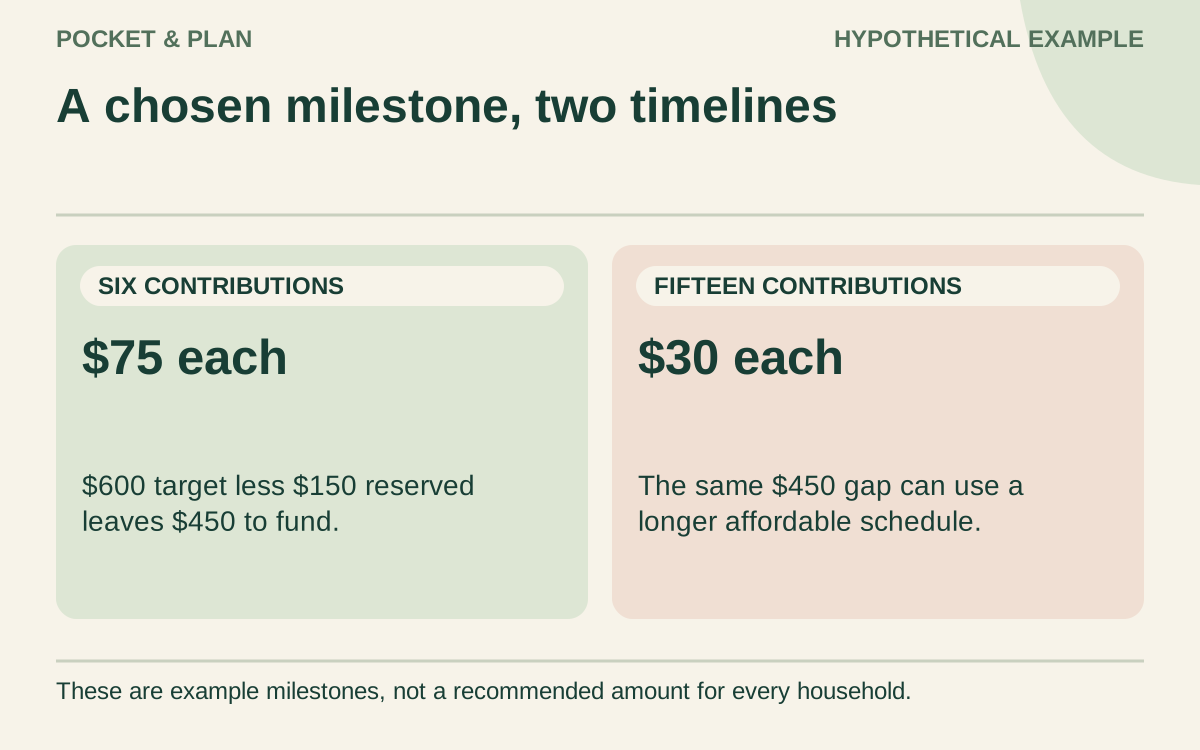
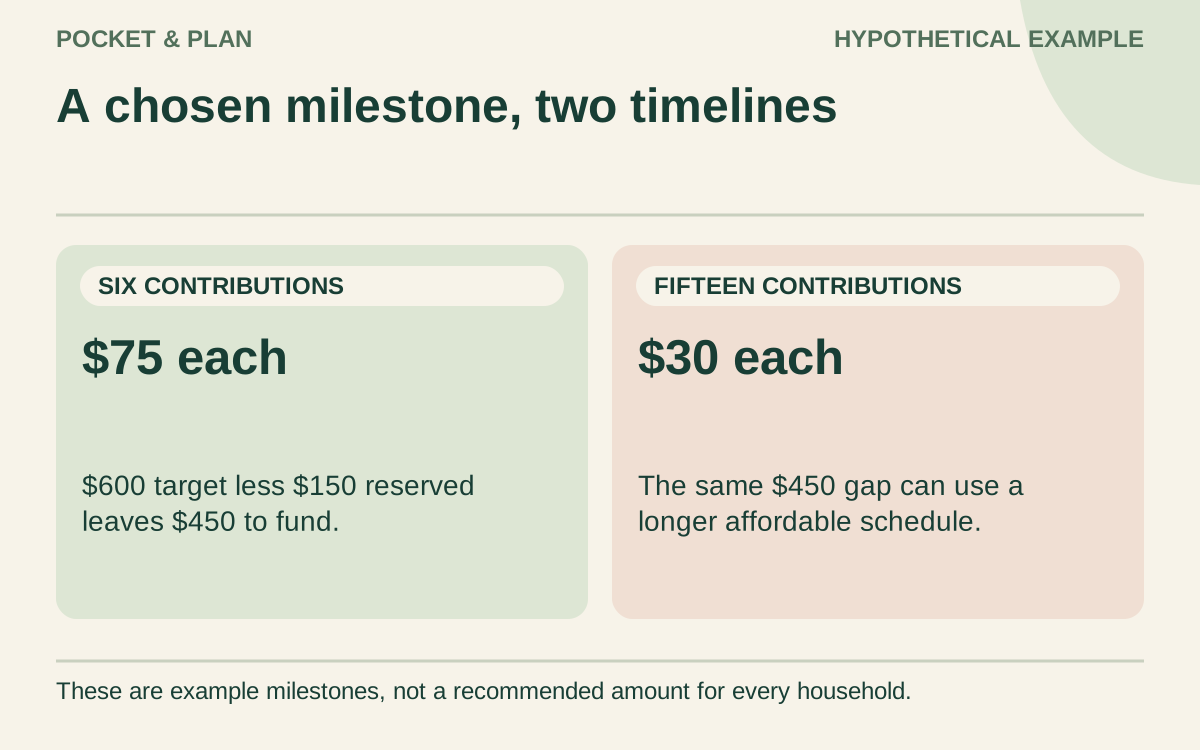
Here is an original hypothetical example. Taylor chooses a $600 starter milestone and already has $150 specifically reserved. The remaining gap is $600 − $150 = $450. Six monthly contributions of $75 would close it, assuming no withdrawals, interest, fees, or other changes.
| Milestone plan | Amount |
|---|---|
| Chosen starter target | $600 |
| Already reserved | $150 |
| Amount still needed | $450 |
| Number of planned monthly contributions | 6 |
| Contribution per month | $75 |
The CFPB savings-plan tool divides a chosen goal across the available weeks. This example applies the same arithmetic to a remaining gap and monthly contribution dates. Use the savings planner to compare another amount or timeline.
If Taylor can currently assign only $30 each month, $450 ÷ $30 requires 15 contributions. The longer schedule describes the available money honestly. Neither a deadline nor a calculator result makes a $75 contribution affordable.
Check the money before making the transfer
Use received household income and existing unassigned funds. Leave known bills, basic living needs, and amounts already reserved visible in the plan. Consumer.gov’s budget process compares income with expenses and uses actual results to inform the next month’s plan; it also allows savings as a planned assignment.
For example, an account may show $500 while $350 is committed before the next payday and $100 is already reserved for another purpose. Under those assumptions, $50 is unassigned. Moving $75 into emergency savings would require changing another assignment or finding another confirmed resource.
Avoid describing borrowed money or an unpaid expected invoice as a contribution from available income. With changing pay, use the irregular-income method to decide contributions after receipts arrive. A month with no available contribution should show that result plainly.
Make the reserve identifiable and usable
Record where the money is held, using a nickname rather than a full account number. Decide how you would access it when needed, and check current fees, minimum-balance terms, and transfer timing directly with the provider. A separate label only works if you can distinguish it from everyday spending money.
The CFPB emergency-fund guide emphasizes keeping emergency money accessible and protected. This article does not compare accounts or verify any particular provider’s protection. If several goals share one account, reconcile the combined assignments against the money actually held there.
Use a short withdrawal decision and rebuilding note
Before using the fund, write the expense, why it needs attention now, the confirmed amount or estimate, and any other reserve already meant for it. That record helps distinguish a necessary use from an optional purchase without making a checklist more important than the actual need.
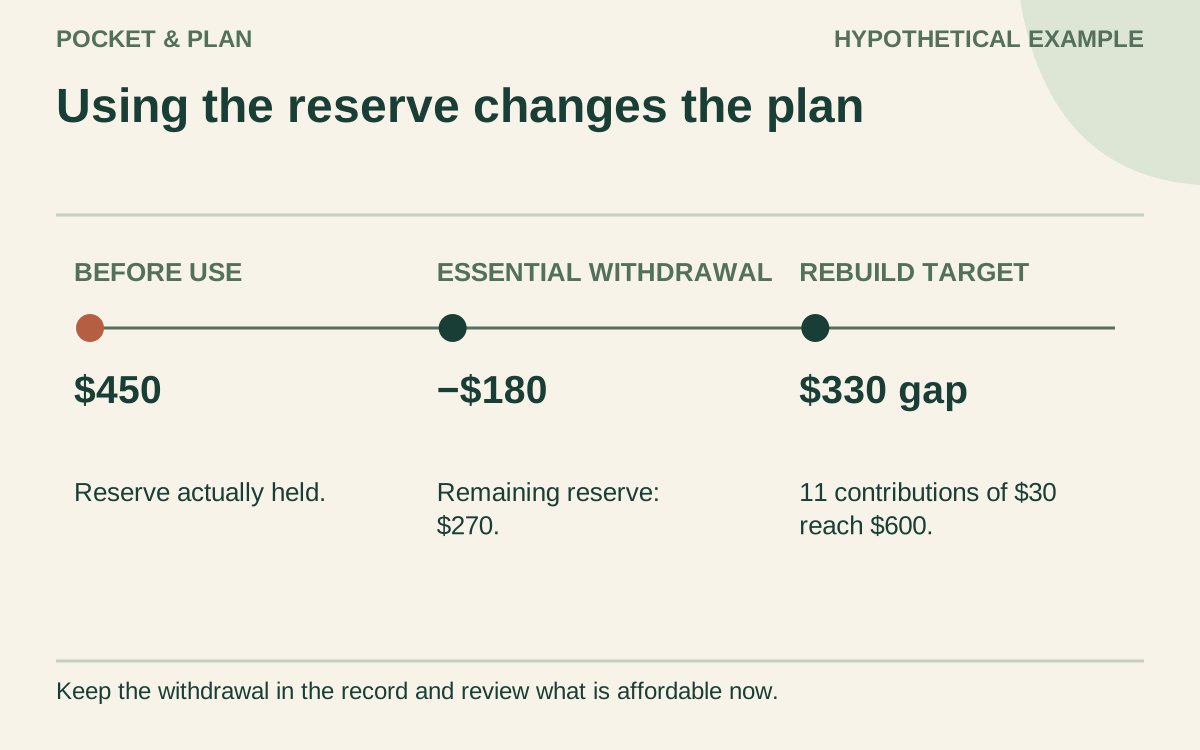
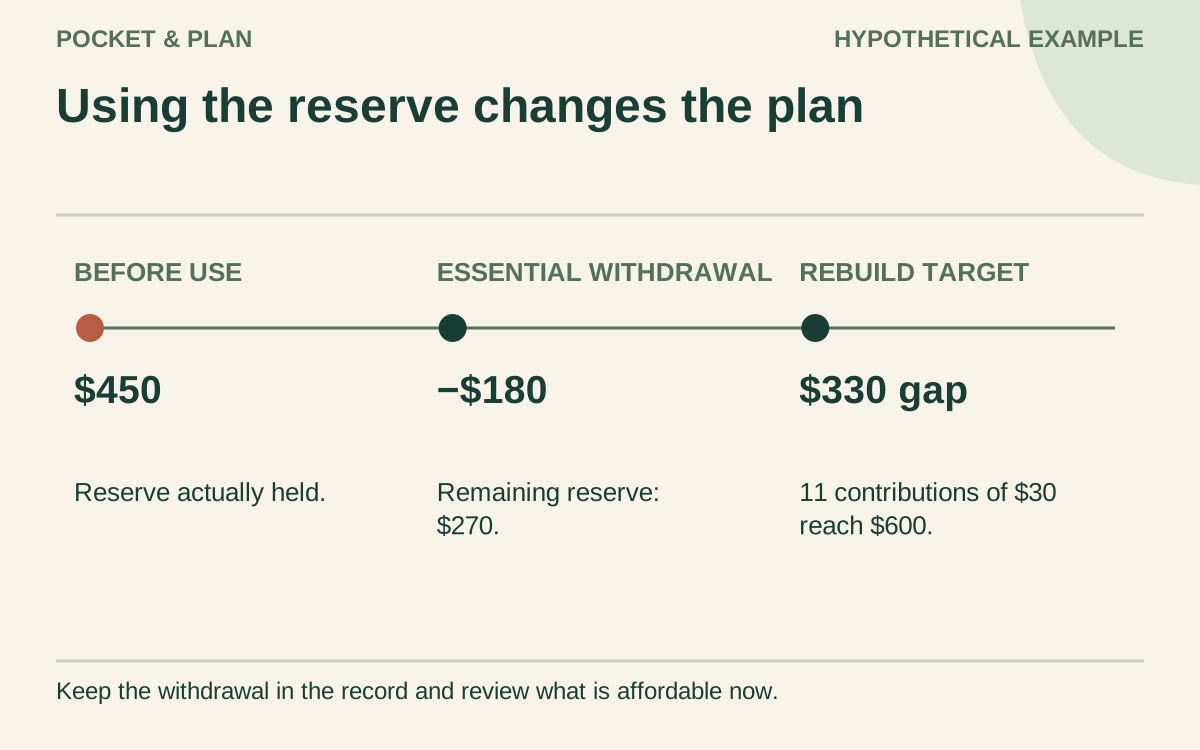
Suppose Taylor’s reserve has reached $450 and an unexpected essential expense uses $180. The remaining balance is $270. Returning to the original $600 milestone requires $330; at a newly reviewed $30 per contribution, that takes 11 contributions if nothing else changes.
Record both the withdrawal and the revised schedule in the savings tracker. Keep the original history rather than resetting the balance to pretend the fund was never used. At the next monthly money review, check whether the target, accessible balance, and affordable contribution still describe your household.
Sources & verification
These primary reference sources support the guide. Worked examples are our own illustrations, not national averages or reported personal results.
- CFPB — An essential guide to building an emergency fund ↗Checked September 11, 2026
- CFPB — Savings plan tool ↗Checked September 11, 2026
- Consumer.gov — Making a Budget ↗Checked September 11, 2026
Published · Last substantive update .
Found a factual error or a calculation that needs checking? Suggest a correction by email with this guide's link. The link opens a draft in your email app; you send it yourself. Contact details · Corrections policy