The short answer
Separate money already available from income you expect, then prepare different assignments for a low month, an ordinary month, and a stronger month.
General educational guide. Sources checked September 10, 2026. Examples are illustrative; amounts should be adjusted to your household. Read our disclosure.
To budget with irregular income, first work out the household costs that need funding, then assign only money you have actually received and can spend. Keep expected income in a separate forecast. Prepare a low-month response and decide how stronger months will replenish reserves before treating the difference as available spending.
This approach suits changing hours, commissions, tips, or other uneven household income. The scenarios below are hypothetical. They illustrate a planning method, not a promise that a particular income level will cover your living costs.
Define the money available to your household
Begin with received take-home funds. For work where a deposit includes business costs or money needed for tax obligations, the whole deposit is not necessarily available for household spending. Identify the spendable household amount before using this worksheet. This guide does not calculate tax obligations or prescribe a reserve percentage.
Keep three separate figures:
- Available now: cleared, spendable money that has not already been assigned.
- Already reserved: money present in an account but committed to bills, future costs, or another purpose.
- Expected later: possible or confirmed future receipts, with dates and any uncertainty noted.
An unpaid invoice belongs in the forecast even when the work is finished. A transfer from an existing reserve can help cover spending, but it is a use of earlier income, not another month’s earnings.
Use history to describe the range
Review your own received household income over enough months to see a pattern. Note the lowest months, ordinary months, and unusually strong months. Flag one-time receipts so they do not quietly become a recurring expectation.
Consumer.gov describes dividing the previous year’s income by 12 to estimate monthly income when pay is not monthly. If the relevant yearly total were $36,000, that estimate would be $3,000. It describes a monthly average; it does not make $3,000 available every month.
A new job, reduced hours, or a lost client can make older history less useful. Write down that change beside the estimate. When you have little history, use the amounts and dates you can substantiate, and make the uncertainty visible rather than inventing a reliable minimum.
Find the essential-cost floor
List the obligations and basic living costs that must be addressed during the planning period. Include housing, food, necessary transport, health needs, required payments, and household-specific responsibilities. Estimate from actual records, with payment dates alongside the amounts.
In this example the household’s essential costs total $2,450: housing $1,200, utilities $220, groceries $350, transportation $220, health and insurance $180, required payments $180, and other basic household costs $100.
That total is a planning floor for this fictional household, not an instruction to cut everyone to the same amount. Check what is absent: upcoming annual costs and optional purchases still need attention, but keeping them visible separately makes the immediate funding gap easier to understand.
Write low, normal, and high-month scenarios
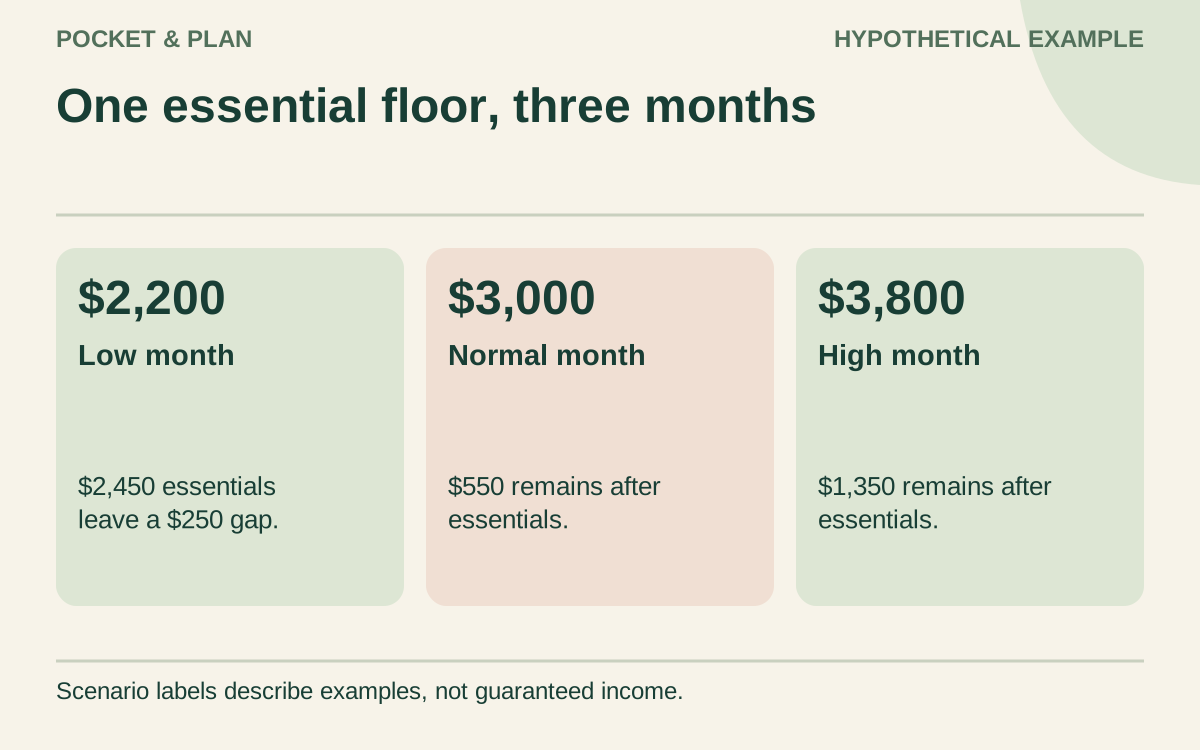
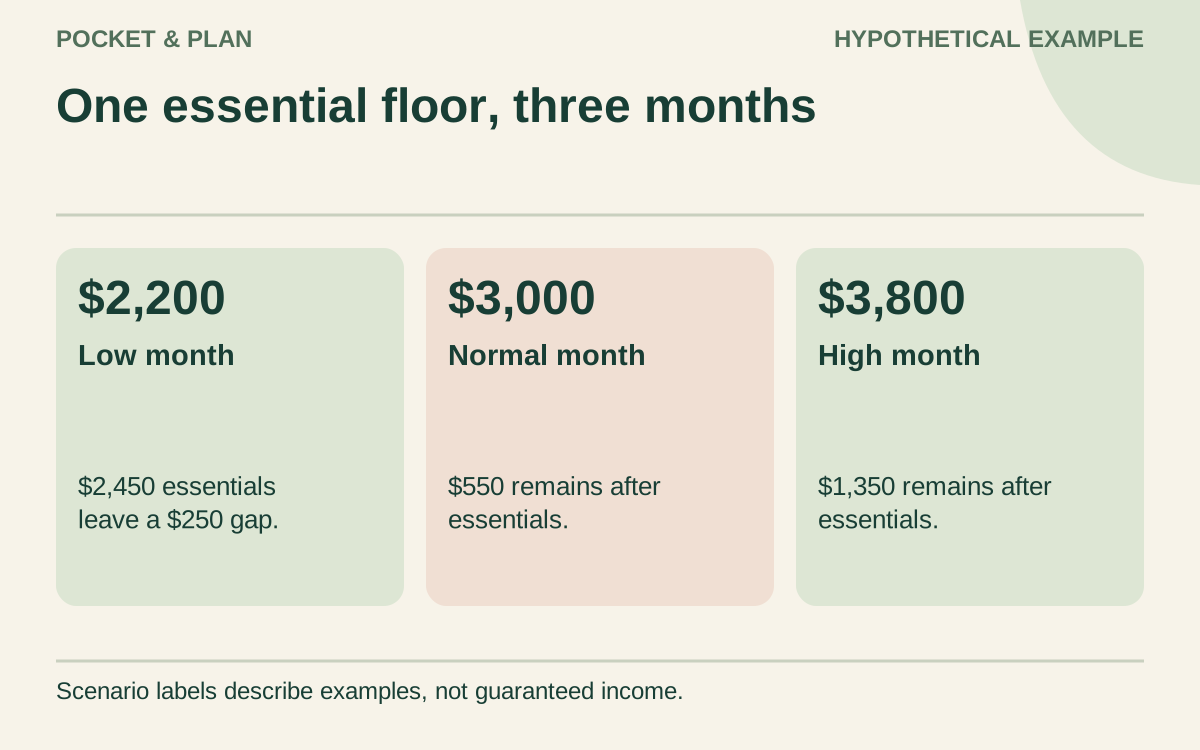
Suppose the household models received spendable income of $2,200, $3,000, or $3,800. The labels describe scenarios, not guaranteed outcomes.
| Assignment or result | Low month | Normal month | High month |
|---|---|---|---|
| Received household income | $2,200 | $3,000 | $3,800 |
| Essential-cost floor | $2,450 | $2,450 | $2,450 |
| Remaining after essentials | −$250 | $550 | $1,350 |
| New future-cost contributions | $0 | $200 | $300 |
| Flexible spending | $0 | $150 | $250 |
| New income-buffer contribution | $0 | $200 | $800 |
| Gap after these assignments | −$250 | $0 | $0 |
The normal plan uses $2,450 + $200 + $150 + $200 = $3,000. The high plan uses $2,450 + $300 + $250 + $800 = $3,800. Neither includes an extra invisible surplus.
The low plan is $250 short. An existing income buffer can cover that gap only if at least $250 is actually available for that purpose. Otherwise the household needs a revised plan or another confirmed resource. Setting optional spending to zero does not solve a shortfall that remains within essentials.
Check the dates before you make payments
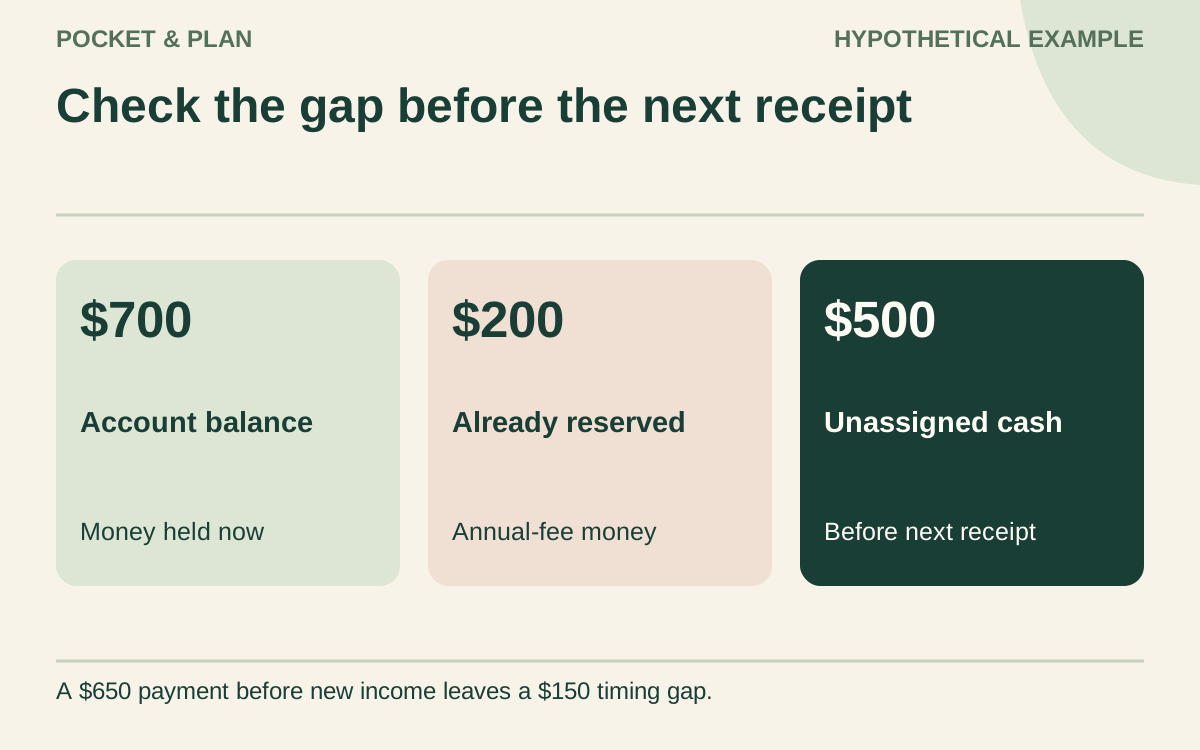
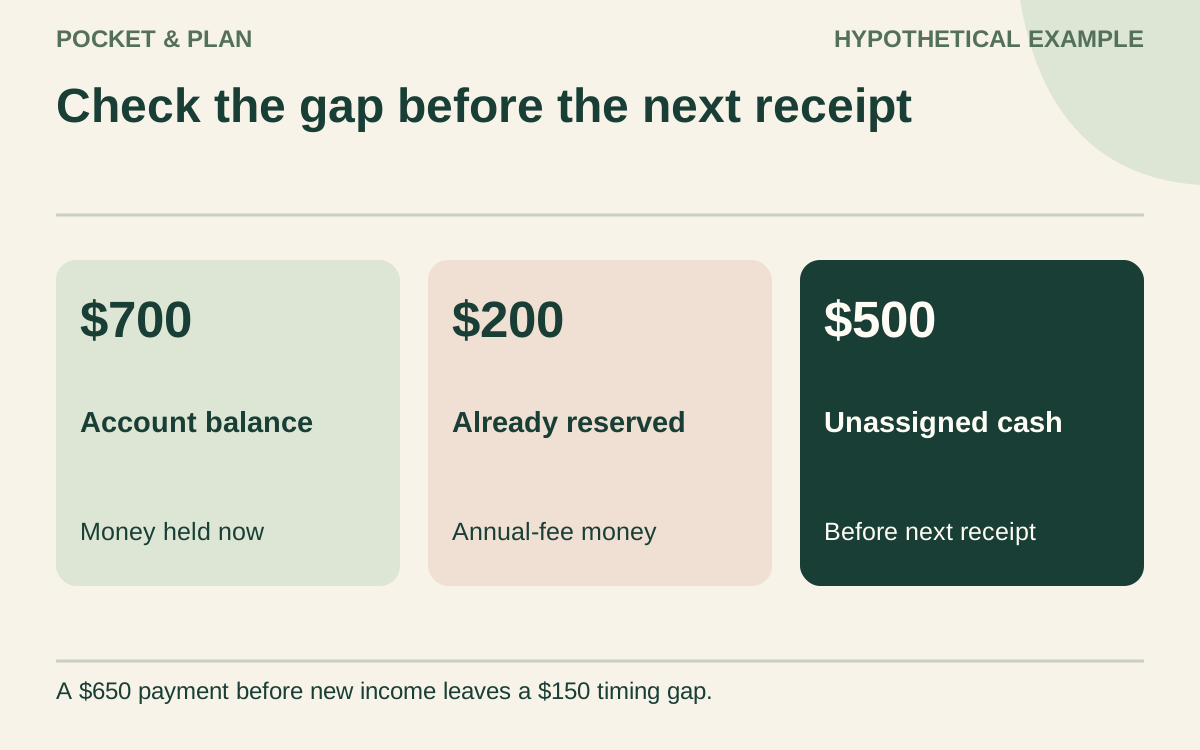
Monthly totals can hide an earlier problem. Imagine a separate week with $700 in the account, including $200 already reserved for an annual fee. Only $500 is unassigned. If $650 must be paid before the next receipt, there is a $150 timing gap. A forecasted deposit later in the month cannot cover today’s withdrawal.
The CFPB’s budgeting guide pairs income and expense tracking with a bill calendar because due dates can conflict with income timing. Use the bill payment tracker to see the gap and record the next action, such as confirming an expected receipt or asking a biller about available arrangements. Do not assume an arrangement is approved until it is confirmed.
Give stronger-month money an explicit order
Write a short priority list while you are making the plan. It might begin with a current shortfall, then an upcoming known cost, then rebuilding the income buffer, followed by another chosen goal. The order depends on your obligations and due dates.
Keep the income buffer’s purpose distinct from a fund for a known future bill. The CFPB emergency-fund guide discusses loss of income as one possible use of emergency savings and notes that an appropriate reserve depends on the household. No particular number of months is assumed here.
If an $800 stronger-month contribution is later followed by a $250 withdrawal, that reserve falls to $550, assuming no other transactions. Record both movements. Its original balance is no longer available to fund a second goal.
Repeat this check whenever income arrives
- Confirm the received amount that is actually spendable by the household.
- Subtract existing assignments before deciding what is available now.
- Review expenses due before the next plausible receipt, including uncertainty.
- Fund or revise the immediate plan, and name any remaining gap.
- Assign stronger-month money according to the current priority list.
- Update the forecast when a receipt is delayed or circumstances change.
Use the budget planner to compare monthly scenarios; it does not predict future income. The biweekly guide is useful when the pay interval itself is regular. For uneven amounts or dates, return to the received-money check before each new assignment.
Sources & verification
These primary reference sources support the guide. Worked examples are our own illustrations, not national averages or reported personal results.
- Consumer.gov — Making a Budget ↗Checked September 10, 2026
- CFPB — Budgeting: How to create a budget and stick with it ↗Checked September 10, 2026
- CFPB — An essential guide to building an emergency fund ↗Checked September 10, 2026
Published · Last substantive update .
Found a factual error or a calculation that needs checking? Suggest a correction by email with this guide's link. The link opens a draft in your email app; you send it yourself. Contact details · Corrections policy