The short answer
Build an annual upkeep list from your property's records, confirm who pays, and fund early jobs without assuming a year's contributions are already available.
General educational guide. Sources checked September 11, 2026. Examples are illustrative; amounts should be adjusted to your household. Read our disclosure.
A home maintenance budget starts with the upkeep your property actually needs, the person or organization responsible for payment, and the expected cost and date of each job. Add those known commitments, identify money already reserved, and check the earliest payments before choosing a regular contribution. A year’s affordable total does not automatically fund a bill arriving next week.
Use this workflow for a defined planning period, such as October through the following September. It organizes costs and records; it does not prescribe maintenance work or determine anyone’s legal responsibility.
Use the home maintenance budget PDF to record the payer, estimate, final amount, and next payment for each task. Check whether the earliest bill and the cushion you want to retain are both funded. This is a manual worksheet for handwriting, with no automatic calculations. Print on US Letter paper in the orientation shown on the file.
Build a property-specific list and confirm who pays
Gather relevant equipment manuals, service records, inspection findings, prior invoices, and the documents describing shared or rented areas. List work supported by those records. A reminder from another household may concern equipment or responsibilities you do not have.
The CFPB’s homeownership guidance identifies maintenance and repairs as costs to consider alongside other housing expenses. For your own list, verify the payer through the applicable property documents and the person managing the arrangement. Record unresolved responsibility as a question rather than assuming an owner, tenant, association, or service provider will cover it.
Include the specific item or area, the basis for its timing, and the next person to contact. Keep optional improvements on a separate project list. Painting for a preferred new color and work identified as necessary upkeep may involve similar suppliers, but they compete for money for different reasons.
Price the work you have identified
Use a written estimate with enough detail to match it to the task. The FTC’s contractor guidance recommends comparing estimates that describe the work, materials, timing, and price. A smaller amount is hard to interpret when the included work differs.
Record the expected total payable by your household, including identified labor, materials, taxes, and other charges. Keep the estimate date and any exclusions beside it. If a visit fee is included in the main quote, do not add it again as a separate expense.
One row per obligation can hold these fields:
| Field | What belongs there |
|---|---|
| Task and payer | The specific work and confirmed payment responsibility |
| Source | Manual, service record, agreement, or quote reference |
| Estimate and its date | A supported planning figure, with unresolved charges noted |
| Payment date | The actual deadline, or a clearly labeled provisional date |
| Final total and paid amount | Confirmed figures kept separate from the estimate |
| Next action | The question, person, and follow-up date |
Check an annual total against the opening month
Here is an invented household plan covering October through September. These amounts illustrate the arithmetic only; they are not typical prices or recommendations to schedule these jobs.
| Identified obligation | Planning amount | Expected payment |
|---|---|---|
| Professional service visit | $240 | October 15 |
| Agreed exterior upkeep | $180 | November 15 |
| Scheduled maintenance work | $420 | February 15 |
| Identified replacement consumables | $120 | May 15 |
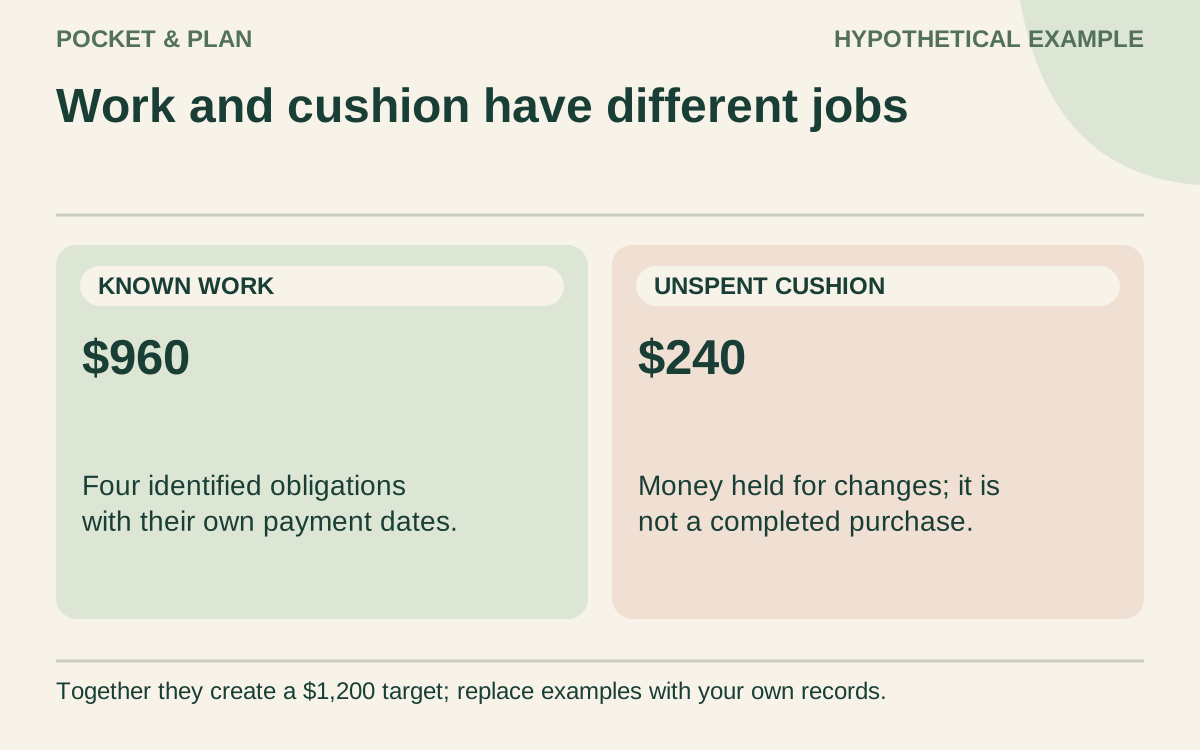
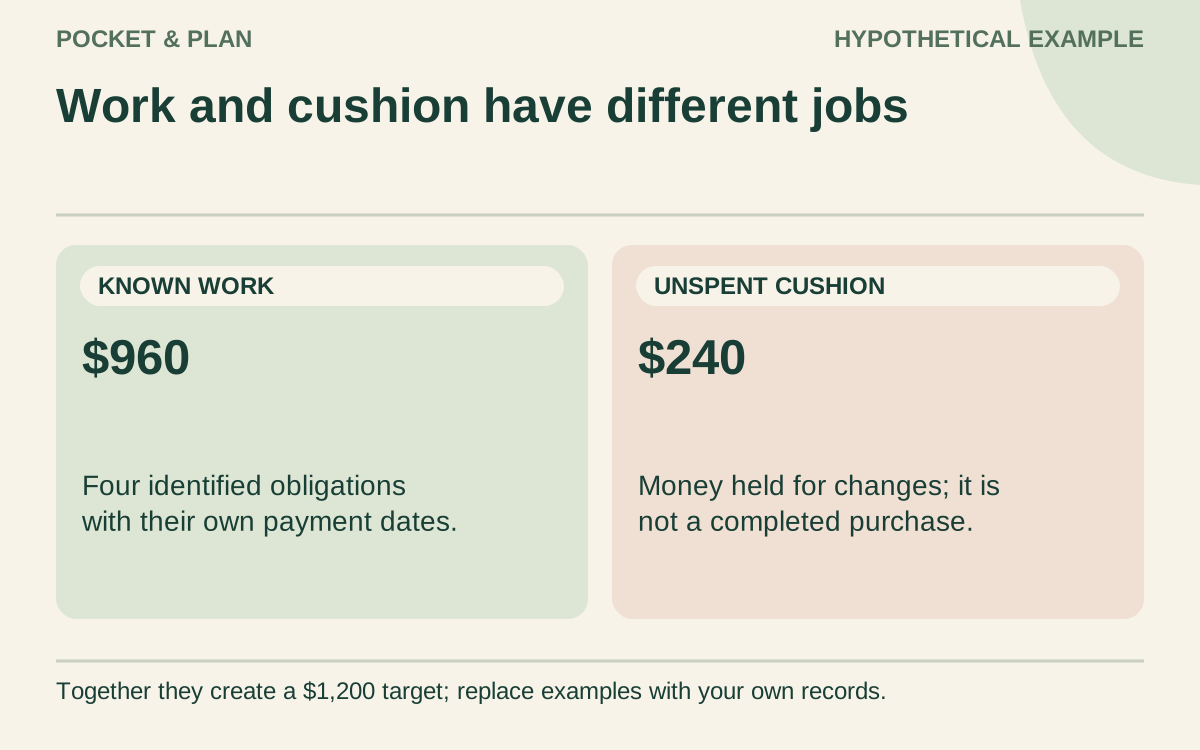
| Known work total | $960 | Four payment dates |
The household also chooses to keep a $240 unspent cushion for changes within this maintenance plan. That creates a $1,200 funding target: $960 of planned work + $240 still reserved. The cushion is not an additional completed purchase or a universal amount every home needs.
With $120 already reserved, the gap is $1,200 − $120 = $1,080. Twelve monthly contributions of $90 would supply it. This assumes the quoted work remains unchanged and no other withdrawals, interest, or fees affect the reserve.
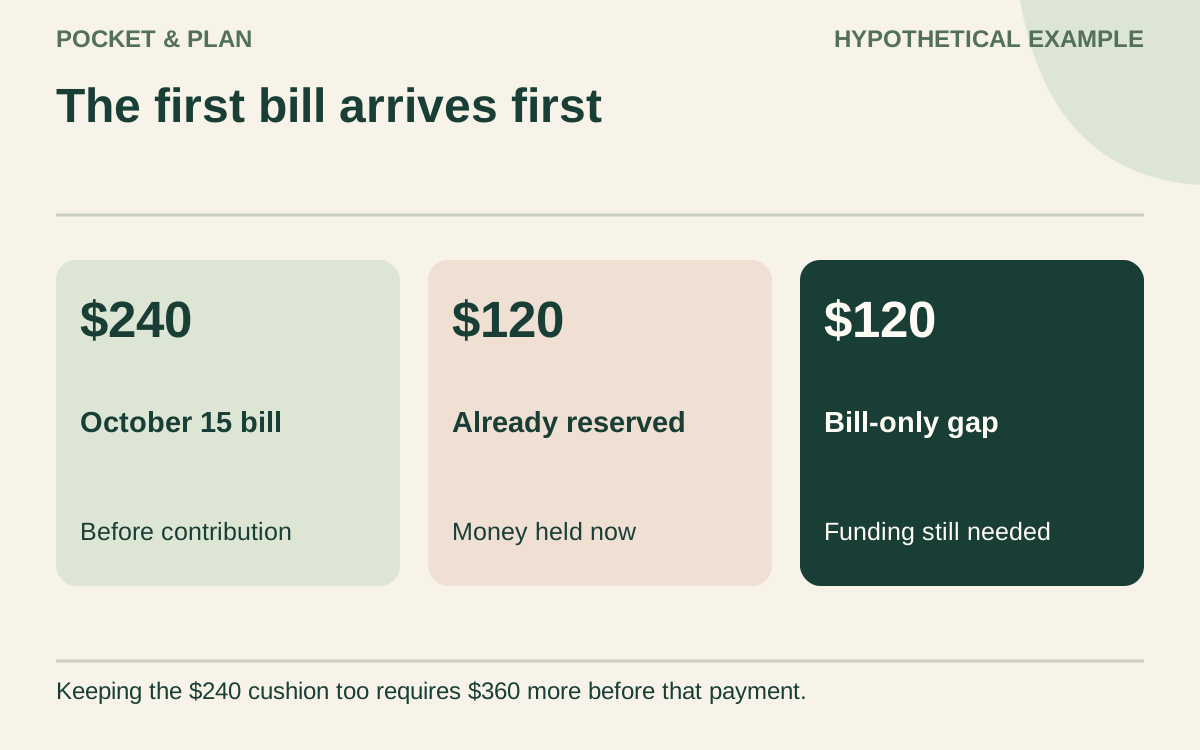
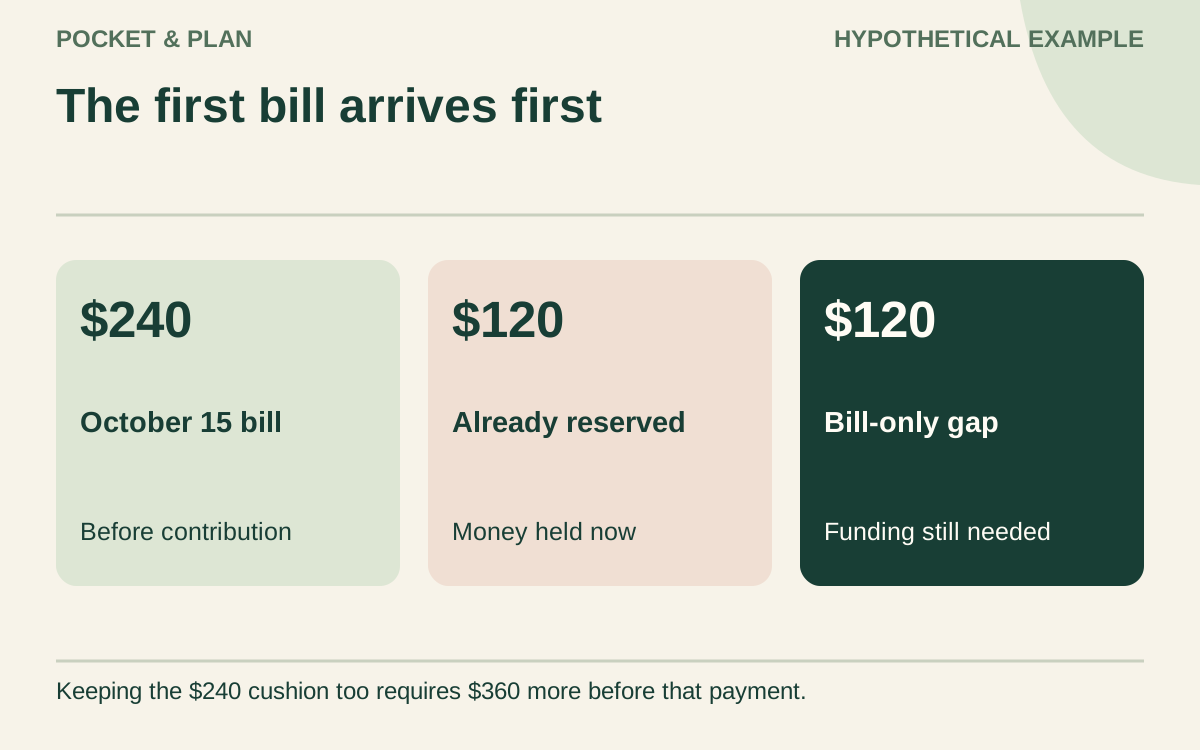
However, the first contribution is scheduled for October 20. The October 15 payment needs $240 while only $120 is reserved, so the plan is $120 short for the bill alone. Keeping the full $240 cushion available on that date would require $360 more: $240 bill + $240 cushion − $120 reserved. Dividing by twelve cannot solve that earlier deadline. Revisit available funding and confirm any feasible timing change with the relevant provider before treating the job as funded.
Give unknown costs an action instead of a zero
If a required task is waiting for a quote, mark its amount as unknown. You may show a subtotal for the priced items, but describe the overall plan as incomplete. A missing price should never make the job look free.
A genuine $0 household cost needs an explanation, such as a confirmed arrangement under which the household has no charge for that task. Keep the confirmation with the row. An expected reimbursement is different: show any payment you must make first and track the reimbursement separately until received.
When work may fall in either of two periods, check the earlier supported payment date first. Put the unresolved question on a calendar and update the forecast when you get an answer. A provider’s date or an appropriate professional assessment should resolve timing; the budget alone cannot establish whether work can wait.
Keep the upkeep reserve separate from other housing money
Use a named sinking fund for the expected jobs, and distinguish it from the household’s emergency fund. A known future service and an unanticipated essential repair need different planning records. If emergency money is used, record that decision and the resulting balance rather than counting it as untouched protection afterward.
The CFPB spending assessment recommends reviewing records far enough back to find less frequent expenses. Apply that review to upkeep invoices, while retaining ongoing housing payments in your monthly budget categories. Money already assigned to rent, utilities, or another obligation is not available maintenance cash.
If several reserves share one account, reconcile their combined assignments with its actual balance. Moving $90 into the upkeep reserve is a transfer and allocation. Paying a provider later uses that allocation; it does not create another $90 of saving.
Update the plan after each completed job
Keep the original estimate available, record the confirmed final total, and match payments to the same obligation. If an estimated $240 job finishes at $260, the plan needs $20 more. If $50 has already been paid toward that final bill, $210 remains; do not list the advance as another job.
Use the bill tracker for confirmed bills and payment evidence, and the savings tracker for reserve contributions and withdrawals. At the next review, carry forward unfinished work, replace outdated quotes, and record any changed responsibility. The resulting list becomes a record of your property’s actual costs for the next planning period.
Sources & verification
These primary reference sources support the guide. Worked examples are our own illustrations, not national averages or reported personal results.
- CFPB — Assess your spending ↗Checked September 11, 2026
- CFPB — What are some of the financial considerations of buying a home? ↗Checked September 11, 2026
- FTC — How To Avoid a Home Improvement Scam ↗Checked September 11, 2026
Published · Last substantive update .
Found a factual error or a calculation that needs checking? Suggest a correction by email with this guide's link. The link opens a draft in your email app; you send it yourself. Contact details · Corrections policy