The short answer
Turn vehicle-specific maintenance records into dated costs, then check whether the money arrives before the work needs to be paid for.
General educational guide. Sources checked September 11, 2026. Examples are illustrative; amounts should be adjusted to your household. Read our disclosure.
Build a car maintenance budget by listing the next work supported by your vehicle’s maintenance records, attaching a current estimate to each item, and checking the money available before its payment date. Keep routine upkeep separate from fuel, insurance, vehicle payments, and unexpected repairs. A monthly savings amount helps only when its contributions arrive before the bills.
Use your own vehicle, driving pattern, and records to set the list. The dollar examples below are invented to demonstrate budgeting; they are not repair prices or a servicing schedule.
Use the car maintenance budget PDF to list work, estimates, confirmed final amounts, payments, and next dates. A blank quote remains unknown, while a documented zero is a completed cost check. This is a manual worksheet for handwriting, with no automatic calculations. Print on US Letter paper in the orientation shown on the file.
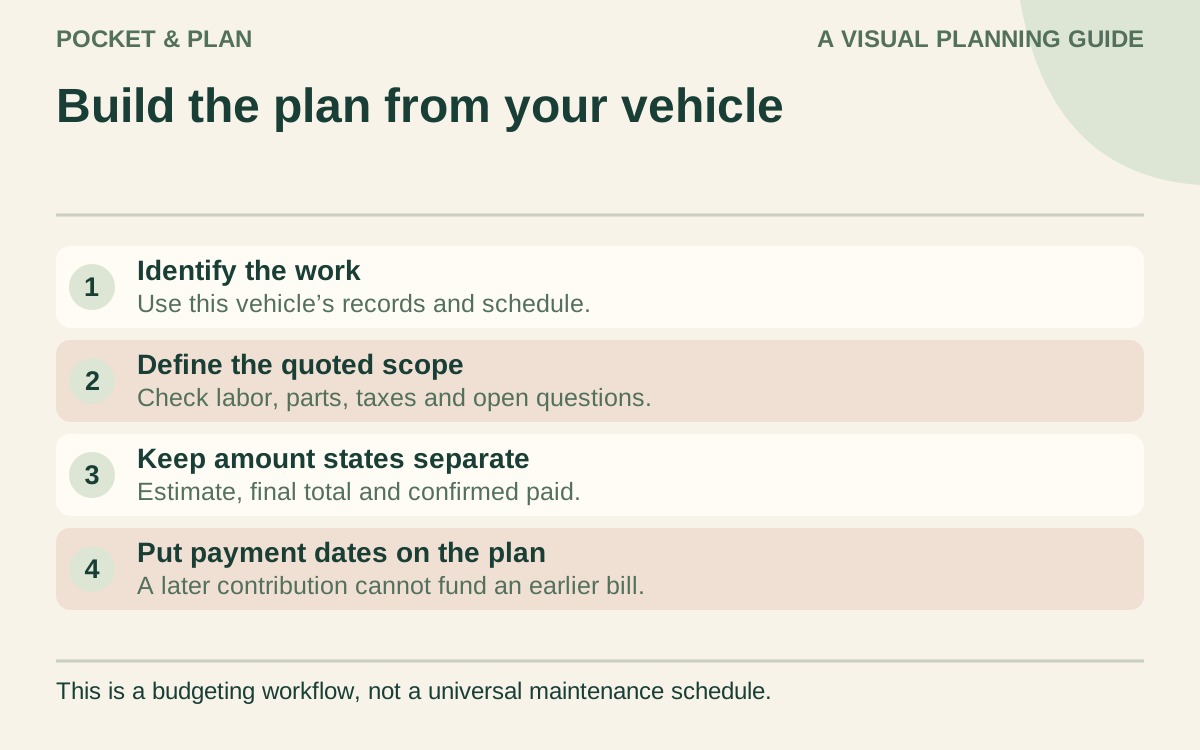
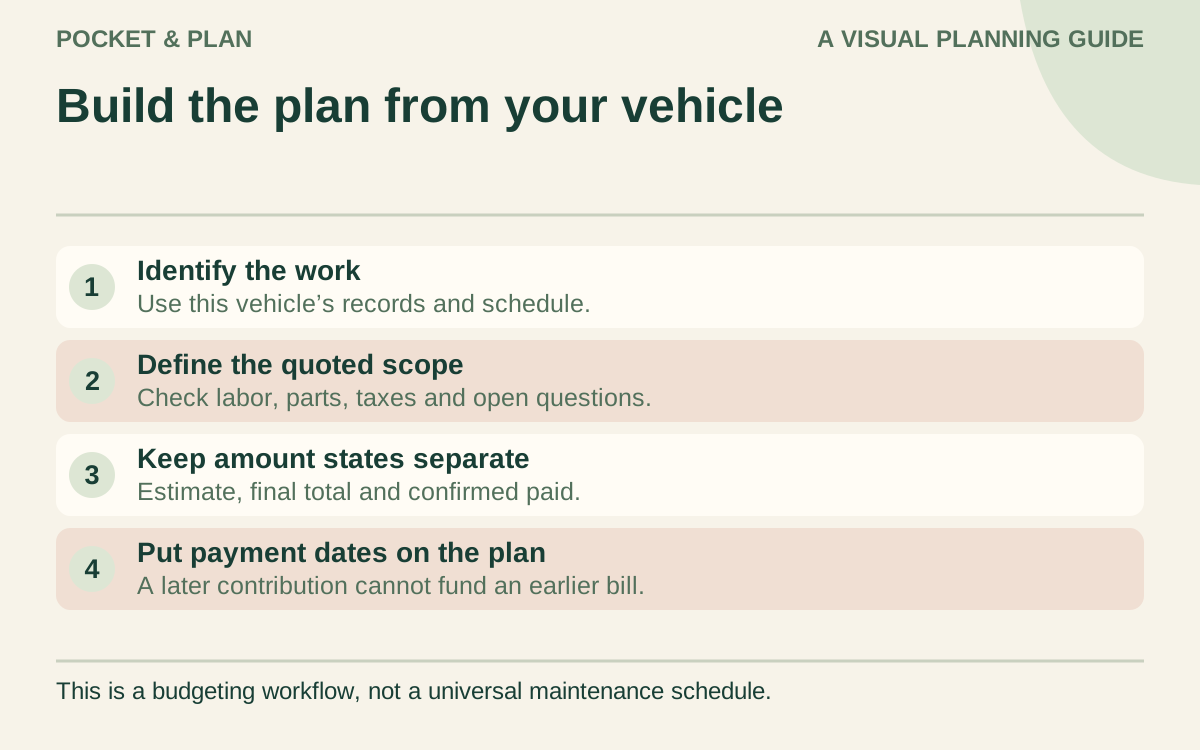
Start with the vehicle’s records and the next review date
Gather the relevant owner’s manual, completed service records, current odometer reading, and any written recommendations awaiting clarification. The FTC’s auto-repair guide points readers to the manufacturer’s maintenance schedule for their driving conditions. It also recommends questioning shop recommendations that differ from that schedule.
Create one row for each identified need, with a vehicle nickname when the household has more than one car. Record the document behind the entry and whether the timing depends on a date, mileage, or an assessment. A reminder to ask about something is different from confirmed work to purchase.
When a mileage milestone is approaching, review how your actual driving has changed. A new commute can move the planning date forward. Keep the projected date labeled as an estimate until the relevant timing is confirmed; an old calendar reminder does not establish that the work can wait.
Give each estimate a clear scope
Ask for a written breakdown that identifies the work, parts, and labor. The FTC guidance also highlights diagnostic charges and a completed repair order. Use those documents to explain what each amount includes, rather than comparing two headline prices with different work behind them.
For the budget, record the expected checkout total, including any identified taxes and other charges. Note the quote date, what remains uncertain, and who will answer the next question. If two proposed services overlap, resolve that overlap before adding both full amounts.
Keep three amount fields: estimated total, confirmed final total, and confirmed paid to date. A blank final amount means it is unknown. A documented final amount of $0 is a real result; record why no payment is due. A scheduled payment stays on your action list until its completion is confirmed.
Test a six-month plan against its first payments
Suppose Morgan reviews one vehicle on September 30 and identifies this hypothetical plan for October through March. The work descriptions stand for needs already checked against that vehicle’s records, and all amounts include the assumed charges for the example.
| Identified work | Planning amount | Payment date |
|---|---|---|
| Verified service visit | $120 | October 5 |
| Quoted replacement work | $360 | November 20 |
| Next scheduled service | $180 | February 15 |
| Identified consumable purchase | $60 | March 5 |
| Total | $720 | Check each date |
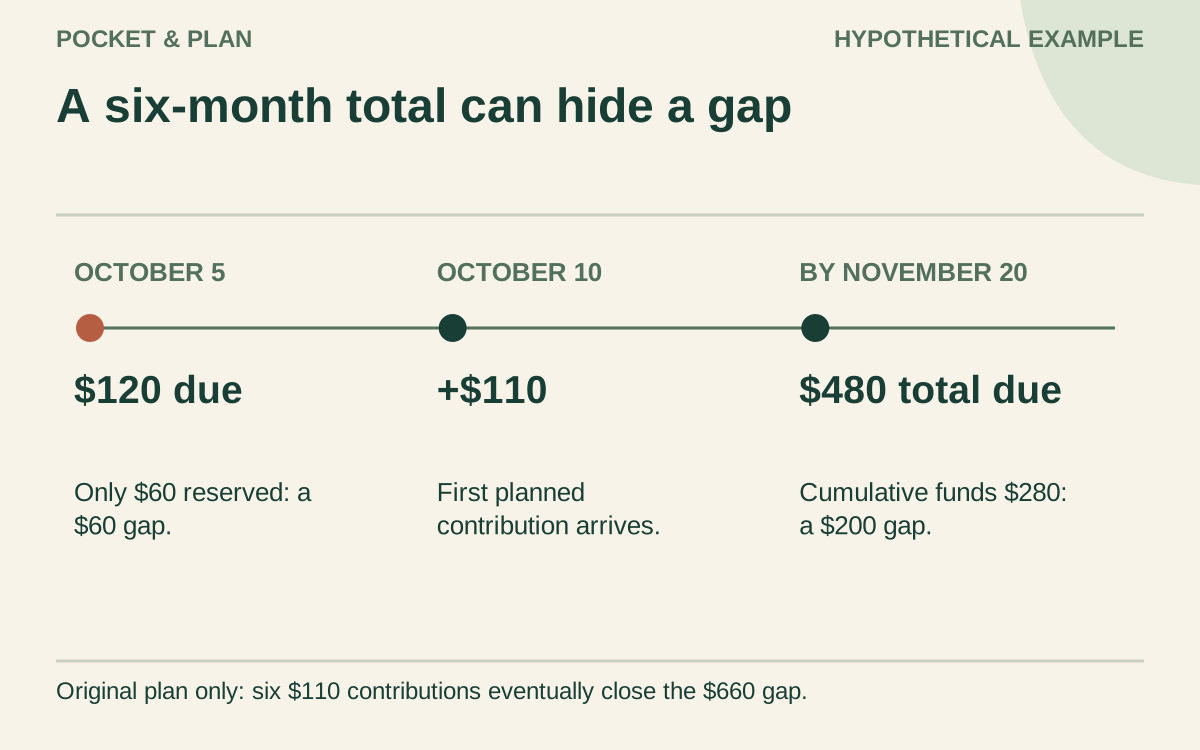
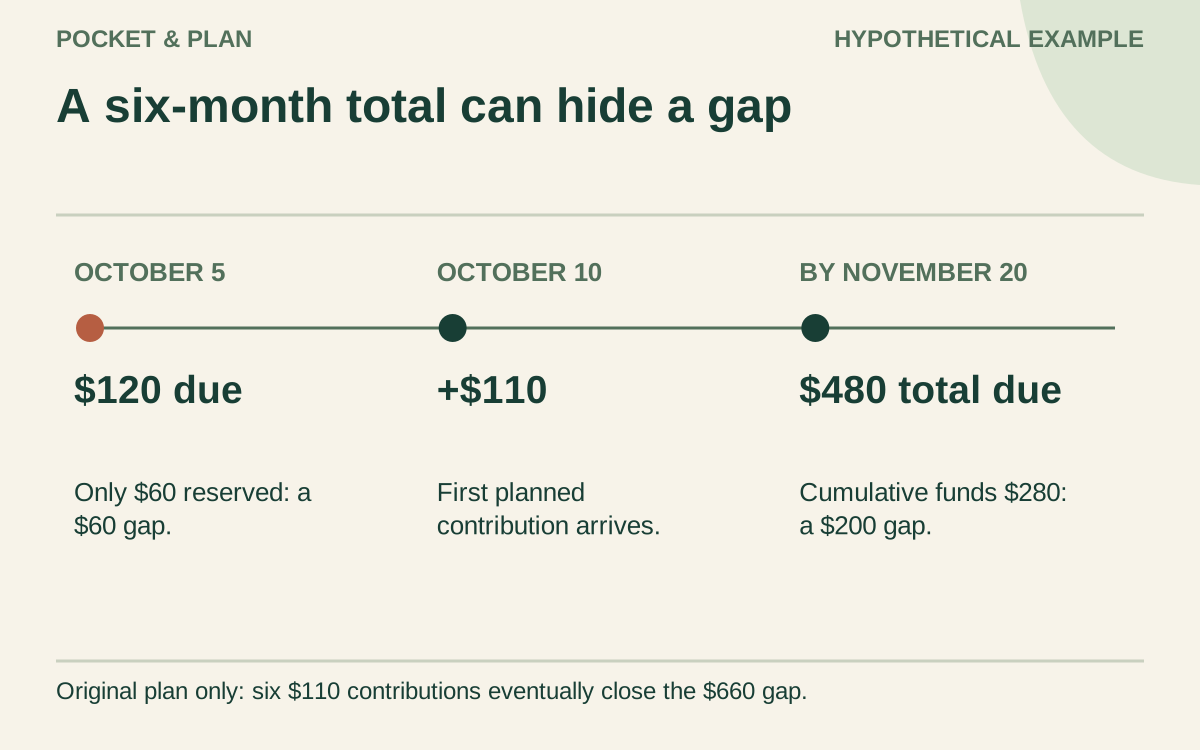
Morgan has $60 reserved. The remaining target is $720 − $60 = $660. Six contributions of $110 would fund that gap, assuming no price changes, withdrawals for other work, interest, or fees. The planned contribution dates are the tenth of each month, October through March.
But the first $120 payment is due on October 5, before the first contribution. Only $60 is available, leaving a $60 shortfall. By November 20, the original contribution plan would provide $60 + $110 + $110 = $280 against $480 of cumulative payments, a $200 gap. Those figures assess the original plan before any remedy is added.
The six-month total balances eventually; the payment calendar does not. Identify another confirmed resource or discuss a feasible payment arrangement before relying on this plan. A budget shortage does not establish that maintenance can safely be postponed. Any changed work date needs appropriate confirmation, not an edited spreadsheet cell alone.
Handle unknown timing without writing in a convenient zero
For work awaiting a quote, write “amount pending” and give the question a follow-up date. If a documented preliminary amount is available, use it as an estimate and retain its source. A subtotal covering only priced items should be labeled as incomplete while another required item remains unpriced.
If timing is uncertain, test the earlier plausible payment date identified through the vehicle’s records or professional assessment. Check a later scenario separately; do not average two dates and assume the resulting date is safe. The decision this reveals is whether more information or earlier funding is needed.
Place confirmed obligations in the bill payment tracker. Its paid-to-date record helps keep an advance on the same bill: a $50 payment toward a $120 total leaves $70 unpaid, not a second $50 expense. Keep estimate-only work in the planning list until its amount is established.
Separate the maintenance reserve from emergency money
Known upkeep belongs in a named sinking fund, with costs and dates you can revisit. The CFPB emergency-fund guide describes emergency savings as a reserve for unplanned expenses or financial emergencies. An unexpected essential repair may need that separate review; its label does not make the same money available twice.
Before choosing contributions, compare them with existing household commitments. Consumer.gov’s budget process includes listing expenses, recording spending, and using the results in the next plan. Add the maintenance assignment to your household budget planner without quietly reducing money already needed for another bill.
Close each job and update the next one
After work is completed, replace the estimate with the supported final total, record confirmed payments, and retain the invoice reference. If a $360 estimate becomes a $340 final bill, the plan needs $20 less. That difference is released from an earlier assignment; it is not new income.
Record the reserve withdrawal in the savings tracker, then reconcile what remains before assigning it to the next job. Carry forward the actual service date and mileage from the record. Review the next obligation when driving patterns, recommendations, or quotes change, so the budget follows the vehicle you are using now.
Sources & verification
These primary reference sources support the guide. Worked examples are our own illustrations, not national averages or reported personal results.
- FTC — Auto Repair Basics ↗Checked September 11, 2026
- Consumer.gov — Making a Budget ↗Checked September 11, 2026
- CFPB — An essential guide to building an emergency fund ↗Checked September 11, 2026
Published · Last substantive update .
Found a factual error or a calculation that needs checking? Suggest a correction by email with this guide's link. The link opens a draft in your email app; you send it yourself. Contact details · Corrections policy