The short answer
Use broad percentages to examine your priorities, detailed assignments to manage the money, or combine them without forcing your bills into unrealistic targets.
General educational guide. Sources checked September 10, 2026. Examples are illustrative; amounts should be adjusted to your household. Read our disclosure.
A zero-based budget assigns all the money in your plan to specific purposes, including savings and reserves. A 50/30/20 budget compares take-home income with broad targets for needs, wants, and savings or debt goals. Choose detailed assignments when you need to see which dollars cover which costs; use percentages when you need a quick view of the overall balance.
You can combine the two. Neither method determines what your household can afford by itself. Start with actual income, obligations, and timing, then use the structure to clarify the decisions you need to make.
Understand what each method measures
In a zero-based plan, available money minus all assignments equals zero. “Zero” refers to the unassigned amount. It does not mean emptying your bank account or spending every dollar. An assignment called “next month’s rent” can remain untouched in the account until it is needed.
With 50/30/20, the familiar reference split is 50% of take-home income for needs, 30% for wants, and 20% for savings or debt goals. The CFPB’s budgeting teaching guide presents needs, wants, and savings targets while emphasizing that the rule will not fit everyone. Treat it as a comparison point you may adapt.
| Question | Zero-based structure | 50/30/20 structure |
|---|---|---|
| What does it organize? | Specific assignments for the money in the plan | Broad shares of take-home income |
| What needs deciding? | Each amount and purpose, including any buffer | What belongs in each group and suitable targets |
| What does a mismatch reveal? | Some money is unassigned or the plan is overallocated | Actual category shares differ from the reference split |
| What still needs a separate check? | Whether funds arrive before payments are due | Individual bills, payment dates, and available cash |
Compare the same hypothetical $4,000 income
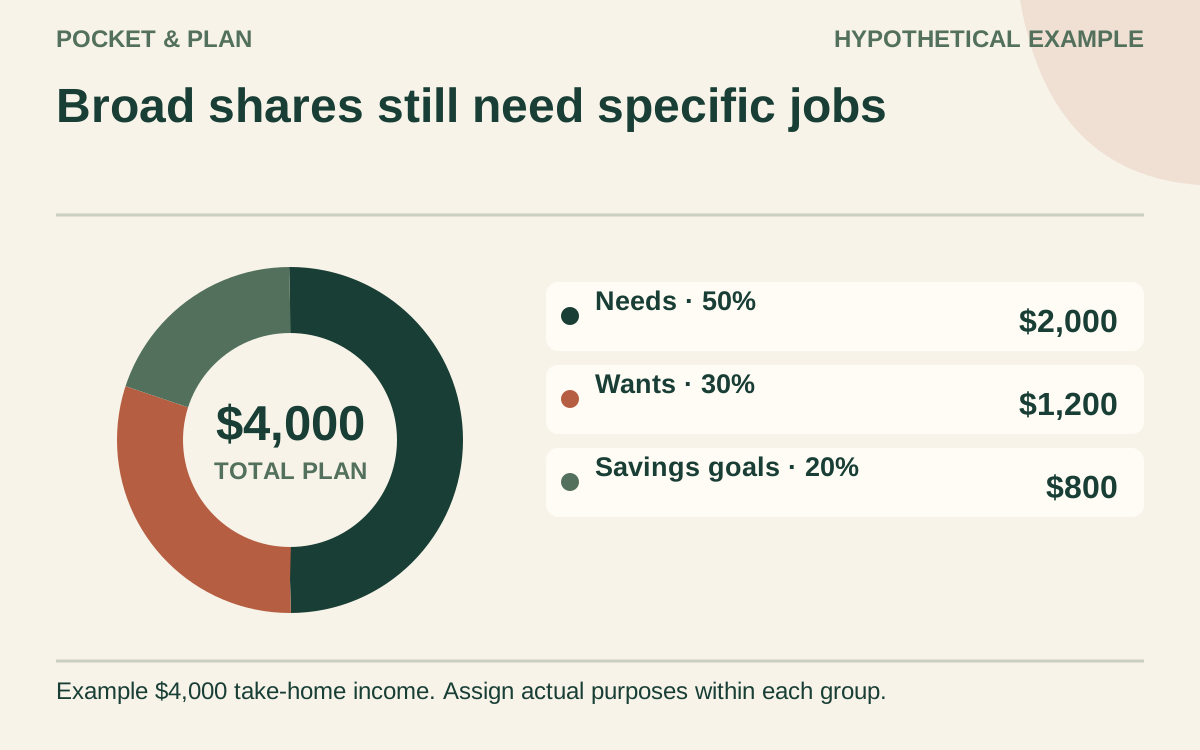
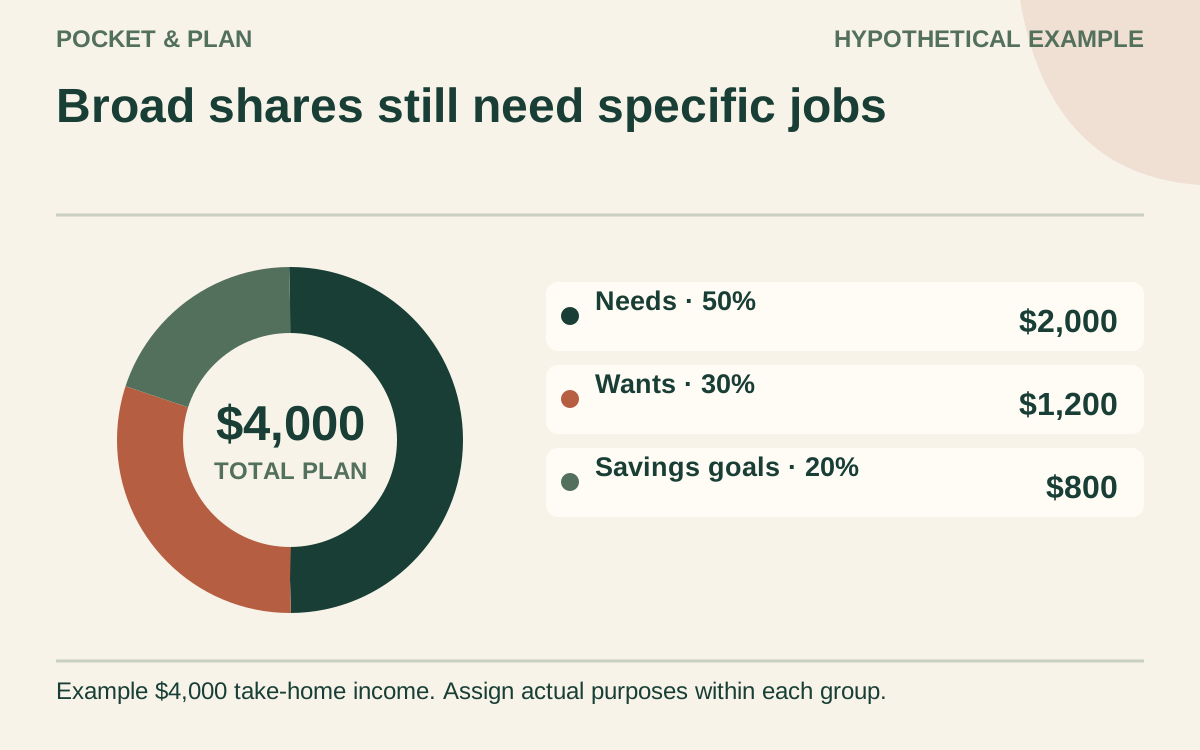
At $4,000 of monthly take-home income, the reference percentages produce:
| Broad group | Calculation | Amount |
|---|---|---|
| Needs | $4,000 × 50% | $2,000 |
| Wants | $4,000 × 30% | $1,200 |
| Savings or debt goals | $4,000 × 20% | $800 |
| Total | $2,000 + $1,200 + $800 | $4,000 |
Those three amounts still leave practical questions. Which bills make up the $2,000? Does the $1,200 include a trip planned for later? What is the $800 for?
One fictional household, with no debt payments in this example, could build the following zero-based detail:
- Needs: housing $1,250, utilities $200, groceries $350, transportation $200.
- Wants: dining out $250, entertainment $150, a future trip $500, personal purchases $300.
- Savings goals: emergency savings $500 and education savings $300.
Needs total $2,000; wants total $1,200; savings total $800. All $4,000 has a purpose, so the unassigned amount is zero. The $500 for the trip and $800 for the two savings goals can remain in accounts. They are assigned money, not an instruction to make immediate purchases.
These are original examples for comparing structures. They do not represent typical costs or recommended amounts for a particular household.
Decide category boundaries before comparing percentages
A category needs a repeatable definition. A basic internet service needed for work might sit with household needs, while an optional upgrade may be a want. A single store receipt may include groceries and hobby supplies. Split it when that distinction would change a decision.
Debt classifications also vary across worksheets. The CFPB’s personal spending-rule worksheet groups savings with debt payments. If your own worksheet puts required minimum payments under obligations and additional repayment under goals, write that convention down. Do not compare the percentages as though both worksheets used identical definitions, and never count the same payment twice.
Likewise, a vacation contribution remains a planned want in the example even when held in a savings account. Classify by purpose when assessing the broad split. Record each contribution once in the detailed allocation, then label it with a broad group; adding the grouped total again would double the plan.
Adapt the split when real needs are higher
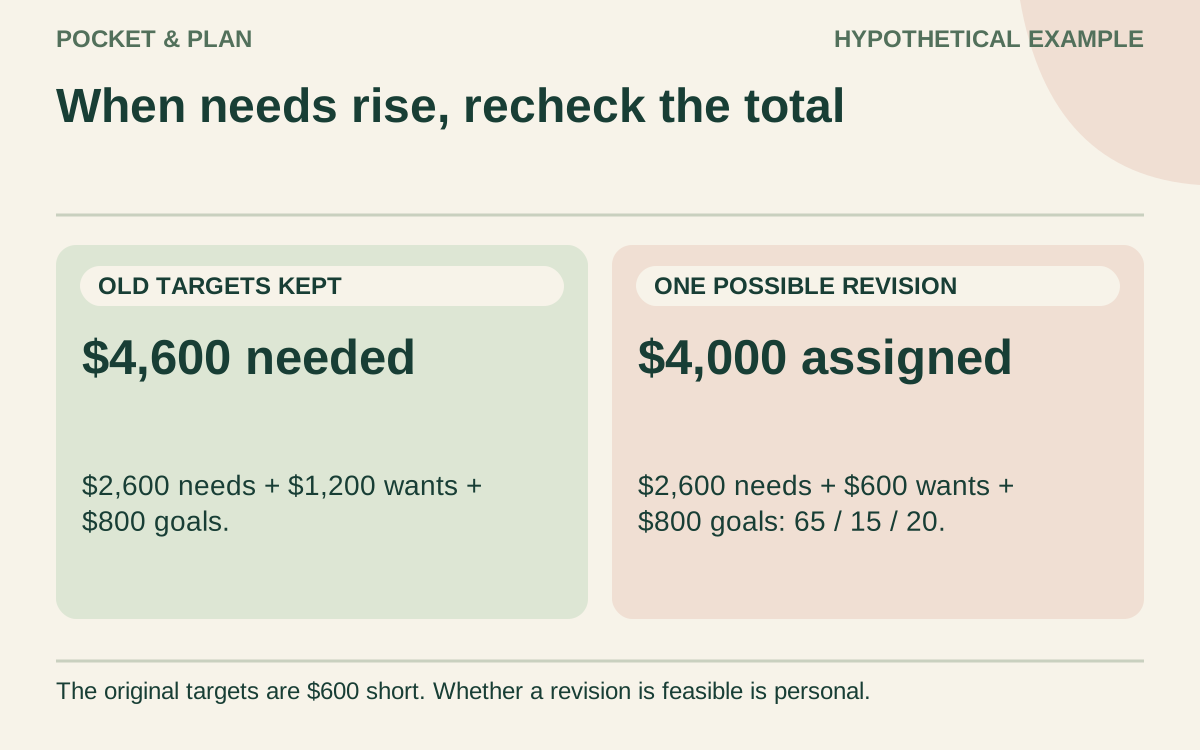
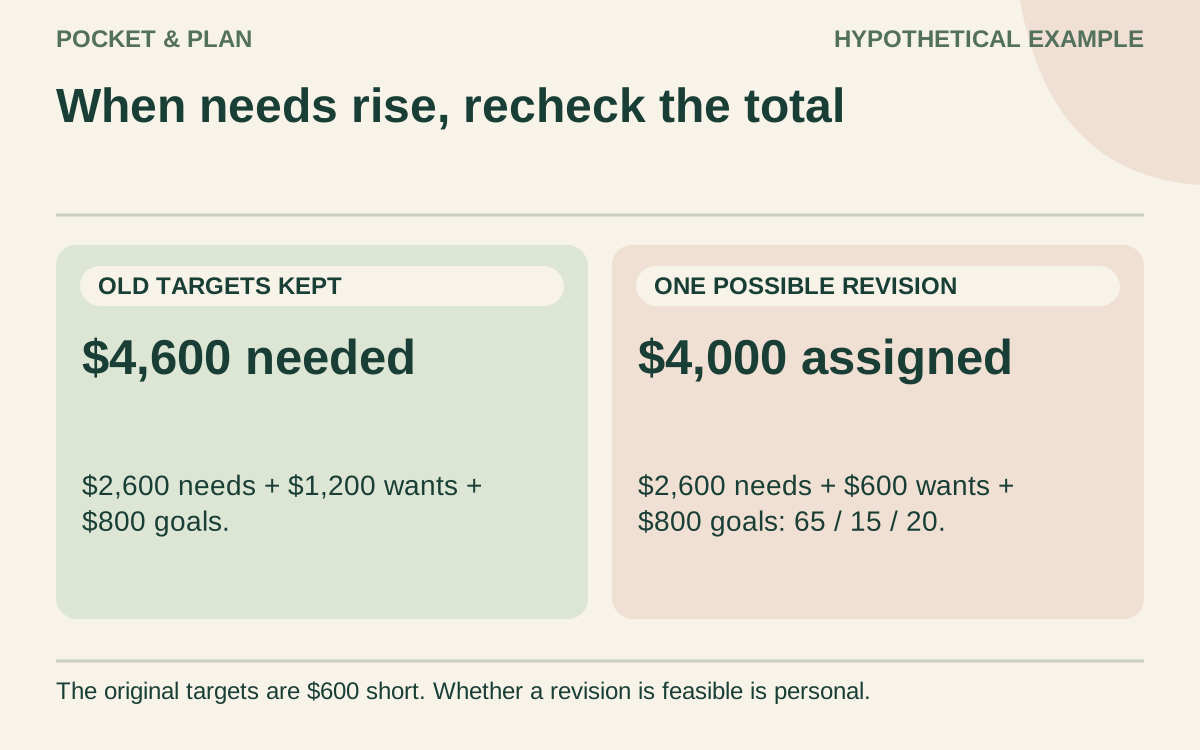
Now suppose this household’s essential costs rise to $2,600 while income remains $4,000. Needs now occupy 65%: $2,600 divided by $4,000. Keeping wants at $1,200 and goals at $800 would require $4,600, creating a $600 shortfall.
One hypothetical revision is $2,600 for needs, $600 for wants, and $800 for goals. It totals $4,000 and represents a 65/15/20 split. This shows the arithmetic of one adjustment; whether $600 of optional spending can be changed depends on the actual commitments.
Another household may need a different allocation. Relabeling an essential expense does not reduce its bill. If essential costs alone exceed available income, neither a new percentage nor more detailed categories closes the gap. The next step is to identify the shortfall and investigate concrete changes or available support.
Choose by the decision you keep missing
If you often wonder whether money in the account is already committed, try detailed zero-based assignments. If your challenge is seeing how much of the whole budget goes toward different priorities, the broad percentage view may be helpful. If maintaining too many categories stops you updating the plan, combine categories that do not need separate decisions.
Try the chosen structure for one complete income-and-bill cycle. Keep a brief note each time it fails to answer a question. For example, “the totals worked but rent came first” signals a timing issue. Our payday worksheet adds that calendar view. Consumer.gov’s monthly process also includes comparing actual spending with the plan before preparing the next month.
Run a final checklist before using either plan
- Income means the same thing throughout the worksheet; avoid mixing gross and take-home amounts.
- Every obligation and planned future cost appears somewhere, including irregular expenses.
- Existing reserves are identified so they are not mistaken for new income.
- Group totals match the detailed assignments without double counting.
- Available cash covers each payment on its actual date.
- Any revision has a specific amount and purpose, not just a different label.
Use the budget planner to check detailed totals. If you want a zero-based result, assign a remaining amount to a named purpose such as a buffer or future goal; do not reduce your cash balance to force zero. Keep the purpose breakdown beside the calculator so the result remains useful when you return to it.
Sources & verification
These primary reference sources support the guide. Worked examples are our own illustrations, not national averages or reported personal results.
- CFPB — Analyzing budgets teacher guide ↗Checked September 10, 2026
- CFPB — My spending rule to live by ↗Checked September 10, 2026
- Consumer.gov — Making a Budget ↗Checked September 10, 2026
Published · Last substantive update .
Found a factual error or a calculation that needs checking? Suggest a correction by email with this guide's link. The link opens a draft in your email app; you send it yourself. Contact details · Corrections policy