The short answer
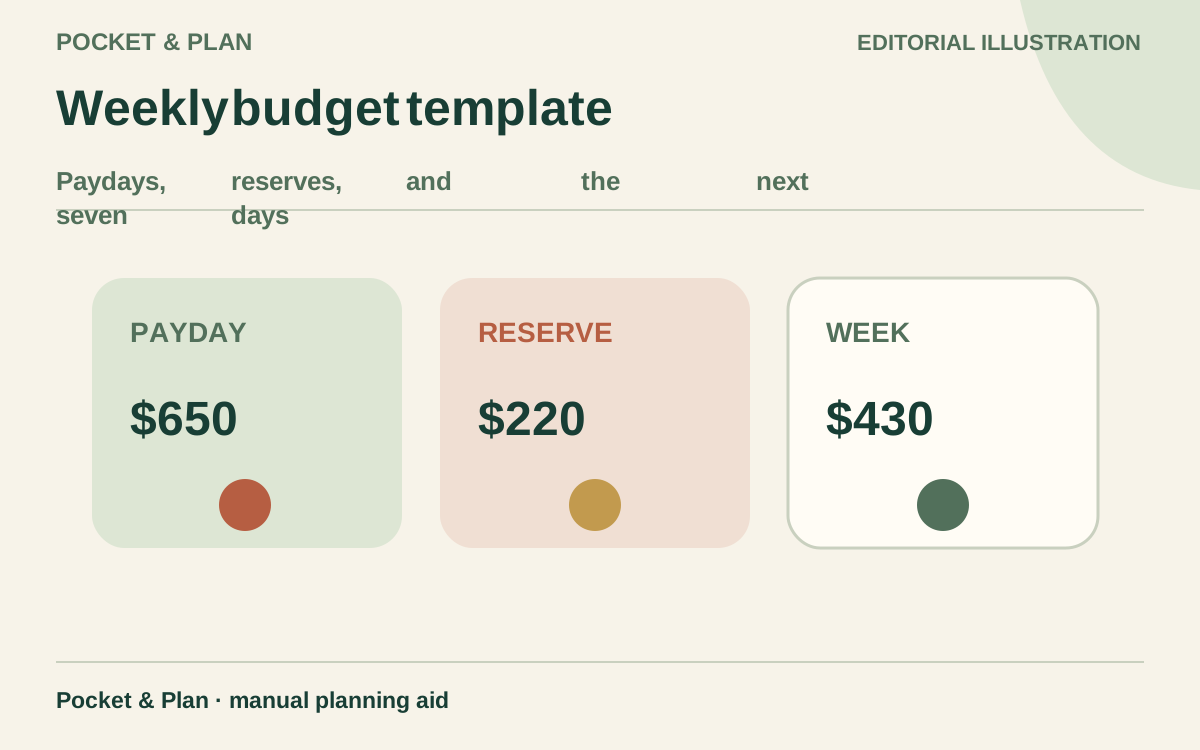
Give each weekly paycheck a plan while keeping monthly bill reserves separate from everyday spending and the average income shown in a monthly budget.
General educational guide. Sources checked September 11, 2026. Examples are illustrative; amounts should be adjusted to your household. Read our disclosure.
A weekly budget template gives each paycheck a job until the next payday while setting aside money for bills that arrive monthly. Use actual deposit dates, list the next seven days of spending, and keep the balance reserved for later bills visible. A four-week spending plan is not the same as a calendar month.
Download the weekly budget printable to record the payday, next payday, received pay, available carryover, assignments, and a separate monthly-bill reserve. It includes a four- or five-payday month overview and space for the next bill date. Print on US Letter paper in landscape orientation. This is a manual worksheet with no automatic formulas, deposits, or reminders.
Put the actual paydays on the month
Check your employer’s payroll calendar and your own deposit records. Write each expected date and amount, then mark the deposit received when it arrives. Note holidays, unpaid time, or changes in hours that affect the schedule or amount. A usual Friday payday is a starting assumption, not proof that every deposit will land on Friday.
For an illustrative Friday schedule with no adjustments, October 2026 has five paydays: October 2, 9, 16, 23, and 30. November has four: November 6, 13, 20, and 27. The October 30 paycheck must still cover needs before November 6 even though those dates cross a month boundary.
This guide is for pay received every week. If you are paid every two weeks, use the biweekly budget template; splitting that check into two weekly spending allowances does not create a second income payment.
Separate average monthly income from deposits
Suppose an invented household receives $650 of take-home pay on every scheduled weekly payday. A planning convention based on 52 checks gives $33,800 per year, or about $2,816.67 per month. That average does not mean $2,816.67 arrives in every calendar month.
| View of the same $650 paycheck | Calculation | Amount |
|---|---|---|
| Four-paycheck month | $650 × 4 | $2,600 |
| Five-paycheck month | $650 × 5 | $3,250 |
| Monthly average using 52 checks | $650 × 52 ÷ 12 | About $2,816.67 |
For an annual plan, count the actual scheduled checks. A calendar year contains more than exactly 52 weeks, so a particular payday weekday can occur 53 times. Holiday adjustments, employment dates, and the employer’s pay rules can also affect how many deposits appear within the year. Do not add a 53rd paycheck simply because it is mathematically possible.
Consumer.gov describes estimating monthly income from the prior year’s income when pay is not monthly. An estimate helps with the broad plan; actual dates and available balances determine whether this week’s payments can be covered.
Write one set of assignments for each paycheck
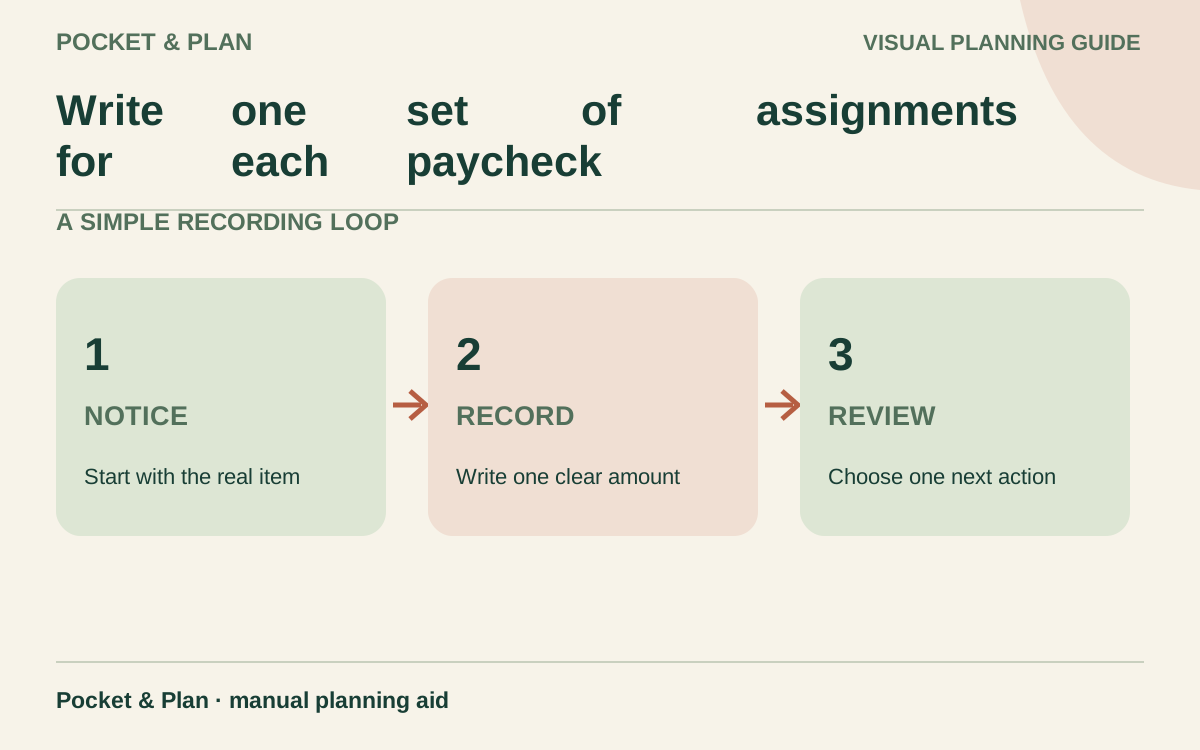
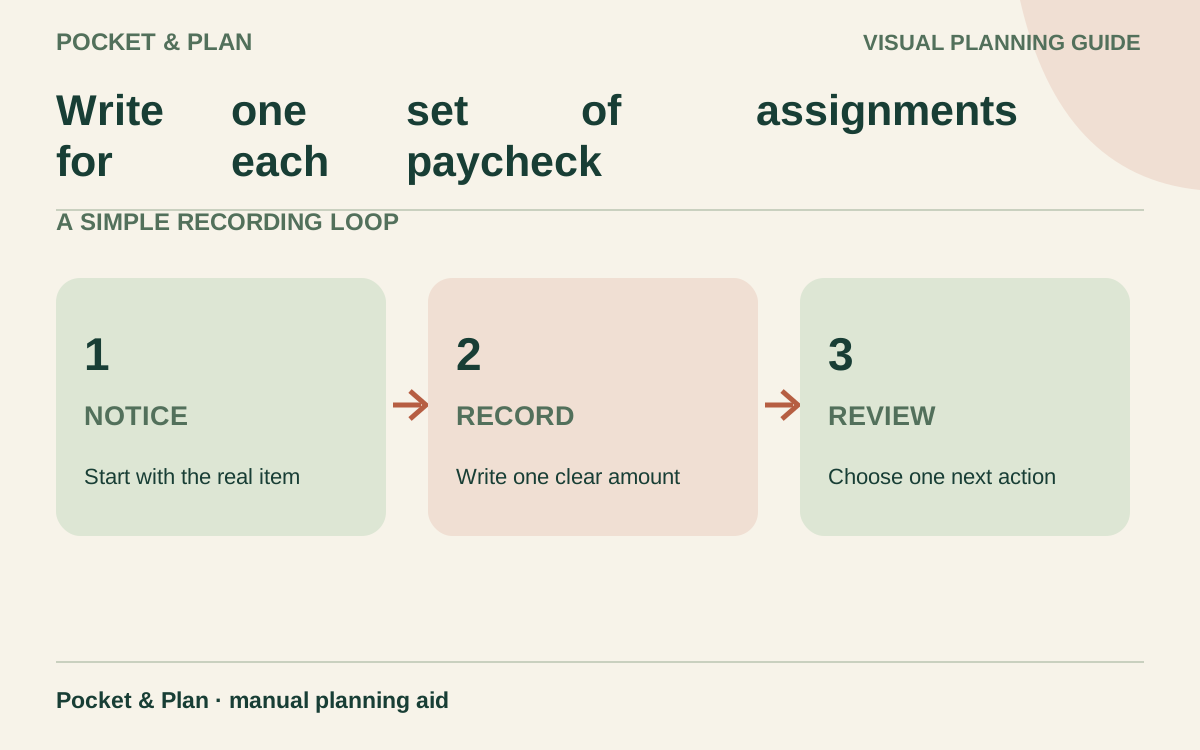
Start with received take-home pay plus genuinely unassigned carryover. Keep existing rent money or other reserved balances visible on their own lines instead of assigning them again as fresh income.
List everyday needs before the next deposit, payments due in that period, contributions toward later bills, and other funded goals. Add an unassigned remainder so an estimation error is visible. Use the monthly category checklist to find costs that disappear when you focus only on seven days.
One hypothetical $650 paycheck could be assigned as follows:
| Purpose | Assignment |
|---|---|
| Reserve for the next $1,300 housing payment | $325 |
| Groceries and transportation until payday | $175 |
| Other planned future costs | $50 |
| Another named savings goal | $60 |
| Optional spending | $25 |
| Unassigned buffer | $15 |
| Total | $650 |
These amounts illustrate the mechanics only. They are not recommended household costs. If the essential weekly amount is higher or another bill is missing, revise the whole assignment before relying on the $15 buffer.
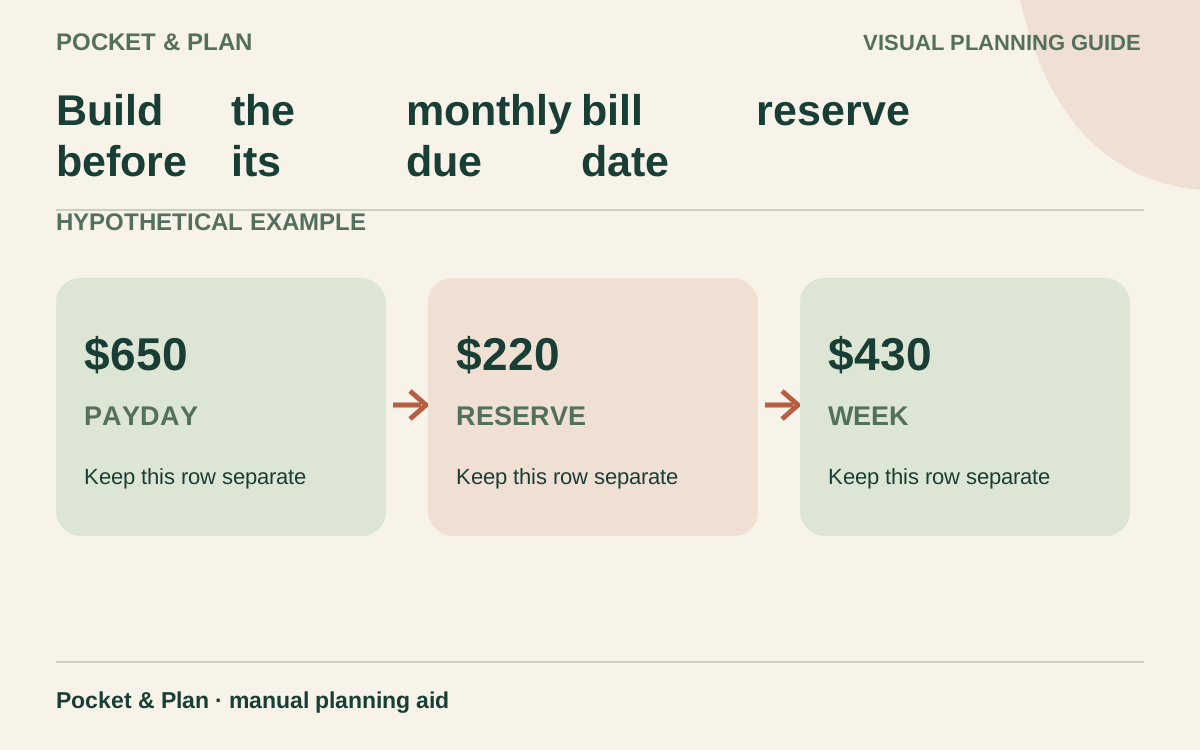
Build the monthly bill reserve before its due date
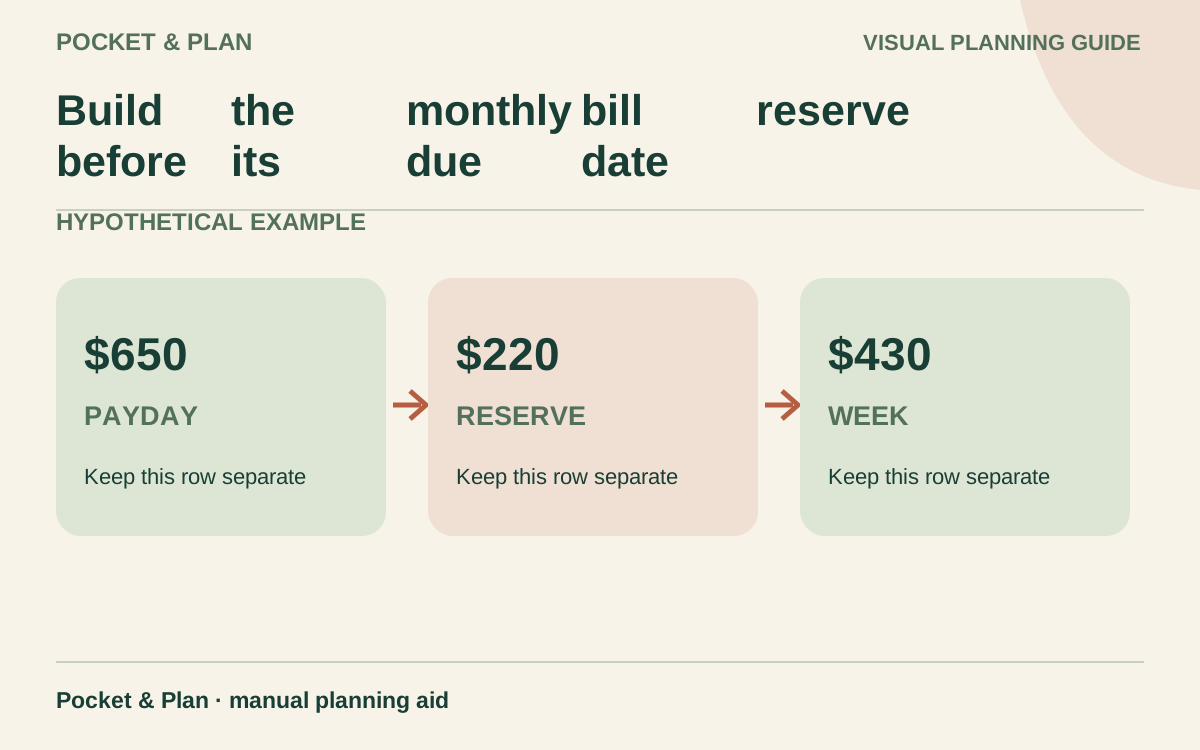
In this example, the $1,300 housing payment is due on the first of each month. Assume October’s payment was fully funded and paid from earlier money before the first October paycheck. The following reserve starts at zero after that payment; the October paychecks are preparing for November.
| October payday | Contribution | Housing reserve afterward |
|---|---|---|
| October 2 | $325 | $325 |
| October 9 | $325 | $650 |
| October 16 | $325 | $975 |
| October 23 | $325 | $1,300 |
| October 30 | $325 | $1,625 |
| November 1 payment | Subtract $1,300 | $325 |
The extra $325 stays identified as housing reserve. Four November contributions would add $1,300, producing $1,625 before a $1,300 December 1 payment, under the same assumptions.
Using $325 on all 52 paydays would set aside $16,900 against twelve $1,300 payments totaling $15,600. The $1,300 difference can build a buffer if affordable; it is not an unexplained surplus or a required saving rate. An annualized contribution of $300 would match that $15,600 total across 52 checks, but still needs a sufficient starting reserve and a date-by-date check. Do not confuse matching the year with covering the first bill.
Check the difficult week before spending a fifth paycheck
The fifth paycheck still needs to fund food, transportation, and its share of coming commitments. Under the sample assignment, $175 covers everyday needs and $325 strengthens the housing reserve before considering the remaining purposes. Calling all $650 “extra” would ignore those jobs.
Check the next month’s opening dates, particularly when a large bill falls before its first paycheck. The CFPB’s bill-calendar guidance recommends listing amounts and due dates and reviewing that calendar weekly. Use the bill tracker alongside the reserve rather than treating a reserved amount as a completed payment.
If you begin with no housing reserve and a $1,300 bill is due tomorrow, assigning $325 from this paycheck leaves a $975 shortfall for that bill. Future weekly contributions do not solve tomorrow’s gap. Record the immediate funding or payment-plan action needed instead of hiding it inside the monthly average.
Carry forward balances without counting income twice
At the next payday, record actual spending, confirm payments, and reconcile each reserve. Carry forward only what remains for its stated purpose. The $325 housing balance after November’s payment is existing reserved money, not a new $325 deposit.
Replace estimates when the facts change, and review any repeated shortfall in everyday spending. Keep one copy per paycheck with the month overview beside it. The useful outcome is a visible connection between seven-day spending, monthly commitments, and the money already set aside for both.
Sources & verification
These primary reference sources support the guide. Worked examples are our own illustrations, not national averages or reported personal results.
- CFPB — Bill Calendar: Know what you owe and when it is due ↗Checked September 11, 2026
- Consumer.gov — Making a Budget ↗Checked September 11, 2026
Published · Last substantive update .
Found a factual error or a calculation that needs checking? Suggest a correction by email with this guide's link. The link opens a draft in your email app; you send it yourself. Contact details · Corrections policy