The short answer
Plan seven days of meals around who needs food and when, assign any extra cooked portions to a specific later meal, and turn the calendar into a shopping list with quantities.
General educational guide. Sources checked September 11, 2026. Examples are illustrative; amounts should be adjusted to your household. Read our disclosure.
A weekly meal planner connects seven days of eating with the people, time, and ingredients available. Fill breakfast, lunch, dinner, and snack spaces; mark meals supplied elsewhere; then assign quantities to the meals your household will provide. Give planned leftovers a source meal, number of portions, and a safe storage plan.
Download the weekly meal planner template. The two-page manual printable has a seven-day calendar, a leftover plan, and a quantity-based shopping worksheet. Print both pages on landscape US Letter paper. It does not calculate portions, check nutrition or storage dates, or generate a shopping list automatically.
Count the meals your household will provide
Start with the calendar before choosing recipes. Add work shifts, travel, school arrangements, and evenings with little cooking time. “Away” should mean food supplied elsewhere, not simply eaten outside the kitchen: a packed lunch still needs ingredients from home.
In a hypothetical two-adult week, seven days × three main meals × two people creates 42 person-meal places. One workplace-provided lunch and a restaurant dinner for both people account for three places. The household therefore needs to supply 39 main-meal portions, plus whatever snacks and other food those people need.
That is a scheduling count, not a calorie target or portion recommendation. This example has 14 breakfasts, 13 lunches, and 12 dinners supplied from home. Adjust for appetites, ages, dietary requirements, guests, and meals that need more than one component.
The EPA recommends planning around actual meals, leftovers, and quantities. Use the count to check for missing meals before setting a grocery allowance in your household grocery budget.
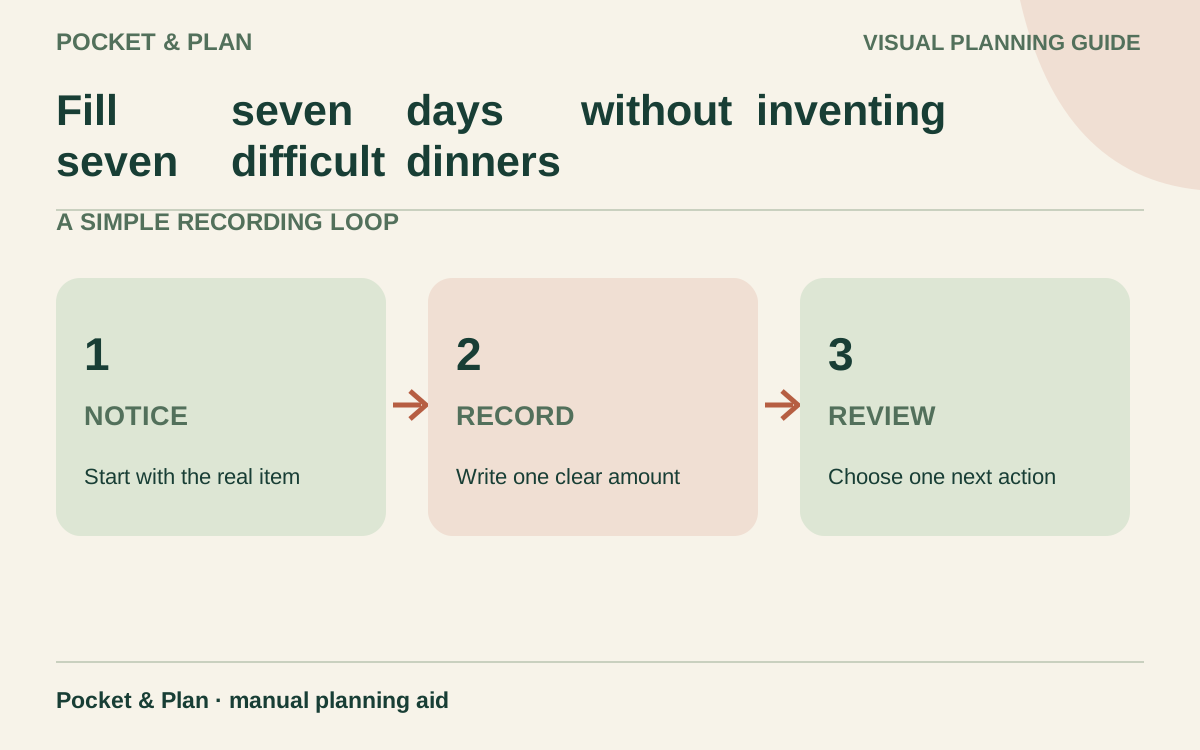
Fill seven days without inventing seven difficult dinners
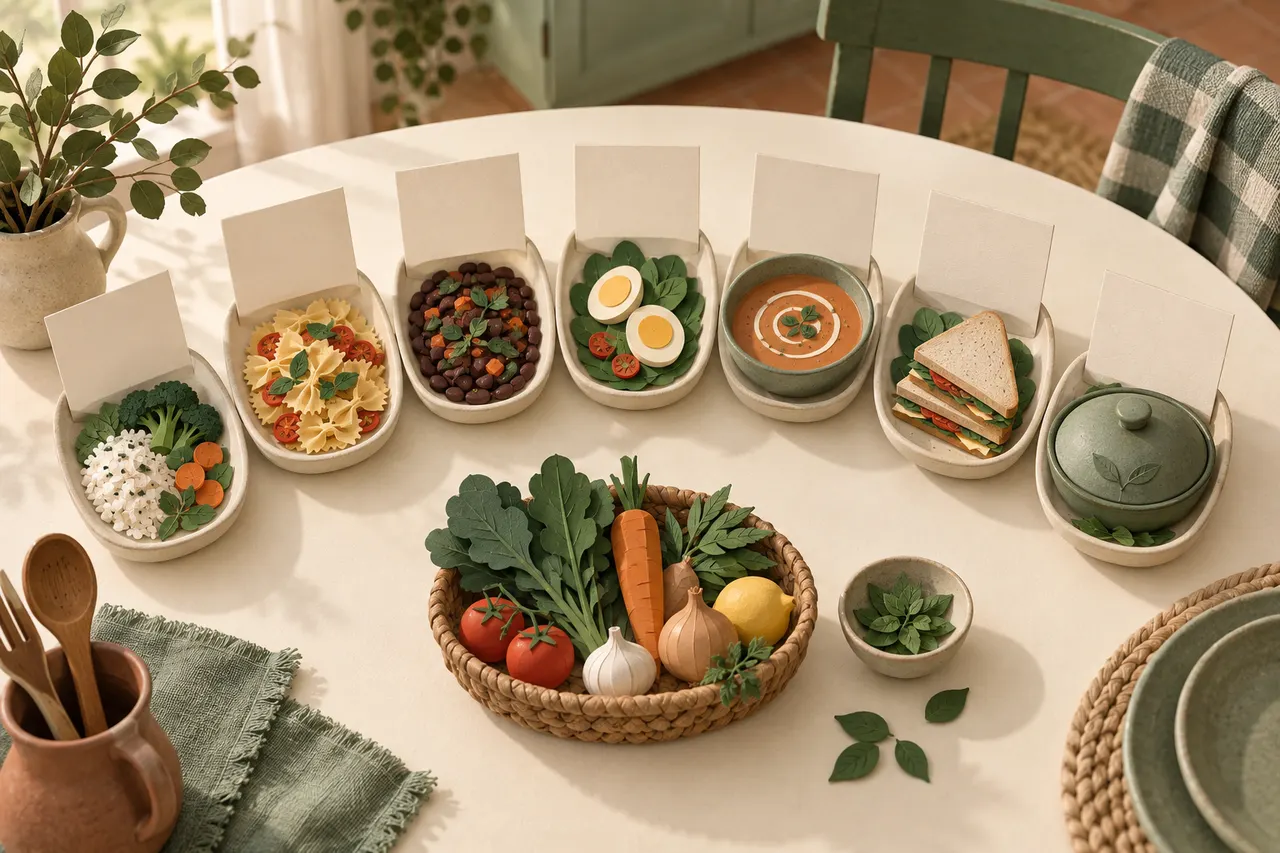
Use familiar meals and repeat breakfasts or lunches when that suits you. Label a genuinely easy option for a busy evening. The table below is an untested planning example; meal names are shorthand, not complete recipes or a nutritionally assessed menu. Add the ingredients and side dishes your household needs.
Every unmarked entry supplies two people. The snack choices also represent two people on each day and are separate from the 39 main-meal count.
| Day | Breakfast | Lunch | Dinner | Snack plan |
|---|---|---|---|---|
| Monday | Oats | Sandwiches | Lentil and vegetable soup; make four portions | Fruit |
| Tuesday | Yogurt breakfast | Two reserved Monday soup portions | Omelet meal | Crackers |
| Wednesday | Oats | One packed sandwich; one meal supplied at work | Pasta meal | Fruit |
| Thursday | Toast breakfast | Hummus wraps | Potato, vegetable, and bean tray meal; make four portions | Yogurt |
| Friday | Yogurt breakfast | Two reserved Thursday tray-meal portions | Restaurant meal for both | Fruit |
| Saturday | Eggs and toast | Freshly prepared baked-potato meal | Bean wraps | Crackers |
| Sunday | Oats | Sandwiches | Two previously safely frozen meal portions | Fruit |
Confirm the Sunday freezer meal exists and identify it before counting it. If it does not, choose another meal and add its ingredients. The pantry guide can help turn overlooked stock into a specific assignment.
Assign each extra cooked portion once
For Monday’s soup, plan four suitable portions: two for dinner and two for Tuesday lunch. Thursday follows the same pattern for Friday lunch. Write the date prepared and the intended later meal on the container and planner.
| Source meal | Portions prepared | Eaten at source meal | Reserved | Later use |
|---|---|---|---|---|
| Monday soup | 4 | 2 | 2 | Tuesday lunch |
| Thursday tray meal | 4 | 2 | 2 | Friday lunch |
| Total for these two batches | 8 | 4 | 4 | Four already-counted lunch portions |
The four reserved portions are part of the week’s 39 main-meal portions. They are not four extra meals to add to that number, and they cannot also supply another dinner. If someone eats a reserved portion early, update the affected lunch immediately.
Plan storage before cooking. The FDA advises prompt chilling: perishable food should not remain at room temperature beyond two hours, or one hour above 90°F. Keep the refrigerator at 40°F or below. Discard food that exceeds those limits; a later reheating step does not correct unsafe storage.
FoodSafety.gov’s storage chart gives refrigerated soups and stews a three-to-four-day limit. The next-day soup assignment fits that limit only with proper handling. Check the actual dish and product instructions for other meals. Reheat leftovers to 165°F, measured with a food thermometer, as shown in the safe-temperature chart.
Convert the calendar into quantities to purchase
Review each chosen recipe and repeated food, combine the quantities, then subtract stock available for this week. Keep dry and cooked weights separate. Do not subtract ingredients already reserved for another use.
The following excerpt uses arbitrary amounts for calculation practice. It covers five foods only, so it is not the complete shopping list for the calendar:
| Selected food | Example requirement | Available | Package or quantity purchased | Remainder after planned uses |
|---|---|---|---|---|
| Dry oats | Six breakfast portions × 40 g = 240 g | 100 g | 500 g | 360 g |
| Yogurt | Four breakfasts plus two snacks × 150 g = 900 g | 300 g | 600 g | 0 g |
| Tortillas | Four wrap-meal portions × two = 8 | 2 | 10 | 4 |
| Eggs | Four meal portions × two = 8 | 3 | 12 | 7 |
| Apples for fruit snacks | Four days × two = 8 | 2 | 6 | 0 |
The oats require only 140 g more, yet the example purchase is a 500 g package. The remaining 360 g belongs to later meals. Calculate the full shopping list in the same way, including the other breakfast components, sandwich fillings, recipe ingredients, seasonings, and drinks you need.
For a deeper example of package cost versus ingredients used, see the three-dinner budget meal plan. This weekly calendar handles the broader schedule rather than repeating that dinner-cost calculation.
Review changes before the next shopping trip
Make a brief midweek check: who is now away, which portions remain, and which food needs a revised use? Move a meal only when its ingredients and storage limits permit. Choose freezing while food is still safe when appropriate; the planner itself cannot determine that.
At week’s end, cross out meals that did not happen and note why. Carry forward usable ingredients with quantities, then change one recurring problem: an overlarge batch, an unrealistic evening, or a missing lunch. Keep the calendar flexible enough to follow while making its shopping implications visible.
Sources & verification
These primary reference sources support the guide. Worked examples are our own illustrations, not national averages or reported personal results.
- EPA — Preventing Wasted Food At Home ↗Checked September 11, 2026
- FDA — How to Cut Food Waste and Maintain Food Safety ↗Checked September 11, 2026
- FoodSafety.gov — Cold Food Storage Chart ↗Checked September 11, 2026
- FoodSafety.gov — Cook to a Safe Minimum Internal Temperature ↗Checked September 11, 2026
Published · Last substantive update .
Found a factual error or a calculation that needs checking? Suggest a correction by email with this guide's link. The link opens a draft in your email app; you send it yourself. Contact details · Corrections policy