The short answer
Build a dated budget for one trip, count booking advances only once, and compare unpaid costs plus a reserve with money actually available for the relevant deadlines.
General educational guide. Sources checked September 11, 2026. Examples are illustrative; amounts should be adjusted to your household. Read our disclosure.
A vacation budget should show the full cost of one trip, what you have already paid, what remains payable, and when each remaining payment is needed. Add a separate reserve for unresolved costs. Compare the money required by each deadline with funds available by that date, rather than relying only on the trip’s eventual savings target.
Use your own quotes, booking records, and household circumstances. This checklist uses a single declared currency, US dollars, for an invented example. It does not recommend destinations, estimate current travel prices, or assume an exchange rate.
Download the vacation budget PDF for a cost list and dated cash plan. Enter booking advances within their full booking total, and start the cash plan with unspent money after earlier payments. This is a manual worksheet for handwriting, with no automatic calculations. Print on US Letter paper in the orientation shown on the file.
Define the trip before collecting prices
Write the travel dates, number of travelers, number of nights, and who is included in your budget. State whether the plan covers the whole party or only your household’s share. Those choices determine whether a quoted amount belongs in the total once, per traveler, per night, or per booking.
List the parts that apply: transportation, lodging, local travel, meals, chosen activities, and any extra arrangements at home. Check the scope of a package before adding separate lines for meals or transfers it already includes.
Keep ordinary household commitments visible in your monthly budget categories. Going away does not automatically release rent or other continuing expenses for the trip. Add an extra travel-related household cost here only if it is not already funded elsewhere.
Record estimates with a source and date. A blank cost means more information is needed; enter 0 only when you have verified that no payment is required.
Check each booking’s full terms
Before treating an offer as a usable budget figure, identify the actual provider, the booking seller, what is included, and what remains to be confirmed. The FTC’s travel guidance recommends obtaining cancellation and refund policies before paying and checking who is selling the travel service.
Keep a source record with the booking reference, full charge, taxes and applicable extras, payment schedule, and cancellation instructions. If a condition is unclear, write the question and the person or business that needs to answer it. Do not translate a label such as “flexible” into an assumed refund amount.
For a quoted nightly rate, verify the number of nights and the total shown for your actual stay. For per-person costs, check the number of people covered. Separate optional upgrades from the option you are currently budgeting so both versions do not accidentally enter the total.
Use one currency in the working total. For other currencies, keep the original amount and currency in the source record and document a dated conversion and relevant charges before combining figures. The example contains no foreign-currency items.
Separate total cost from amounts already paid
Use these fields for each obligation: item, estimated or confirmed total, confirmed paid to date, remaining amount, payment date, and source or next action. The paid amount is cumulative for that obligation.
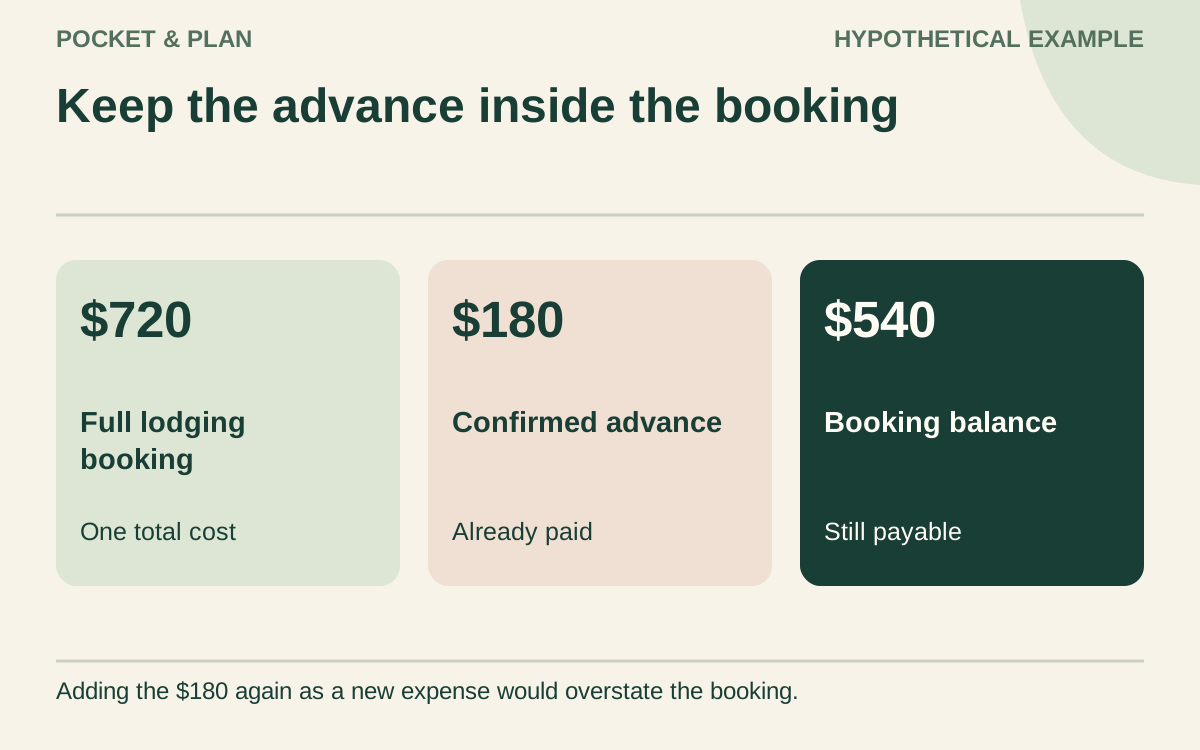
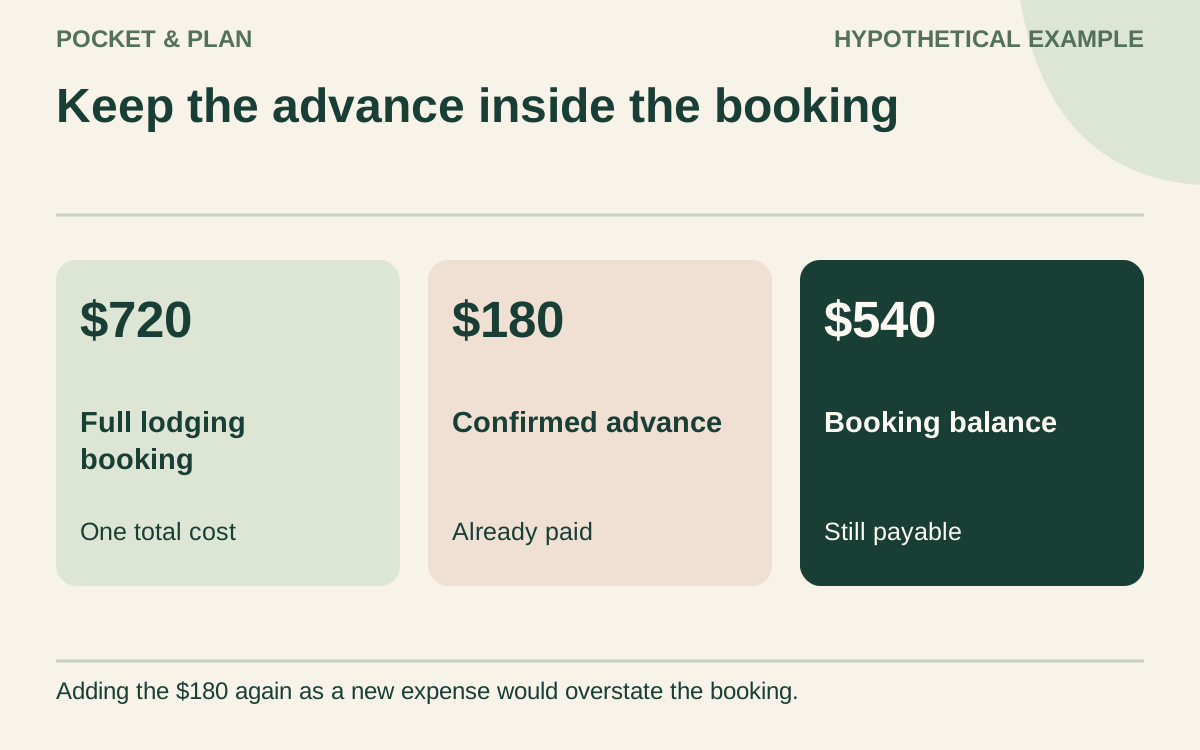
An advance credited toward a booking belongs inside its full cost. For example, a hypothetical lodging booking totaling $720 with $180 already paid leaves $540 payable. Adding the $180 advance as another expense would incorrectly turn a $720 booking into $900.
A refundable security deposit is different from an advance credited to the bill. If one applies to your booking, list the money temporarily required separately from spending and verify its terms. Do not subtract an expected return from an earlier payment requirement. The worked example assumes no separate security deposits or card holds.
For installments, give each remaining installment its own amount and date beneath the same booking. Their combined balance must equal the booking’s unpaid amount. Do not assign the full balance to every installment date. The bill tracker can help organize confirmed payments and evidence alongside this plan.
Work through one complete trip budget
Imagine a household records this USD-only trip as of October 1. All figures and dates are hypothetical, all payments listed as paid are confirmed, and the working totals include the applicable charges assumed for this example.
| Item | Working total | Paid by Oct 1 | Still needed | Remaining payment date |
|---|---|---|---|---|
| Main transportation | $480 | $480 | $0 | Already paid |
| Lodging | $720 | $180 | $540 | October 10 |
| Local transportation | $120 | $0 | $120 | October 20 |
| Meals | $240 | $0 | $240 | October 20–23 |
| Activities | $90 | $30 | $60 | October 15 |
| Extra care at home | $60 | $0 | $60 | October 19 |
| Total payments | $1,710 | $690 | $1,020 | Check each date |
| Unspent reserve | $190 | $190 | Keep available | |
| Total funding target | $1,900 |
The cost lines total $1,710. Confirmed payments of $690 leave $1,020, and the $190 reserve raises the full funding target to $1,900. The reserve is available money, not an expense already incurred.
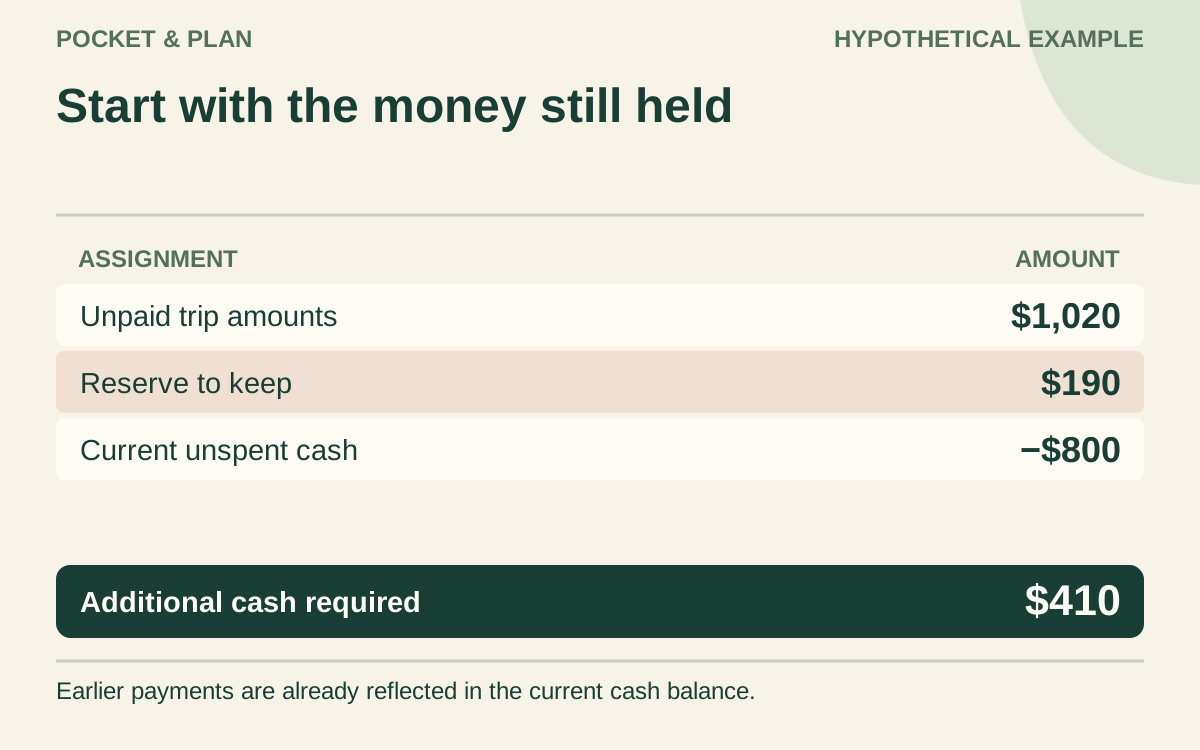
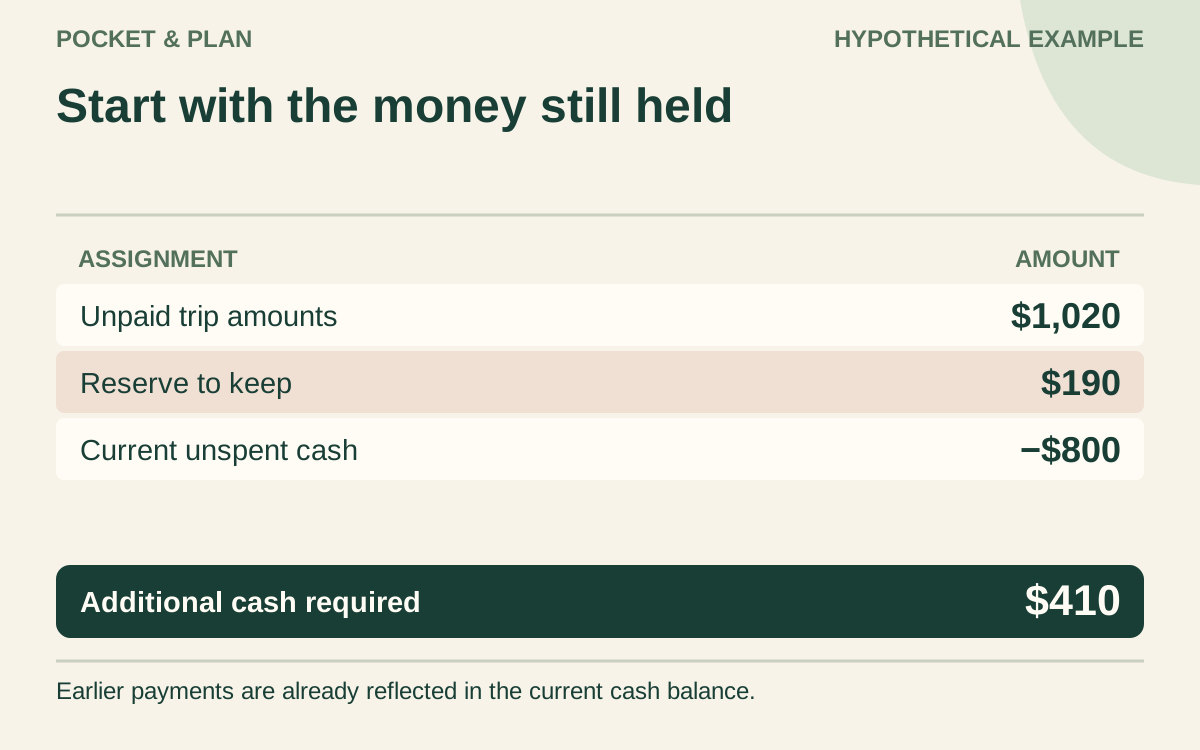
Suppose the household currently has $800 of unspent trip money, after making the $690 of payments. Its remaining requirement is $1,020 plus $190, or $1,210. The additional gap is $410. Subtracting the paid $690 again from that $1,210 would count the same payments twice.
Test the payment calendar before committing more
The CFPB cash-flow tool uses successive periods to connect available money with expenses as they occur. Apply that timing check to the unpaid trip amounts, while keeping everyday bills funded separately.
In the example, paying $540 on October 10 leaves $260 of the current $800. Paying the next $60 on October 15 leaves $200, still covering the $190 reserve. The later unpaid costs total $420. Another $410 must arrive before those purchases if the household is to finish them and retain the reserve.
If that $410 is confirmed received on October 18, the balance becomes $610. The $60 care payment leaves $550; the remaining $120 transport and $240 meals leave $190. The sequence works under these assumptions. An anticipated contribution arriving after the meals would not solve the earlier shortage.
Use the savings tracker for actual contributions. Keep future income, possible reimbursements, and pending refunds marked as forecasts until received.
Close bookings and reconcile after the trip
Replace estimates with final charges, retain receipts, and check that installments add up to each booking’s total. Record any cancellation request separately from a confirmed cancellation or completed refund; follow the specific policy you saved.
Reconcile remaining reserve with unspent trip money and assign it deliberately. Keep notes about missing cost categories for the next trip, while using fresh quotes for its amounts. This closes one trip’s record without allowing unresolved refunds or old estimates to become the next trip’s available budget.
Sources & verification
These primary reference sources support the guide. Worked examples are our own illustrations, not national averages or reported personal results.
- FTC — Avoid Scams When You Travel ↗Checked September 11, 2026
- CFPB — Creating a cash flow budget tool ↗Checked September 11, 2026
Published · Last substantive update .
Found a factual error or a calculation that needs checking? Suggest a correction by email with this guide's link. The link opens a draft in your email app; you send it yourself. Contact details · Corrections policy