The short answer
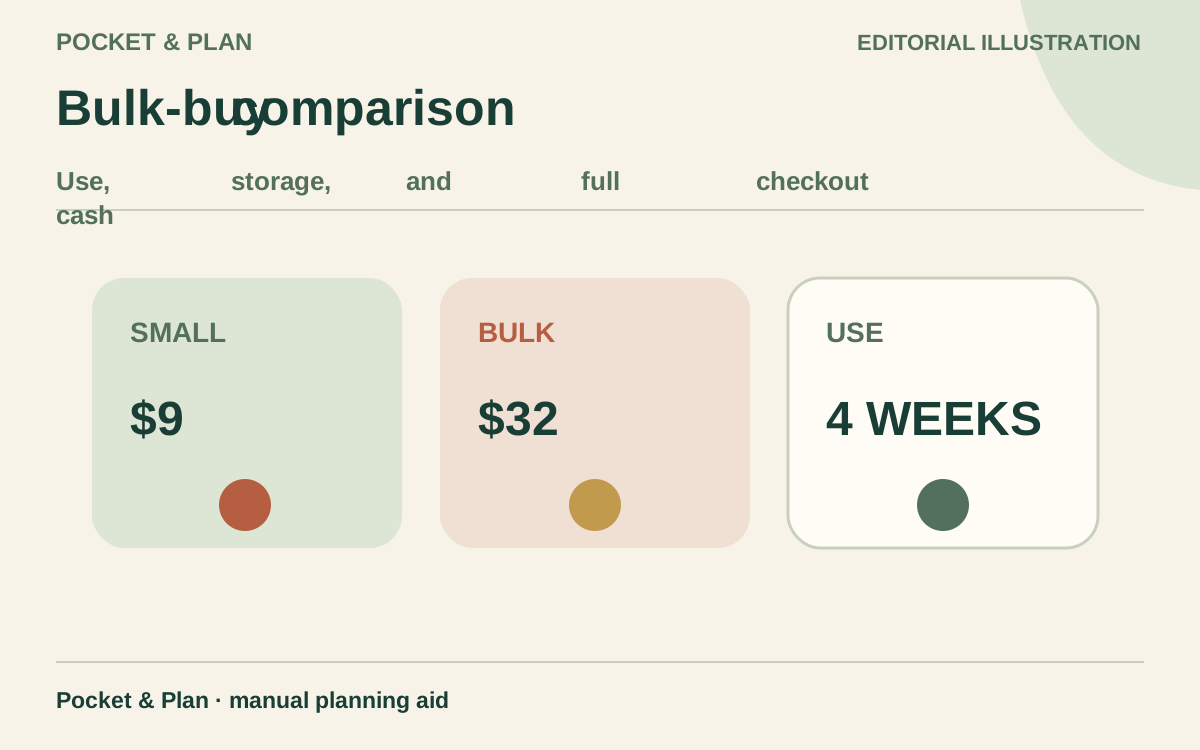
Compare a bulk purchase with the smaller quantities you would actually buy, allowing for storage, expected use, extra costs, and money tied up in remaining food.
General educational guide. Sources checked September 11, 2026. Examples are illustrative; amounts should be adjusted to your household. Read our disclosure.
Buying in bulk can be cheaper when the food replaces purchases you would otherwise make, you can store and use it, and the price advantage covers any extra costs. A lower price per pound alone does not settle the decision. You also need the full purchase amount available today.
Use the printable bulk-buy comparison worksheet for one item and a chosen time window. It is a manual worksheet: enter your own observations and calculate the results. Every price below is invented to explain the method, not a current offer or a promised saving.
Choose a use window and check your storage
Start with four weeks, six weeks, or another period your household can realistically plan. Estimate consumption from recent use, allowing for travel and meals away. Subtract suitable food already at home to find the amount you still need. Having room for a large package does not mean you need its contents.
Write down where the purchase will go and how you will handle it after opening. Check the product’s storage directions and whether suitable containers or freezer space are available. EPA recommends checking existing food before shopping, planning quantities around meals, and labeling stored grains in airtight containers. Its advice supports matching the purchase to a practical use plan.
Use your meal plan for two to assign quantities to meals. If expected use depends on suddenly eating an unfamiliar food every day, try a smaller package first.
Compare equivalent products in the same unit
Check product type, dietary requirements, edible quantity, and offer conditions. Compare dry rice with equivalent dry rice, for example, rather than comparing dry weight with prepared weight.
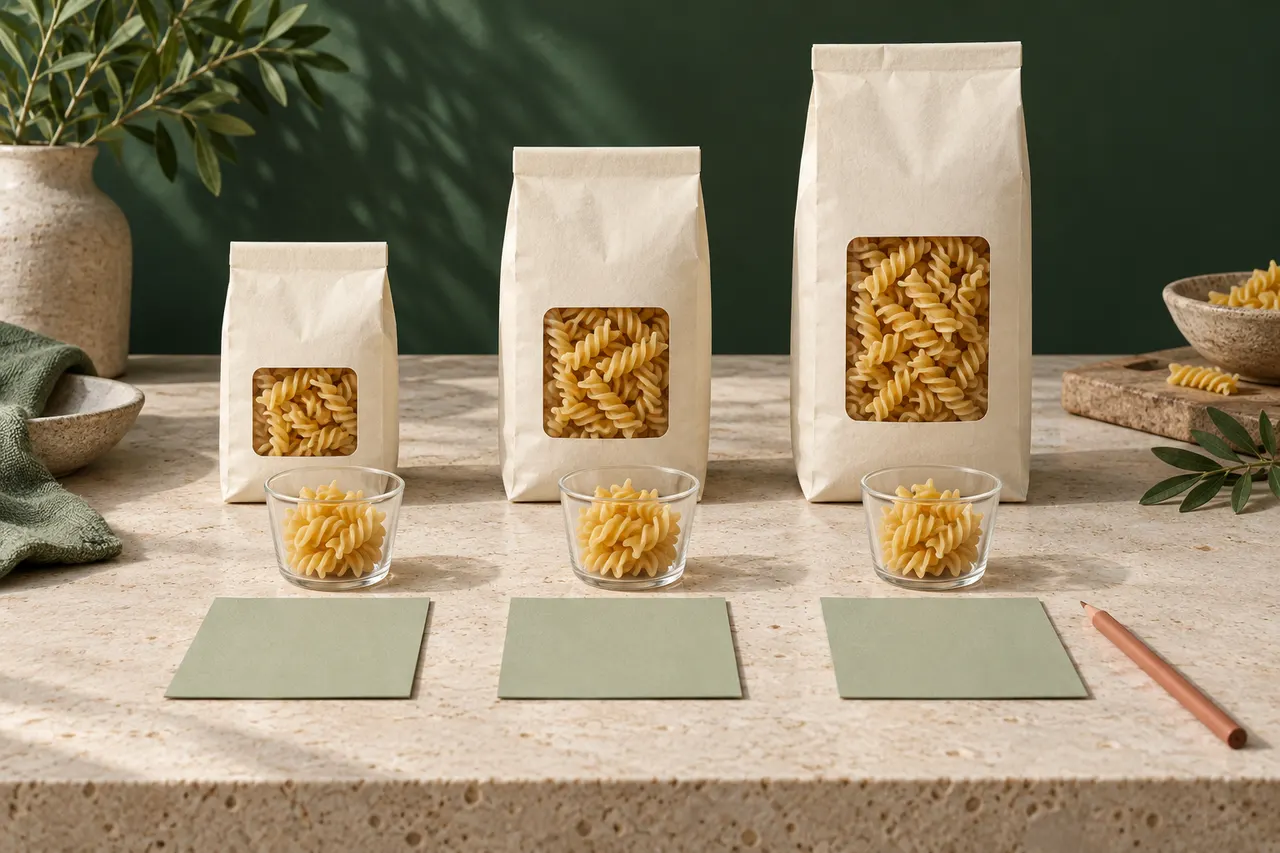
NIST explains that unit pricing expresses the price for a consistent measure, such as an ounce or gram. Divide each package’s price by its quantity using the same unit. Your grocery price book can hold the dated prices and qualifying conditions.
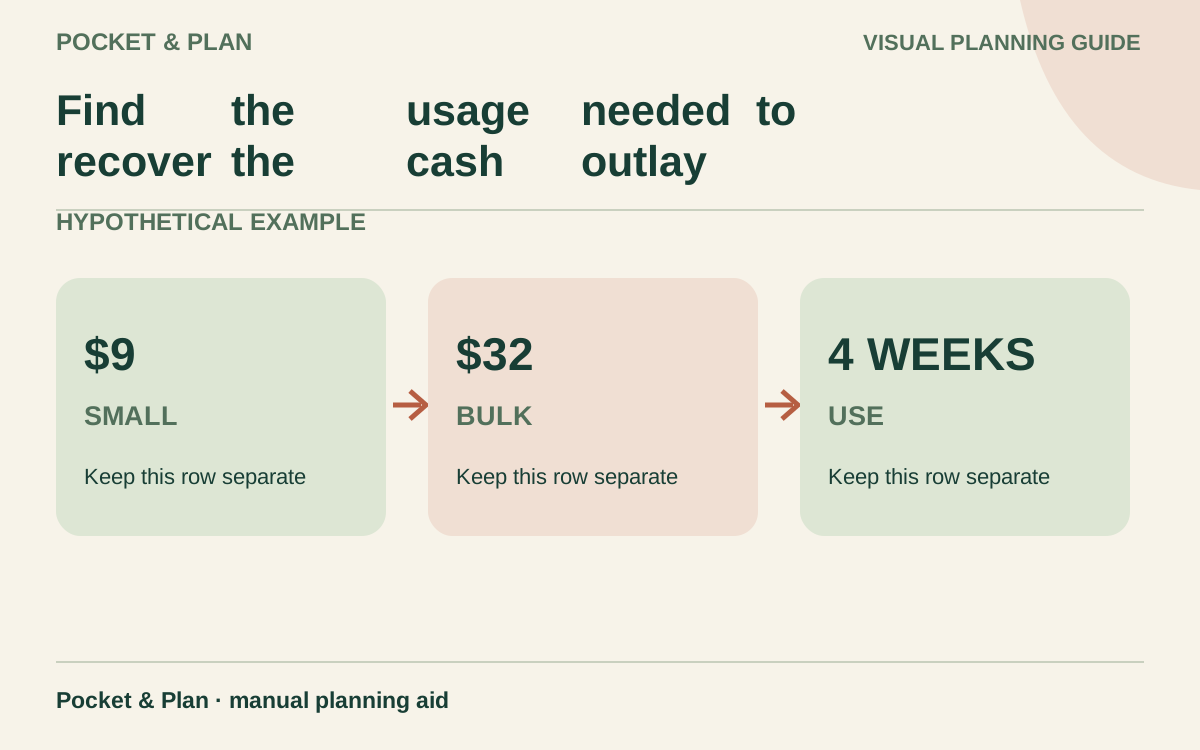
Suppose equivalent oats cost $7.50 for a 5-pound bag or $2.50 for a 1-pound bag. The package unit prices are $1.50 and $2.50 per pound. Assume these are complete item charges, with no additional tax or discounts. Add any actual charges consistently when replacing the example.
Separate checkout cash from food used and remaining stock
Assume no starting oats, four pounds eaten within four weeks, and suitable storage for the remainder. Buying the bulk bag also requires $2.50 of extra travel spending that buying small bags would avoid. No other extra costs apply.
| Four-week comparison | One bulk bag | Four small bags |
|---|---|---|
| Quantity purchased | 5 lb | 4 lb |
| Food checkout cost | $7.50 | $10.00 |
| Extra travel cost | $2.50 | $0.00 |
| Total cash outflow | $10.00 | $10.00 |
| Quantity eaten | 4 lb | 4 lb |
| Purchase cost of food eaten | $6.00 | $10.00 |
| Usable food remaining | 1 lb | 0 lb |
| Remaining food at purchase cost | $1.50 | $0.00 |
The bulk outflow reconciles as $6.00 eaten + $1.50 still in stock + $2.50 extra travel = $10.00. Its food-used cost plus extra travel is $8.50. Both choices require $10.00 across the window, although the smaller purchases can be spread across shopping dates.
The remaining $1.50 is food, not available cash. It is also not automatically waste. If it stays usable and replaces a later purchase, carry it into the next plan. If it becomes unusable and is discarded, record $1.50 of waste instead; the original $10.00 outflow does not change. Keep the full payment inside your grocery budget.
Find the usage needed to recover the cash outlay
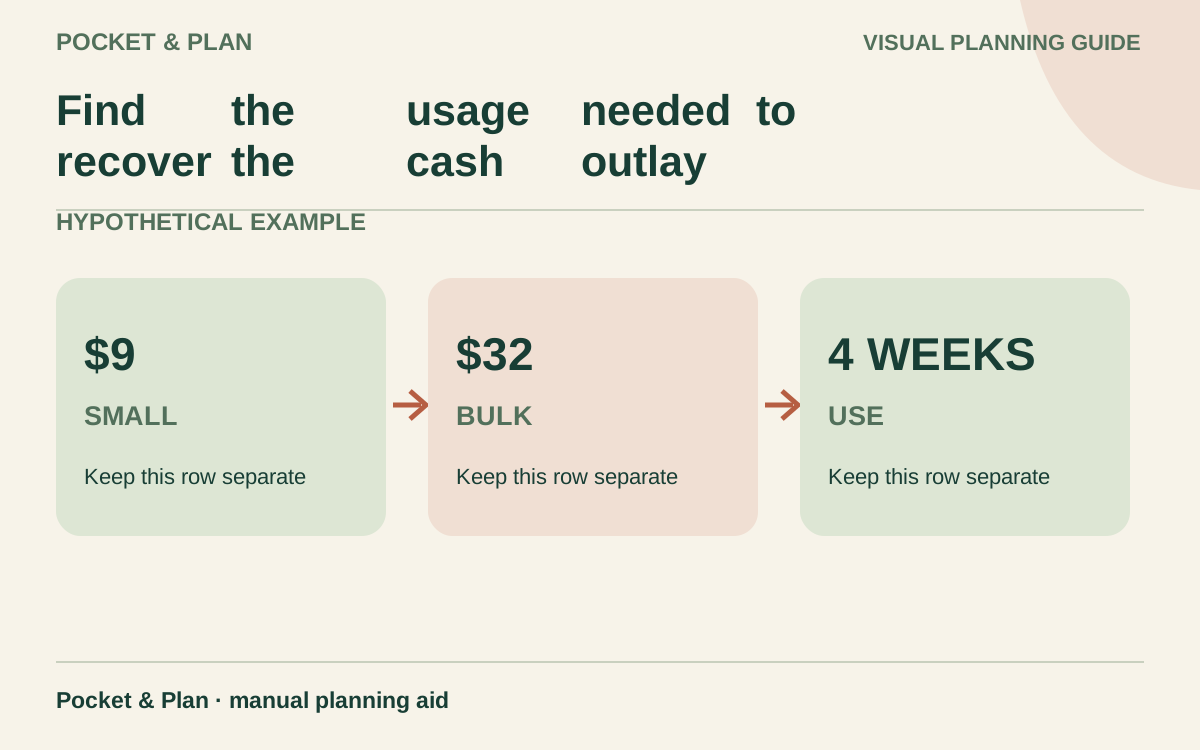
For a conservative comparison, ask how much you must use before equivalent smaller purchases would cost the bulk outflow. Give remaining stock zero credit in this particular calculation; that is a planning assumption, not a declaration that the stock is worthless.
Bulk food price plus avoidable extras ÷ smaller-option cost per pound = cash-recovery quantity.
Here, ($7.50 + $2.50) ÷ $2.50 = 4 pounds. At that usage, cash outflows tie. More than four pounds must replace smaller purchases for the bulk choice to reduce cash spent under these assumptions.
| Quantity used from the 5-pound bag | Equivalent small-bag spending | Bulk outflow | Bulk cash difference |
|---|---|---|---|
| 3 lb | $7.50 | $10.00 | $2.50 more |
| 4 lb | $10.00 | $10.00 | Equal |
| 5 lb | $12.50 | $10.00 | $2.50 less |
These rows use whole 1-pound packages and the same fixed extra travel cost. For a fractional need, calculate the smaller packages actually required; a theoretical price for 3.4 pounds is not a checkout option when only whole bags are sold. If the calculated recovery quantity exceeds the entire bulk package, this purchase cannot recover its outlay on that basis.
Count membership and travel costs only once
Separate a purchase decision from a membership decision. If a membership is already paid, nonrefundable, and would be kept regardless of this purchase, its incremental cost for this shop is zero. You can separately allocate part of its cost to groceries for household reporting, but do not add that allocation as another cash payment.
If joining or renewing is required specifically for the proposed shopping plan, include the avoidable fee when evaluating that plan. A hypothetical $60 fee paid now is $60 of cash now; dividing it into $5 monthly allocations does not change the payment date. Assess it against the realistic annual basket, not one hoped-for bargain, and count the fee only once across items.
Use the same principle for travel: include the additional fuel, fare, parking, or delivery spending caused by choosing bulk. Do not charge the entire ordinary shopping trip if both options require it. Note extra time separately, and include necessary new storage supplies.
Make the decision and review what happened
Buy the larger package when its quantity, storage needs, payment timing, and full cost fit the plan. A smaller pack can still be the workable choice when available grocery cash is tight or future use is uncertain. Do not increase consumption just to make a calculation appear successful.
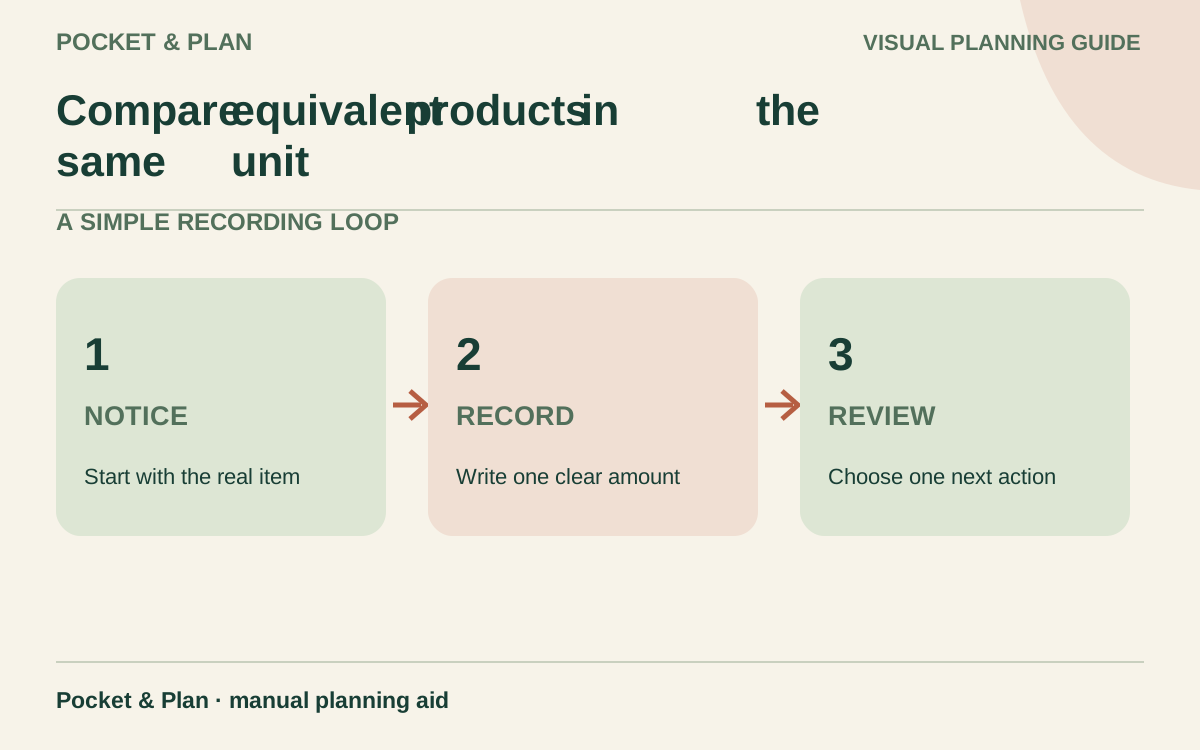
At the review date, record actual quantity used, usable stock remaining, discarded quantity, and unplanned costs. Give remaining food a specific next use. These observations make the next bulk decision more reliable than repeating a package-size rule.
Sources & verification
These primary reference sources support the guide. Worked examples are our own illustrations, not national averages or reported personal results.
- NIST — Uniform Unit Pricing: Tools for Consumers to Fight Shrinkflation ↗Checked September 11, 2026
- EPA — Preventing Wasted Food At Home ↗Checked September 11, 2026
Published · Last substantive update .
Found a factual error or a calculation that needs checking? Suggest a correction by email with this guide's link. The link opens a draft in your email app; you send it yourself. Contact details · Corrections policy