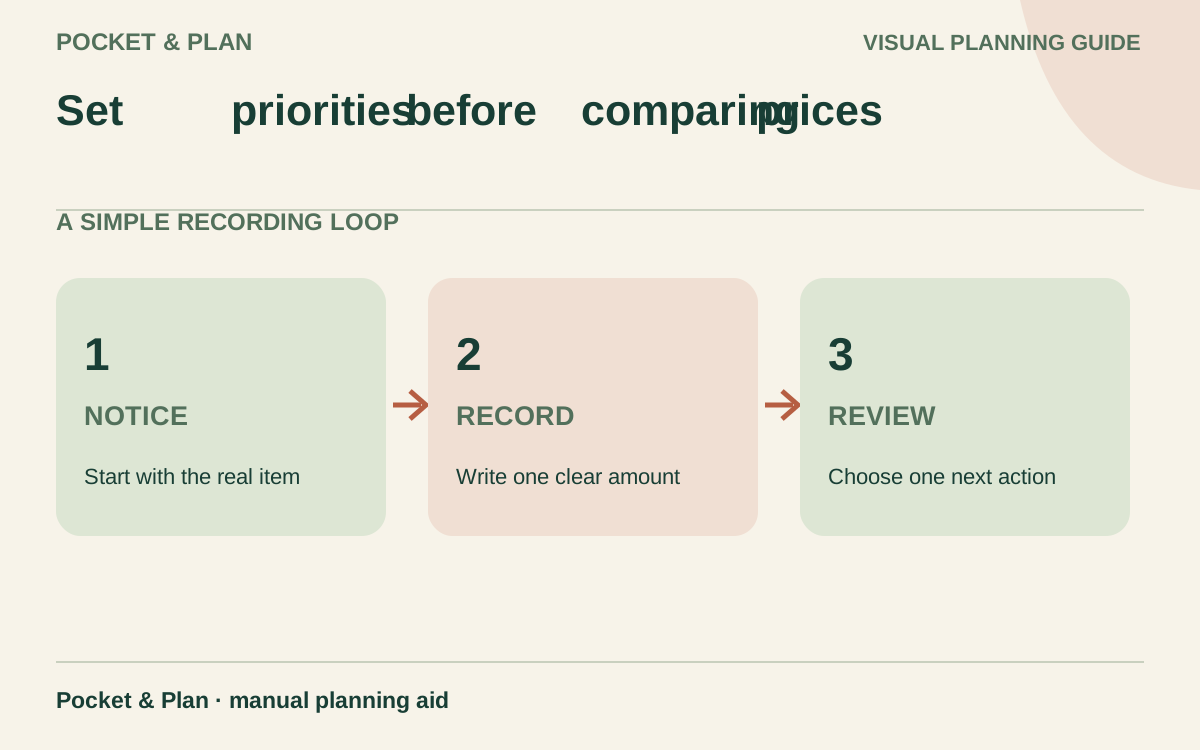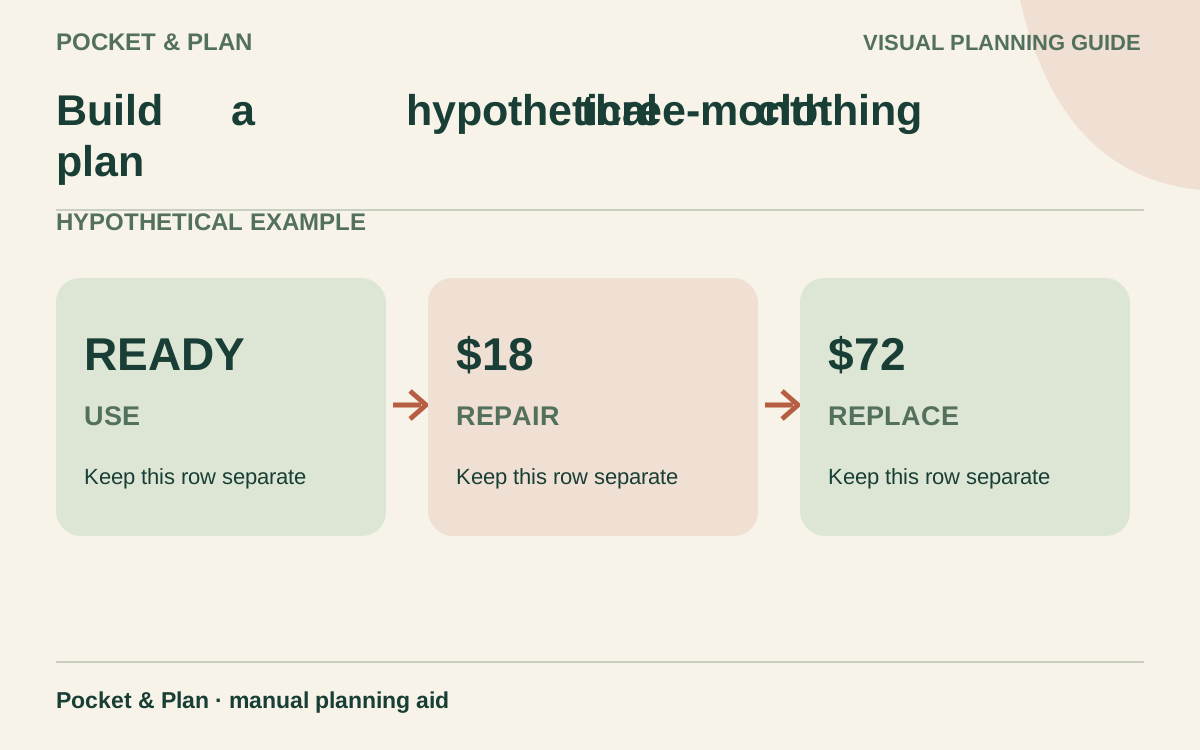
The short answer
Separate usable clothes from genuine wardrobe gaps, compare repair and replacement, and put each planned purchase on a funding calendar.
General educational guide. Sources checked September 11, 2026. Examples are illustrative; amounts should be adjusted to your household. Read our disclosure.
A clothing budget starts with the clothes you can use and the specific gaps you need to fill. Identify the activity, fit, season, and date behind each gap; compare repair or replacement; then include the full cost in your household plan. A percentage of income cannot tell you whether you need work shoes next week or already own enough shirts.
Use the clothing budget printable to list wardrobe gaps, proposed actions, complete costs, and needed-by dates. The manual worksheet also has space for available funding, contributions, purchases, and confirmed refunds. Print it on US Letter paper in landscape orientation. It has no automatic calculations or store-price feed.
Start with a wardrobe check you can finish
Choose one person’s clothes and one practical period, such as the next three months. Include the activities that actually need clothing: work, school, weather, exercise, or an upcoming occasion. Keep other household members on clearly labeled rows or separate copies.
Look for usable items before shopping. Put each relevant item into one of four groups: ready to wear, needs a specific repair or alteration, no longer suitable, or uncertain. Try on items where fit is unclear. An item does not meet a need simply because it remains in the closet.
Write the gap as a job: “shoes suitable for the current workplace requirements by October 5” is more useful than “new shoes.” Do not assume a repair is possible or affordable without checking the item’s condition and obtaining the needed information. If work requires particular protective equipment, verify those requirements with the employer rather than substituting a cheaper-looking item.
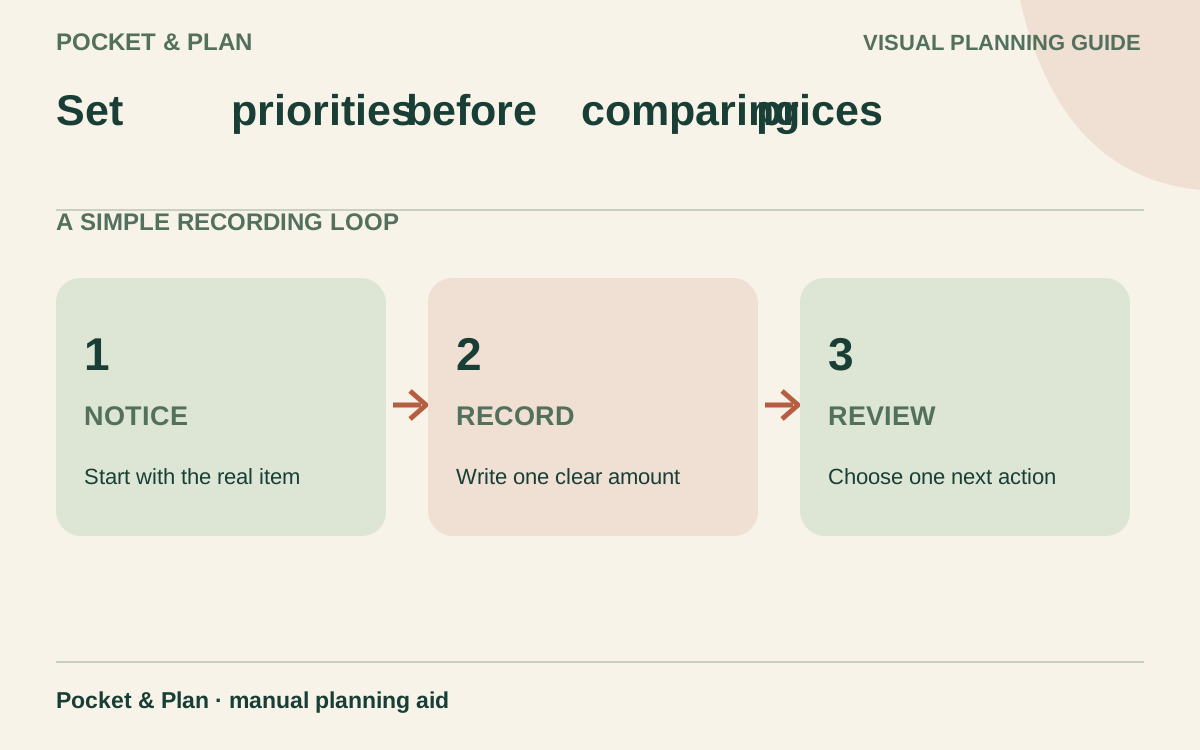
Set priorities before comparing prices
Give each gap a needed-by date and a reason. Separate current necessities from replacements that can wait and optional variety. The aim is a usable wardrobe, not the smallest possible clothing allowance.
Consumer.gov’s budgeting guide includes clothing among expenses to compare with income and other bills. Place the proposed clothing amount inside that household plan before committing to purchases. If several urgent needs do not fit, revise timing or identify available resources; calling an essential item optional does not solve the gap.
Use the monthly category checklist to decide whether cleaning, repairs, uniforms, and sports clothing belong in this category or another one. Write the convention down. Otherwise a clothing plan can look inexpensive because related costs are hidden elsewhere.
Price the complete solution to each gap
Record the item or repair, quantity, evidence for its estimate, and complete expected charge. Include applicable tax, shipping, alteration, or other necessary extras. An estimate should stay labeled until you have a final charge.
The FTC’s online-shopping guidance recommends comparing total costs and checking return charges, deadlines, and any different rules for sale items. Keep the relevant terms with the purchase record. A possible refund is not guaranteed funding for a second order.
Compare options that solve the same problem. A repair quote and a replacement price are useful only when the repaired item would still fit and serve its purpose. For secondhand purchases, consider the condition you can actually assess and any necessary cleaning or alterations. Do not assume an item will last a particular number of wears without evidence.
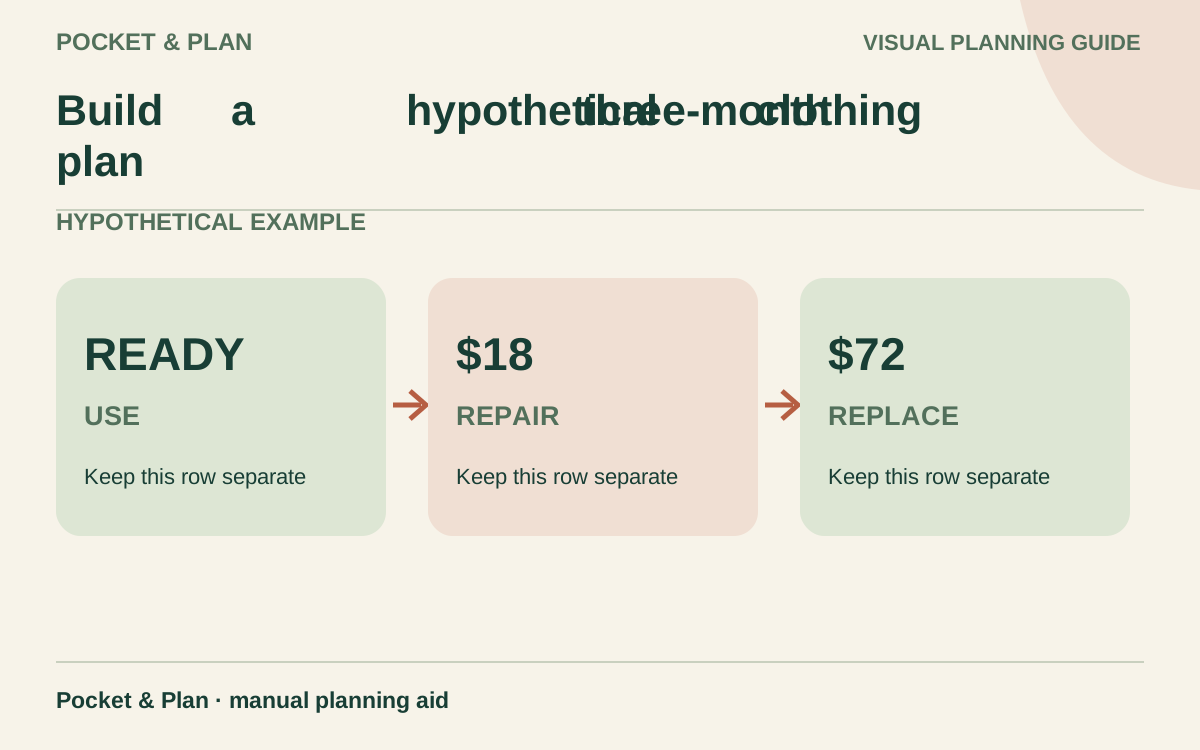
Build a hypothetical three-month clothing plan
Imagine Sam has checked the wardrobe and identified these five jobs. Every amount is invented and represents the complete charge assumed for that row. They are not current store prices or a recommended clothing budget.
| Wardrobe job | Planned action | Complete cost |
|---|---|---|
| Suitable shoes for work | Buy one pair | $80 |
| Two usable pairs of jeans needing repair | Obtain the specified repairs | $24 |
| Two missing everyday shirts | Buy two at $28 each | $56 |
| Coat for the coming season | Buy one suitable coat | $100 |
| Necessary extras for these purchases | Allow for identified additional costs | $20 |
| Planned purchases and work | $280 | |
| Uncommitted clothing reserve | Keep available | $20 |
| Total funding target | $300 |
The five spending rows total $280. Adding the $20 reserve creates a $300 target, but the reserve is not a purchase. The extras row covers costs not already included elsewhere; it must not repeat shipping or tax included in an item’s complete charge.
Suppose $60 is already reserved for clothing. The remaining funding gap is $240, which three affordable $80 contributions would fill. Those contributions move available household money into this purpose; they do not reduce the cost of the clothes.
Check the dates as well as the total
The $300 plan works only if its funding arrives before each payment. In this hypothetical schedule, the existing $60 and first $80 contribution are available before the coat and repairs need payment:
| Stage | Available before spending | Planned payment | Remaining |
|---|---|---|---|
| Opening $60 plus first $80 contribution | $140 | Coat $100 plus repairs $24 | $16 |
| Add second $80 contribution | $96 | Shoes $80 | $16 |
| Add third $80 contribution | $96 | Shirts $56 plus extras $20 | $20 |
The final $20 is the original reserve. If the coat is needed before the first contribution, the opening $60 is $40 short of that coat alone. A balanced three-month total does not remove this earlier gap.
Use the sinking-fund guide to record existing clothing money and each new contribution. Do not count the same opening balance again each month.
Record purchases and returns without losing the original cost
Replace each estimate with its actual charge, retaining the receipt reference and date. Keep a return as a separate linked event. Record whether the seller has received the item and whether the refund actually completed.
For another step in Sam’s invented example, one of the two $28 shirts is returned. Assume the seller deducts a disclosed $6 return charge and a $22 refund clears back to the debit account. The shirts then cost $34 net: $56 paid minus $22 received. That consists of the kept $28 shirt and the $6 return charge.
With all other rows unchanged, total net spending becomes $258 and the clothing money remaining becomes $42. Before the refund cleared, only the original $20 remainder was available. If a refund instead goes to a credit card, record the card credit accurately rather than claiming the same amount arrived as bank cash.
Keep a short list for the next season
At the end of the period, compare planned jobs with the clothes and repairs actually obtained. Note an unresolved fit problem, a missed date, or an estimate that excluded a necessary extra. Keep those observations with the next list.
Carry forward only the clothing money that remains after reconciliation. Optional items can stay on a waiting list, as in the no-spend planning guide, while essential gaps keep their dates and funding actions. The next clothing budget can then begin with a clear view of what is already usable and what still needs attention.
Sources & verification
These primary reference sources support the guide. Worked examples are our own illustrations, not national averages or reported personal results.
- Consumer.gov — Making a Budget ↗Checked September 11, 2026
- FTC — Online Shopping ↗Checked September 11, 2026
Published · Last substantive update .
Found a factual error or a calculation that needs checking? Suggest a correction by email with this guide's link. The link opens a draft in your email app; you send it yourself. Contact details · Corrections policy