The short answer
Choose an affordable party scope, separate fixed and guest-dependent costs, and check the cash needed for advances and refundable holds before booking.
General educational guide. Sources checked September 11, 2026. Examples are illustrative; amounts should be adjusted to your household. Read our disclosure.
A birthday party budget works best when it separates costs that stay roughly fixed from costs that change with the number of people attending. Set the amount your household can fund, define the guest count, include complete purchase and booking costs, and check when each payment is needed. Track refundable holds separately because they still require available money.
Download the birthday party budget printable for a manual cost plan and payment record. It includes a guest-count field, fixed and per-person estimates, confirmed payments, remaining amounts, a reserve, and a separate refundable-hold record. Print on US Letter paper in landscape orientation. It does not calculate automatically, make bookings, or send reminders.
Choose the party scope before choosing a package
Write the occasion, date, location type, and number of people the plan must serve. Count the birthday person, accompanying adults, siblings, or helpers when they will use food, seating, supplies, or paid places. The number of invitations is not always the number of people needing something.
Agree on the parts that matter most: perhaps a shared meal, one activity, and time together. Check what you already have or can use with permission. A borrowed table may avoid a purchase, but transport or cleaning could still need a place in the plan.
Keep the party amount inside the household’s other commitments. Consumer.gov’s budget guidance starts with income, bills, and other expenses and compares the resulting totals. A party limit needs that wider check before deposits are paid.
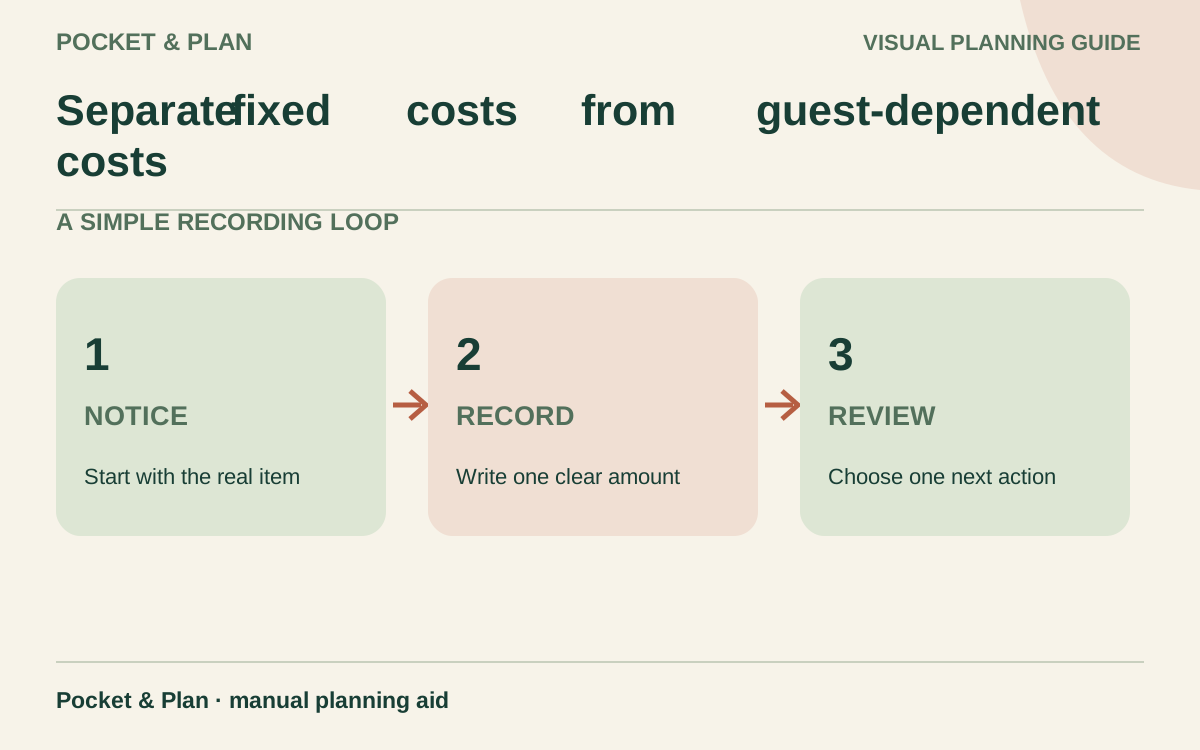
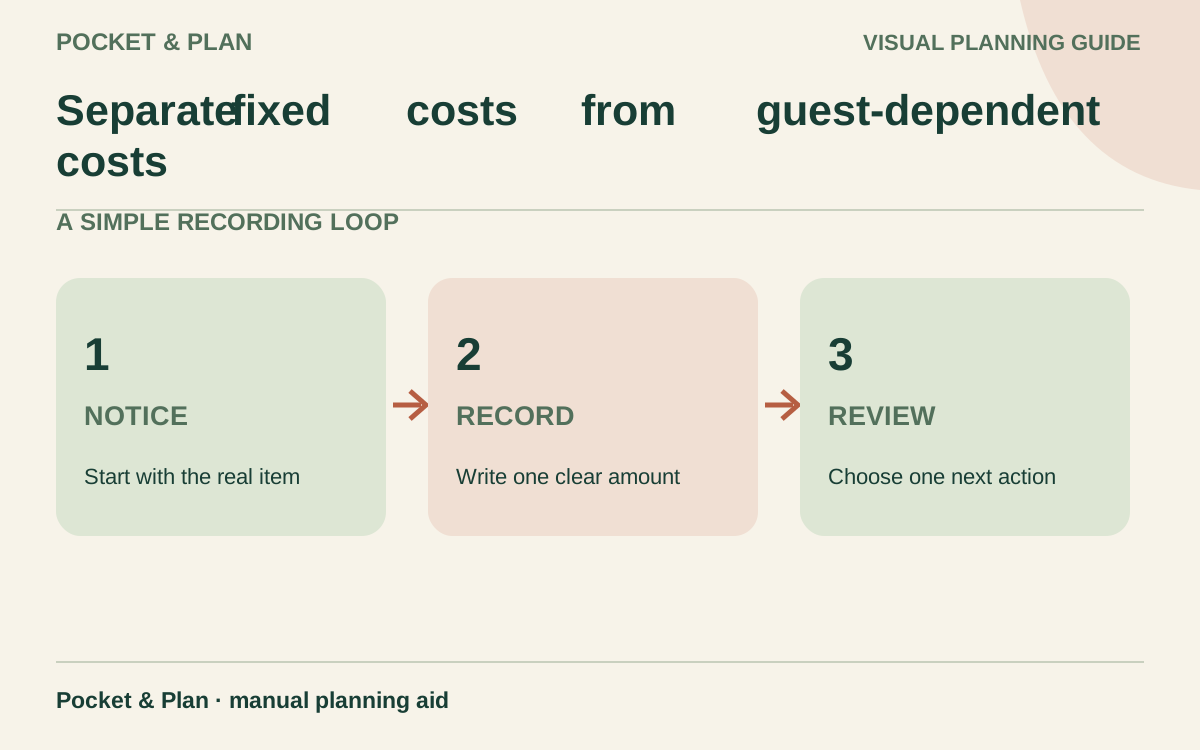
Separate fixed costs from guest-dependent costs
Put each planned charge into one of three groups: fixed for this specific plan, calculated from people or units, or uncertain until a quote is checked. Fixed is a working assumption; a larger group may require a different venue or package.
| Cost group | Examples to check | Useful record |
|---|---|---|
| Fixed for the selected scope | Space hire, one cake, one activity booking | Complete quote and what it includes |
| Guest-dependent | Food, drinks, admission, tableware | Charge per counted person or required package |
| Separate cash requirement | A refundable damage hold | Amount, payment date, and return conditions |
| Uncommitted reserve | Money for a defined uncertainty | Amount kept available rather than spent |
Check minimum orders, package sizes, included guests, and extras. A quote described as per person may still have a minimum charge. If eight supplies come in a pack, calculate the packs needed rather than buying a fraction of one. Mark an unknown required cost for follow-up instead of entering zero.
For decorations or other goods ordered online, the FTC recommends comparing full purchase costs and checking delivery and return policies. Keep confirmations and receipts. For venue or activity services, obtain their specific written scope, cancellation terms, and payment schedule; the online-goods guidance does not establish a service contract’s rules.
Work through a hypothetical $350 party plan
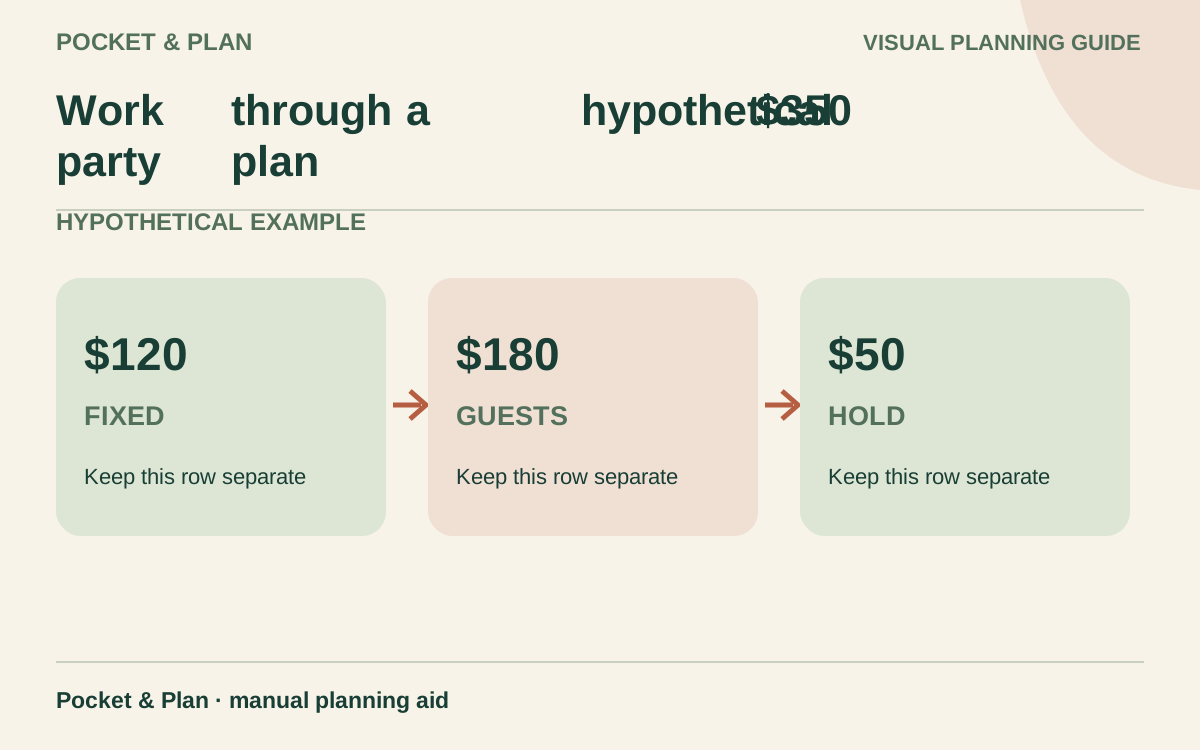
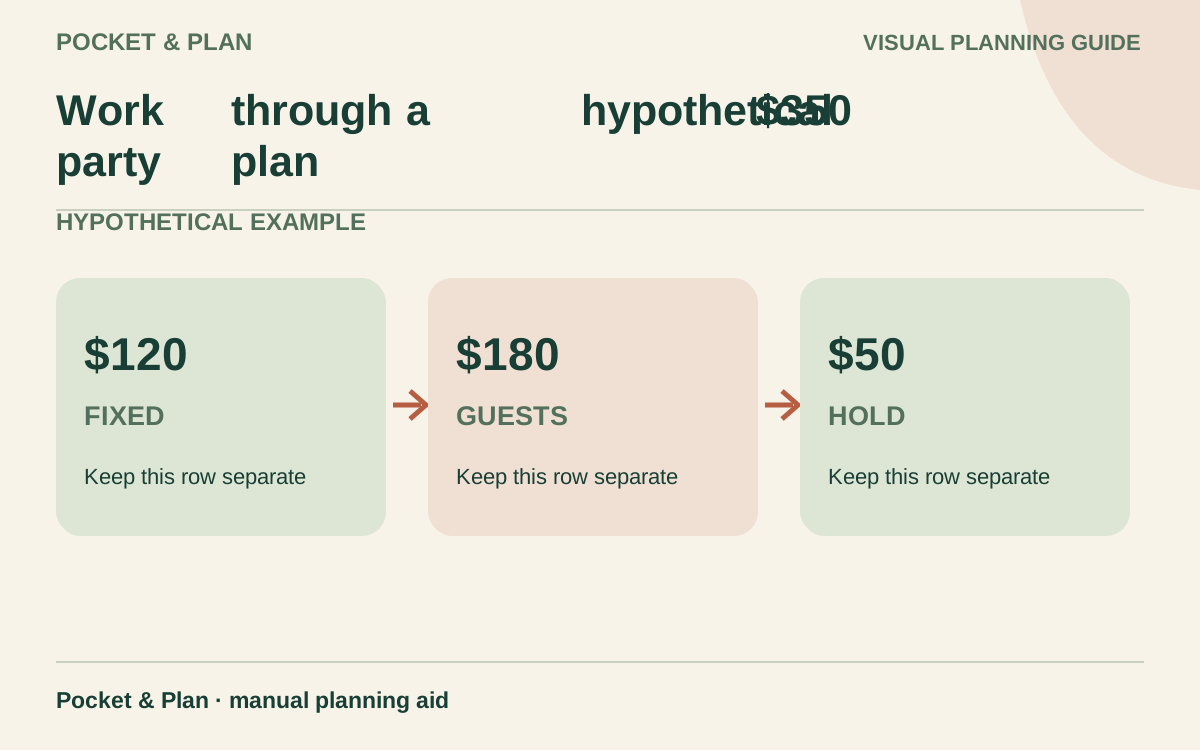
This invented example covers 12 people in total, including the birthday person and all accompanying adults who need food and supplies. The amounts are complete assumed charges, including applicable extras in the example. They are not local quotes or typical party prices.
| Cost | Calculation | Planned amount |
|---|---|---|
| Venue for the agreed scope | Fixed | $90 |
| Activity materials | Fixed | $40 |
| Decorations | Fixed | $25 |
| Cake | Fixed | $35 |
| Food | 12 people × $8 | $96 |
| Drinks | 12 people × $2 | $24 |
| Tableware | 12 people × $1 | $12 |
| Planned party cost | $190 fixed + $132 guest-dependent | $322 |
| Uncommitted reserve | Kept available | $28 |
| Party funding limit | $322 + $28 | $350 |
The guest-dependent amount is $11 per person. That is not the party’s total cost per person: fixed costs still need paying. For this exact plan, $322 divided by 12 is about $26.83 of planned cost per attendee; the $28 reserve is excluded because it has not been spent.
If two additional people attend and all fixed assumptions remain valid, variable costs rise by $22. The new cost is $344, leaving only $6 within the $350 limit. Keeping the original $28 reserve would instead require $372. Decide which scope or funding change is workable before confirming the larger count.
Distinguish an advance payment from a refundable hold
Assume the venue’s written terms require a $30 advance toward its $90 charge, plus a separate $50 refundable damage hold. The remaining venue charge is $60. The $30 advance is already part of the $90 cost, so adding both as full expenses would double count it.
The $50 hold is different. Under the example’s stated assumptions it may be returned, but it ties up cash until that happens. The complete cash provision is therefore $400: $322 planned costs + $28 reserve + $50 hold. This is a cash requirement, not a claim that the party costs $400.
Now suppose the $30 advance has already been paid, and $180 remains available in the party fund after that payment. The still-needed amount is $292 unpaid costs + $28 reserve + $50 hold = $370. Against the available $180, the funding gap is $190.
Two $95 contributions would close that gap if both arrive before the relevant payments. Do not subtract the paid $30 from the available $180 again; the example already states that the current balance is after the payment.
Test the payment sequence before booking more
In the same example, suppose the next requirement is the $60 venue balance plus the $50 hold. Paying $110 from the available $180 leaves $70. Two later $95 contributions would raise that to $260, enough for the other $232 of party costs and the $28 reserve.
If those $232 of purchases must be made after only one contribution arrives, only $165 is available and the immediate shortfall is $67. The overall budget still balances eventually, but the payment schedule does not. Change the timing, scope, or confirmed funding before making another commitment.
Use the bill payment tracker for actual due dates and confirmed payments, and the savings tracker for the fund’s deposits and withdrawals. Keep the hold identifiable instead of treating it as an ordinary expense or spare cash.
Close the party with receipts and actual returns
After the event, replace estimates with final charges and investigate any unpaid balance. Track a returned purchase or released hold by its actual amount and confirmation date. In this example, a fully returned $50 hold plus an unused $28 reserve would leave $78 available after all other planned payments. Before the hold returns, only $28 remains available in the fund.
If any hold is retained, record the actual charge and the reason supported by the venue’s records. An expected return is not received money. Likewise, an offered contribution from another household belongs in available funding only after it arrives.
Keep gifts separate when they are outside the party limit; the gift budget guide handles recipient-based purchases. Finish with a short note about the guest count, quantities, and charges that changed. Those actual records are a more useful starting point for the next celebration than copying a spending target that happened to fit this example.
Sources & verification
These primary reference sources support the guide. Worked examples are our own illustrations, not national averages or reported personal results.
- Consumer.gov — Making a Budget ↗Checked September 11, 2026
- FTC — Online Shopping ↗Checked September 11, 2026
Published · Last substantive update .
Found a factual error or a calculation that needs checking? Suggest a correction by email with this guide's link. The link opens a draft in your email app; you send it yourself. Contact details · Corrections policy