The short answer
Choose a weekly contribution pattern that fits the timing of your income, then track completed deposits instead of assuming every planned week was funded.
General educational guide. Sources checked September 11, 2026. Examples are illustrative; amounts should be adjusted to your household. Read our disclosure.
The classic 52-week savings challenge starts with $1 in week 1, adds $2 in week 2, and increases the deposit by $1 each week until week 52’s $52 contribution. Completing all 52 deposits produces $1,378 before interest, fees, or withdrawals. Reversing the amounts produces the same total, as does saving exactly $26.50 on each of 52 deposit dates.
The schedule is a way to organize contributions, not evidence that your budget can support them. Choose the goal and affordable amounts first. A smaller completed plan can be more useful than a larger target that makes necessary expenses harder to cover.
Use the printable 52-week savings plan to write planned and completed deposits beside all 52 week numbers. The classic amounts are a schedule, not a record of money received; use your own plan fields for another contribution pattern. This is a manual worksheet for handwriting, with no automatic calculations. Print on US Letter paper in the orientation shown on the file.
Check the total and the changing weekly commitment
Pair the first and last amounts: $1 + $52 = $53. The next pair is $2 + $51 = $53. There are 26 pairs, so 26 × $53 = $1,378.
The early weeks are much cheaper than the final weeks. In the ascending version, the first four deposits total $10, while the last four total $202. Look beyond the attractive $1 starting point before committing to a finish date.
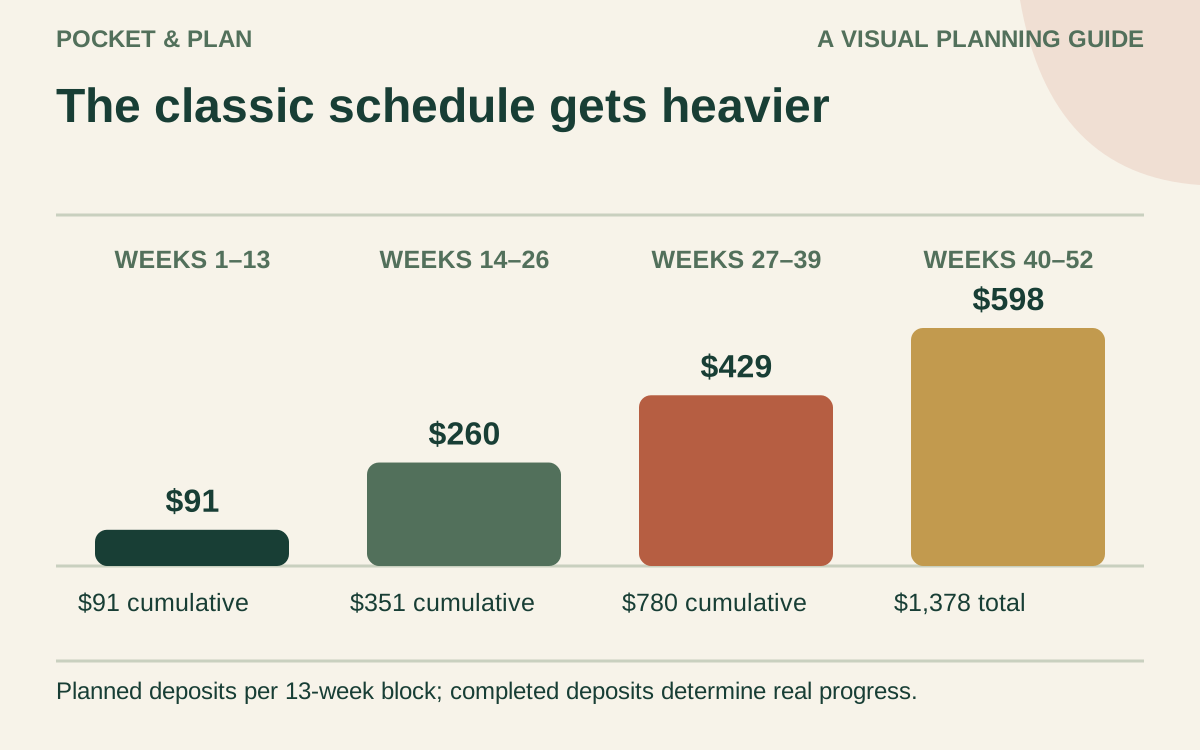
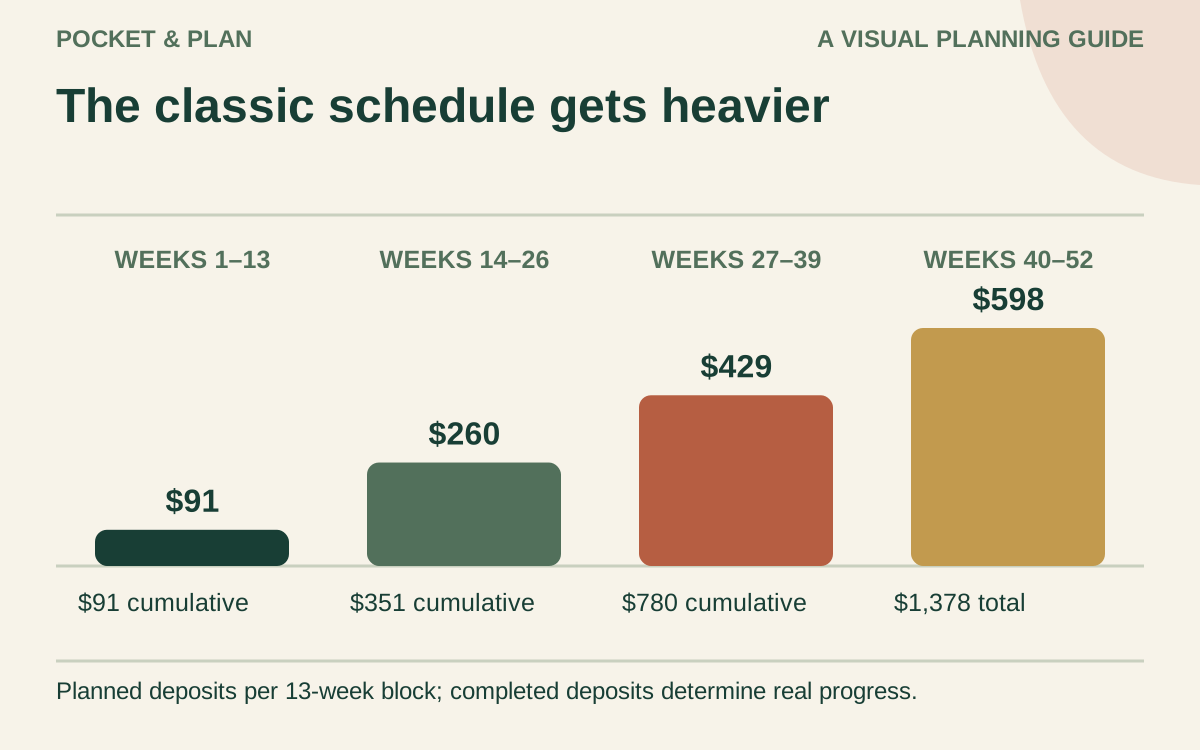
These blocks divide the classic ascending schedule into equal 13-week periods:
| Deposit weeks | Deposits during the block | Cumulative contributions |
|---|---|---|
| 1–13 | $91 | $91 |
| 14–26 | $260 | $351 |
| 27–39 | $429 | $780 |
| 40–52 | $598 | $1,378 |
The table assumes every numbered deposit is completed once. It describes a plan, not your actual balance. An existing opening balance belongs in a separate field so it is not mistaken for another challenge contribution.
Compare ascending, reverse, and fixed versions
An ascending schedule places the largest deposits late in the challenge. A reverse schedule starts with $52 and ends with $1, placing the largest deposits early. Neither order creates more savings when the same amounts are funded.
For a steady alternative, divide $1,378 by 52: $26.50 per deposit. This amount is exact to the cent; no final rounding adjustment is needed. It removes the weekly increase but still requires that amount to be available on every scheduled date.
You can also scale the target. A fixed $5 for 52 deposits totals $260. Label it a $260 plan rather than claiming it reaches $1,378. The CFPB savings-plan worksheet uses a goal amount and number of weeks to calculate a contribution. That general planning method supports the comparison here; the worksheet does not specifically recommend this challenge.
Put actual deposit dates on the calendar
“Week 1” means your first scheduled week. It does not have to mean the first week of January. Write all 52 intended deposit dates so the finish date follows your start and cadence. Counting 52 deposits is more precise than assuming the last payment automatically lands on December 31.
If you are paid every two weeks, review the two weekly amounts together. For example, classic weeks 19 and 20 require $19 + $20 = $39. You could reserve that $39 on payday and make the two scheduled deposits, or record one combined deposit with both labels. Count the actual $39 only once.
For uneven income, decide after each receipt how much is available. The irregular-income guide separates received household funds from hoped-for future receipts. Changing the schedule is an explicit revision, not a reason to record contributions that never occurred.
Fit the contribution around the rest of the budget
Review food, housing, necessary transport, healthcare needs, and payments due before the next income receipt. Consumer.gov’s budgeting guidance builds the plan from income and expenses and includes comparing actual spending with expectations. Use that check before choosing a challenge deposit.
Suppose an entirely hypothetical week leaves $30 available after existing assignments. The fixed $26.50 version fits within that amount and leaves $3.50 unassigned. A $40 classic deposit does not fit; it would leave a $10 gap. The worksheet cannot close that gap by moving a number into another column.
If using an automatic transfer, choose its amount and timing deliberately and monitor the source account. The CFPB emergency-fund guide warns that automatic savings transfers need enough checking-account funds to avoid overdraft costs. Automation does not verify your household commitments for you.
Record interruptions without hiding the result
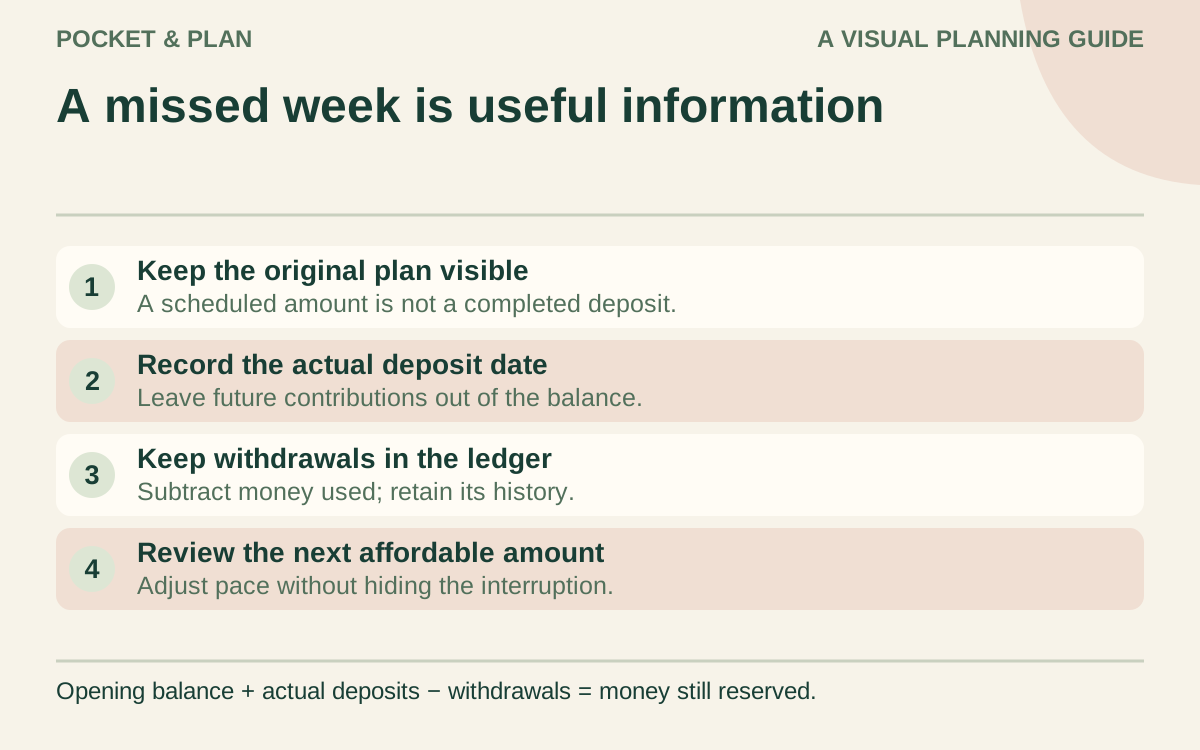
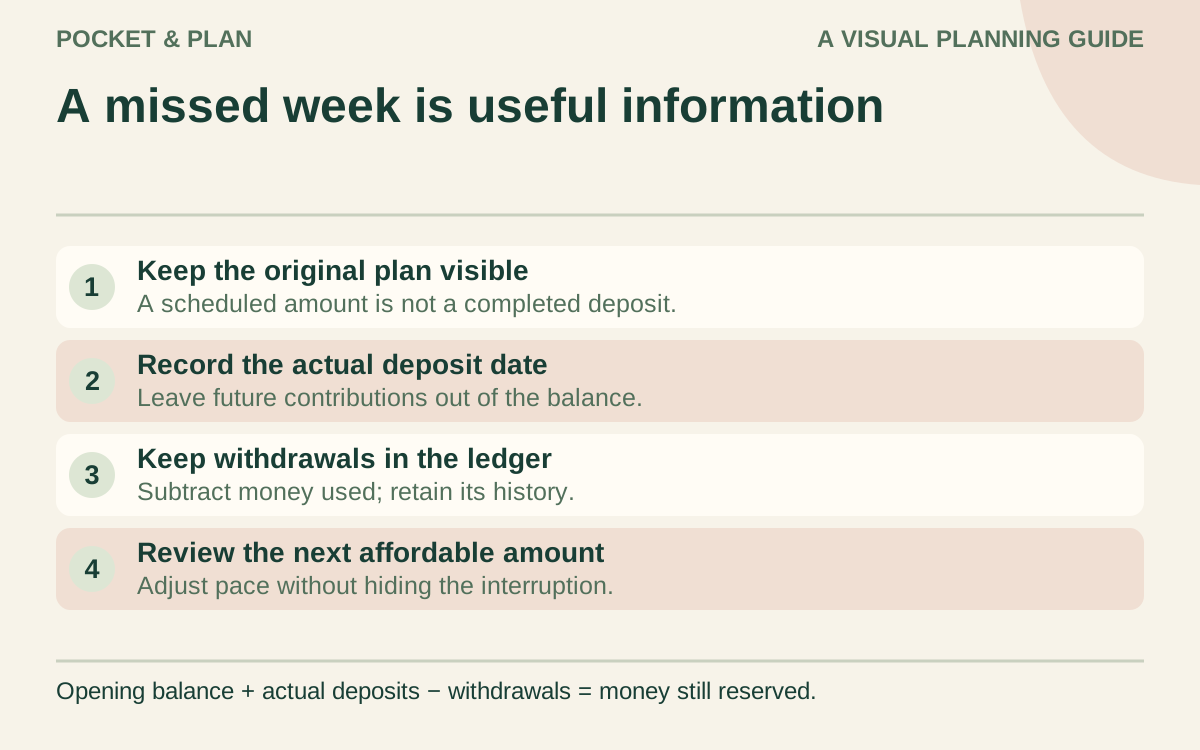
Keep the scheduled amounts in a separate plan, and use the savings tracker for completed deposits, dates, withdrawals, and the running balance. Mark a missed contribution as $0 actual in your plan rather than leaving a checked box beside the scheduled amount.
Imagine completing every classic deposit except week 21’s $21. Gross contributions would be $1,378 − $21 = $1,357. If $60 was also withdrawn, the remaining balance from those contributions would be $1,297, assuming no opening savings, interest, or fees. The withdrawal and skipped deposit explain different parts of the result.
You can extend the timeline, reduce the target, or later add an affordable contribution. Catching up is optional and depends on money actually available. Do not fund a missed week twice because it appears on both an old checklist and a revised schedule.
Review the purpose as well as the progress
At each check-in, confirm completed transactions, compare the next few deposits with the budget, and note any change to the goal. The same numbered method can fund an expected purchase or another chosen reserve; its label does not determine the appropriate target.
If a much larger numbered target interests you, compare the arithmetic in the 100-envelope guide before switching. Keep the current money assigned to its real purpose and preserve the transaction history. A completed sheet matters less than an accurate record of the money still available.
Sources & verification
These primary reference sources support the guide. Worked examples are our own illustrations, not national averages or reported personal results.
- CFPB — Savings plan tool ↗Checked September 11, 2026
- Consumer.gov — Making a Budget ↗Checked September 11, 2026
- CFPB — An essential guide to building an emergency fund ↗Checked September 11, 2026
Published · Last substantive update .
Found a factual error or a calculation that needs checking? Suggest a correction by email with this guide's link. The link opens a draft in your email app; you send it yourself. Contact details · Corrections policy